

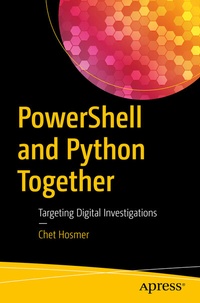
PowerShell and Python Together
Description

You will learn how to join PowerShell's robust set of commands and access to the internals of both the MS Windows desktop and enterprise devices and Python's rich scripting environment allowing for the rapid development of new tools for investigation, automation, and deep analysis.
PowerShell and Python Together takes a practical approach that provides an entry point and level playing field for a wide range of individuals, small companies, researchers, academics, students, and hobbyists to participate.
What You'll Learn
-
Leverage the internals of PowerShell for: digital investigation, incident response, and forensics
-
Leverage Python to exploit already existing PowerShell CmdLets and aliases to build new automation and analysis capabilities
-
Create combined PowerShell and Python applications that provide: rapid response capabilities to cybersecurity events, assistance in the precipitous collection of critical evidence (from the desktop and enterprise), and the ability to analyze, reason about, and respond to events and evidence collected across the enterprise
Who This Book Is For
System administrators, IT personnel, incident response teams, forensic investigators, professors teaching in undergraduate and graduate programs in cybersecurity, students in cybersecurity and computer science programs, and software developers and engineers developing new cybersecurity defensesMore details
Other editions
Additional editions
Person
Chet Hosmer
is the founder of Python Forensics, Inc., a non-profit organization focused on the collaborative development of open source investigative technologies using Python and other popular scripting languages. He has been researching and developing technology and training surrounding forensics, digital investigation, and steganography for decades. He has made numerous appearances to discuss emerging cyber threats, including National Public Radio's Kojo Nnamdi show, ABC's Primetime Thursday, and ABC News Australia. He has also been a frequent contributor to technical and news stories relating to cyber security and forensics with IEEE, The New York Times, The Washington Post, Government Computer News, Salon.com, and Wired Magazine.
Chet serves as a visiting professor at Utica College in the cybersecurity graduate program where his research and teaching focus on advanced steganography/data hiding methods and the latest active cyber defense methods and techniques. He also is an adjunct professor at Champlain College, where his research and teaching focus is on applying Python and other scripting languages to solve challenging problems in digital investigation and forensics.
Chet resides on the Grand Strand of South Carolina with his wife Janet, son Matthew, two Labrador retrievers (Bailey and Vinny), and feline tenants Lucy, Sasha, and Evander.
Content
Chapter 1: An Introduction to PowerShell for Investigators.- Chapter 2: PowerShell Pipelining.- Chapter 3: PowerShell Scripting Targeting Investigation.- Chapter 4: Python and Live Investigation/Acquisition.- Chapter 5: PowerShell / Python Investigation Example.- Chapter 6: Launching Python from PowerShell.- Chapter 7: Loose Ends and Future Considerations.- Appendix: Challenge Problem Solutions.-
