

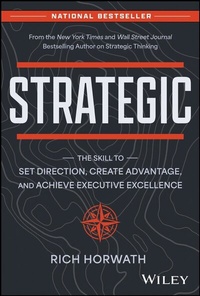
Strategic
Description

In Strategic, New York Times and Wall Street Journal bestselling author Rich Horwath delivers an incisive roadmap to help leaders at all levels think, plan, and act strategically to navigate every business challenge they face. The book offers business leaders a proven framework--the Strategic Fitness System--containing dozens of tools, techniques, and checklists to confidently master every area of the business, from designing market-winning strategies to shaping the organization's culture.
The practical content will help executives in any industry improve what research has shown to be the most important leadership factor to an organization's future success--strategic competence--and use this skill to transform complexity to clarity in charting their strategic direction. The book features:
* A common language for strategy and business planning
* Practical tools for developing the four dimensions of executive fitness key to advancing the company's growth: strategy, leadership, organization, and communication
* Techniques for designing enduring competitive advantage and frameworks for creating innovative new value for customers
* Methods for evolving the business model to transform the trajectory of the business
* The Strategic Quotient (SQ)--a validated assessment of an executive's strategic thinking, planning, and execution
With practical tools and dozens of real-world examples, readers of Strategic will immediately be able to set direction, create advantage, and achieve executive excellence. Be more than tactical--be Strategic.
More details
Other editions
Additional editions
Person
Content
Navigate Your Business 4
Being Strategic 6
The Unstrategic 7
Strategic Fitness 9
What's Your Strategic Quotient (SQ)? 11
Trail Blazes 14
Part I Strategy Fitness 17
Chapter 1 Strategy 19
Strategy Is Not 20
GOST Framework 22
Strategy Defined 24
When to Change Strategy 26
3A Strategic Framework 28
Strategy Development 30
Designing a StrategyPrint 34
Trail Blazes 36
Chapter 2 Resource Allocation 39
Reallocation of Resources 43
Discipline to Focus 46
Making Trade- offs 49
Trail Blazes 51
Chapter 3 Decision Making 53
Creating Decision Trees 56
Avoiding Decision Traps 58
Determining Decision Rights 60
Delegation: Lead at Your Level 64
Trail Blazes 68
Chapter 4 Competition 71
Assessing the Competition 72
Competitive Positioning 75
Learning to Differentiate 78
Understanding Competitive Advantage 82
Trail Blazes 86
Part II Leadership Fitness 89
Chapter 5 Leadership 91
Situational Awareness 92
Emotional Intelligence 96
Leadership Philosophy 98
Trail Blazes 101
Chapter 6 Personal Performance 103
Three Principles of Preparation 105
Energy Management 109
Executive Presence 112
Trail Blazes 114
Chapter 7 Mental Toughness 117
Seven Saboteurs of the Mind 118
Mental Training Techniques 119
Nonjudgmental Observation 122
Breaking the Judgment Habit 124
Trail Blazes 126
Chapter 8 Time and Calendar 129
Eliminating Time Traps 130
Three Ways to Monotask 131
Optimizing Email 136
Trail Blazes 137
Part III Organization Fitness 139
Chapter 9 Organizational Foundation 141
Organizational Structures 142
Purpose 143
Mission 143
Vision 145
Values 146
Culture 147
Internal Obstacles 151
Trail Blazes 155
Chapter 10 Business Model 157
Evolving Your Business Model 158
Creating a Value Proposition 161
Mapping a Value Chain 163
Designing the Future State 165
Trail Blazes 171
Chapter 11 Talent and Succession 173
Talent Scorecard 174
Five Talent Traps 175
Succession Planning 177
Trail Blazes 181
Chapter 12 Innovation 183
Insight 184
Solving Challenges 186
Biomimicry 187
Domain Jumping 189
Catalyzing Questions 191
Trail Blazes 194
Part IV Communication Fitness 197
Chapter 13 Strategy Conversations 199
Dialogue 203
Discussion 205
Direction 208
Trail Blazes 211
Chapter 14 Collaboration 213
Enhancing Collaboration 214
Facilitation Framework 218
Trail Blazes 224
Chapter 15 Customers 227
Internal Customers 228
One- on- Ones 229
Managing Up and Laterally 230
External Customers 232
Board of Directors 237
Trail Blazes 239
Chapter 16 Meetings 241
Strategic Meeting Framework 243
Strategic Approach to Meetings 247
Trail Blazes 251
Close 253
Notes 257
About the Author 271
Index 273
INTRODUCTION
"Cloudy weather, cloudy."
The Lockheed Electra plane flew through the overcast sky under a blanket of rain, having already traveled more than 22,000 miles of the planned 29,000-mile journey.
"KHAQQ calling Itasca. We must be on you, but we cannot see you. Fuel is running low. Been unable to reach you by radio. We are flying at 1,000 feet."
The U.S. Coast Guard cutter Itasca was stationed just offshore of Howland Island, a whisper of land 1.5 miles long by .5 miles wide in the South Pacific, approximately 2,000 miles southwest of Hawaii.
"KHAQQ calling Itasca. We received your signals but unable to get a minimum. Please take bearing on us and answer 3105 with voice."
The U.S. Coast Guard cutter Itasca attempted to get a bearing on the transmission and failed.
"KHAQQ to Itasca, we are on the line 157 337, will repeat message, we will repeat this on 6210 KCS. Wait. We are running north and south."1
Silence.
The two pilots aboard the aircraft were never heard from again.
Or were they?
A day later in Rock Springs, Wyoming, 16-year old Dana Randolph was tuned in to a shortwave band of his parent's radio and reported hearing a woman say, "This is Amelia Earhart. Ship on reef south of the equator. Station KHAQQ."2
The same day in St. Petersburg, Florida, 15-year-old Betty Klenck was also tuned into her family's radio shortwave band. She reported hearing a woman, sounding in distress, say, "This is Amelia Earhart."3
The most extensive air and sea search in naval history, covering 250,000 square miles of ocean, found . nothing.
On May 20, 1937, Amelia Earhart departed from Oakland, California, with Fred Noonan, in an attempt to become the first woman to fly around the world. Over the course of more than six weeks, they followed a route that included 28 stops in exotic locales such as Caripito, Venezuela; Natal, Brazil; Asaab, Ethiopia; Bangkok, Thailand; Bandoeng, Java (Indonesia); Darwin, Australia; and Lae Papau, New Guinea. They were scheduled to stop on Howland Island to refuel and complete the trip by flying to Honolulu and then returning to Oakland, California. Just prior to her final flight from New Guinea, Earhart said, "Not much more than a month ago, I was on the other shore of the Pacific, looking westward. This evening, I looked eastward over the Pacific. In those fast-moving days, which have intervened, the whole width of the world has passed behind us, except this broad ocean. I shall be glad when we have the hazards of its navigation behind us."4
Those last words, "the hazards of its navigation," are eerily prophetic. What few people know is that shortly before her fateful trip, she received the following letter from world-renowned navigation author, inventor, and instructor P.V.H. Weems:5
May 14, 1937
MISS AMELIA EARHART
c/o G.P. Putnam
2 W. 45th ST. NEW YORK, N.Y.
Dear Miss Earhart:
In case you could find time to come to Annapolis for a few weeks intensive work in celestial navigation, I believe you would be well re-paid for the efforts. I have just had Miss Amy Johnson here for two weeks. She did beautiful work and seems to be more than pleased with the results.
As I see the picture, both of you ladies are in the flying game of your life-time work. Aside from piloting, about which there is no question of your both having a great deal of ability, the only important contribution you can make to a flight is the ability to see the direct course as not to miss the objective.
As both of you know a great deal about dead-reckoning and radio, I recommend that you make a special effort to perfect yourself, not only in radio including the Morse Code, but also in celestial navigation, since radio and celestial navigation afford the only means for fixing your position above the cloud or over the water ..
I further believe you would save a great deal of expense and perhaps worry by practicing until you could lay out your own charts and do your own navigation all the way through. You can then take any reasonably dependable co-pilot with you and be sure of hitting your objective. In addition, it would give you a great deal more confidence and you could keep your plans more confidential when necessary .
Yours sincerely,
P.V.H. WEEMS.
Amelia Earhart's disappearance remains a mystery to this day. Several theories have emerged as to what happened to her: she crash-landed on the remote Gardner Island and died a castaway there; she landed in the Japanese-held Marshall Islands where she was taken prisoner and transferred to the island of Saipan. Another theory holds that she was then released from the Japanese island and repatriated to the United States under an assumed name. The U.S. government's official explanation was that the plane ran out of fuel and fell into the ocean.6 While no proof of Earhart's true fate has been confirmed, and each of these theories has been disputed, what is indisputable is that she will be remembered as a courageous visionary with an indomitable spirit.
Earhart was a pioneer and trailblazer in aviation and a fearless role model for men and women alike. Her long list of achievements includes being the first woman to fly across the Atlantic Ocean, the first woman to fly solo across the Atlantic, the first woman to fly solo nonstop coast to coast, setting numerous speed records in domestic and international flights, published author, and recipient of awards including the National Geographic Society's gold medal from President Herbert Hoover, and the Distinguished Flying Cross awarded by the U.S. Congress.7 However, floating out there like the insidious cloud cover on that fateful day, the question remains: Would Amelia Earhart have completed her amazing journey around the world if she had taken P.V.H. Weems's offer to enhance her navigational skills?
Navigate Your Business
To navigate is to direct or manage something on its course-in other words, to control the movement from one place to another.8 To navigate means to determine one's position and direction and make a way over or through. Historically, the field of navigation is most prominent in air, sea, and space as the primary skill in successfully guiding planes, ships, and rockets to their intended destinations. More recently, the term "navigate" has been used in an array of contextual landscapes including politics, relationships, ecosystems, and business.
As Earhart's story demonstrates, the ability to navigate is critical to success. In Earhart's era, it was estimated that 50% of aircraft accidents were due to bad navigation. Navigational authority P.V.H. Weems noted, "Many flyers are really lost a good part of the time."9
Today, research indicates that "human error contributes to 80% of navigational accidents and that in many cases essential information that could have prevented the accident was available to but not used by those responsible for the navigation of the vessels concerned."10 The business corollary of this issue is exemplified in a 10-year study of 103 companies that found that strategic blunders-the inability to navigate an organization's course-were the cause of the greatest loss of shareholder value a whopping 81% of the time.11
Whether you are navigating a vehicle or a business, it's imperative that you're able to effectively determine your current position and then set direction. A study of 250,000 executives showed that setting strategic direction is the most important role of a leader and the number-one factor that improved organizational health.12 Despite the importance of leaders' ability to set direction, research by Gallup over the past 30 years with more than 10 million managers found only 22% of employees strongly agreed that the leaders of their organization have set clear direction for the business.13
During my strategic executive coaching work the past 20 years, the issue of how to best navigate the business has become a recurring theme for many highly effective leaders, as the following direct quotations demonstrate:
"One issue I'm wrestling with is how best to navigate that with the team."
"There are just some things that I don't know how to, I don't know how to navigate them."
"That's what I want healthcare to be like. That's what my family wants. Yes, it's fragmented. It's confusing to know how to navigate it, and how are we going to solve that?"
"As our market becomes even more competitive with nontraditional players entering, I'm just trying to constructively navigate."
When Disney brought back Bob Iger for his second stint as CEO, his return was described this way in the Wall Street Journal: "Walt Disney Co. has brought back the CEO responsible for its pivot to streaming. As he returns, Robert Iger has to navigate a competitive landscape that is far more challenging than when he left less than three years ago."14
The navigational role of a leader was further described by Hilton CEO Chris Nassetta in the following manner: "I have a philosophy in life, and that is keeping a steady hand on the wheel. Have a plan and work the plan and adapt the plan. The...
