

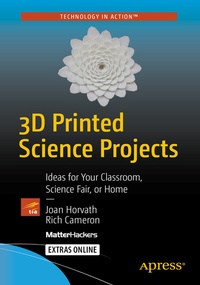
3D Printed Science Projects
Ideas for your classroom, science fair or home
Published on 11. May 2016
XX, 203 pages
978-1-4842-1323-0 (ISBN)
Description

Create 3D printable models that can help students from kindergarten through grad school learn math, physics, botany, chemistry, engineering and more.
This book shows parents and teachers how to use the models inside as starting points for 3D printable explorations. Students can start with these models and vary them for their own explorations. Unlike other sets of models that can just be scaled, these models have the science built-in to allow for more insight into the fundamental concepts.
Each of the eight topics is designed to be customized by you to create a wide range of projects suitable for science fairs, extra credit, or classroom demonstrations. Science fair project suggestions and extensive "where to learn more" resources are included, too. You will add another dimension to your textbook understanding of science.
What You'll Learn
Who This Book Is For
Parents and teachers
This book shows parents and teachers how to use the models inside as starting points for 3D printable explorations. Students can start with these models and vary them for their own explorations. Unlike other sets of models that can just be scaled, these models have the science built-in to allow for more insight into the fundamental concepts.
Each of the eight topics is designed to be customized by you to create a wide range of projects suitable for science fairs, extra credit, or classroom demonstrations. Science fair project suggestions and extensive "where to learn more" resources are included, too. You will add another dimension to your textbook understanding of science.
What You'll Learn
-
Create (and present the science behind)3D printed models.
-
Use a 3D printer to create those models as simply as possible.
-
Discover new science insights from designing 3D models.
Who This Book Is For
Parents and teachers
More details
Series
Edition
First Edition
Language
English
Place of publication
Berkeley
United States
Publishing group
APRESS
Product notice
Reflowable
Illustrations
XX, 203 p. 113 illus., 112 illus. in color.
File size
6,47 MB
ISBN-13
978-1-4842-1323-0 (9781484213230)
DOI
10.1007/978-1-4842-1323-0
Schweitzer Classification
Other editions
Additional editions
Joan Horvath | Rich Cameron
3D Printed Science Projects
Ideas for your classroom, science fair or home
Book
05/2016
1st Edition
Apress
€64.19
Article exhausted; check for reprint
Persons
As an engineer and management consultant,
Joan Horvath
has coordinated first-of-a-kind interdisciplinary technical and business projects, helping people with no common vocabulary (startups, universities, small towns, etc). work together. Her experience as a systems engineer has spanned software development, spacecraft flight operations, risk management, and spacecraft/ground system test and contingency planning.As an educator, Joan's passion is bringing science and technology to the non-specialist in a comprehensible and entertaining way that will stay with the learner for a lifetime.
Rich Cameron is a co-founder of Pasadena-based Nonscriptum LLC. Nonscriptum consults for educational and scientific users in the areas of 3D printing and maker technologies. Rich (known online as "Whosawhatsis") is an experienced open source developer who has been a key member of the RepRap 3D-printer development community for many years. His designs include the original spring/lever extruder mechanism used on many 3D printers, the RepRap Wallace, and the Deezmaker Bukito portable 3D printer. By building and modifying several of the early open source 3D printers to wrestle unprecedented performance out of them, he has become an expert at maximizing the print quality of filament-based printers. When he's not busy making every aspect of his own 3D printers better, from slicing software to firmware and hardware, he likes to share that knowledge and experience online so that he can help make everyone else's printers better too.
Rich Cameron is a co-founder of Pasadena-based Nonscriptum LLC. Nonscriptum consults for educational and scientific users in the areas of 3D printing and maker technologies. Rich (known online as "Whosawhatsis") is an experienced open source developer who has been a key member of the RepRap 3D-printer development community for many years. His designs include the original spring/lever extruder mechanism used on many 3D printers, the RepRap Wallace, and the Deezmaker Bukito portable 3D printer. By building and modifying several of the early open source 3D printers to wrestle unprecedented performance out of them, he has become an expert at maximizing the print quality of filament-based printers. When he's not busy making every aspect of his own 3D printers better, from slicing software to firmware and hardware, he likes to share that knowledge and experience online so that he can help make everyone else's printers better too.
Content
1. 3D Math Functions
2. Light and Other Waves
3. Gravity
4. Airfoils
5. Simple Machines
6. Plants and Their Ecosystems
7. Molecules
8. Trusses
Appendix A: 3D Printing
Appendix B: Links
