

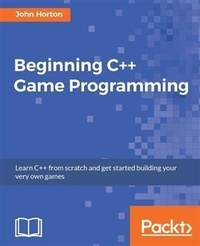
Beginning C++ Game Programming
Learn C++ from scratch and get started building your very own games
1st Edition
Published on 3. June 2024
520 pages
978-1-78646-777-5 (ISBN)
Description

Beginner's guide to create exciting desktop gamesKey Features - [*] This book offers a fun way to learn modern C++ programming while building exciting 2D games
- [*] This beginner-friendly guide offers a fast-paced but engaging approach to game development
- [*] Dive headfirst into building a wide variety of desktop games that gradually increase in complexity
- [*] It is packed with many suggestions to expand your finished games that will make you think critically, technically, and creatively
Book DescriptionThis book is all about offering you a fun introduction to the world of game programming, C++, and the OpenGL-powered SFML using three fun, fully-playable games. These games are an addictive frantic two-button tapper, a multi-level zombie survival shooter, and a split-screen multiplayer puzzle-platformer. We will start with the very basics of programming, such as variables, loops, and conditions and you will become more skillful with each game as you move through the key C++ topics, such as OOP (Object-Orientated Programming), C++ pointers, and an introduction to the Standard Template Library. While building these games, you will also learn exciting game programming concepts like particle effects, directional sound (spatialization), OpenGL programmable Shaders, spawning thousands of objects, and more. What you will learn - [*] Get to know C++ from scratch while simultaneously learning game building
- [*] Learn the basics of C++, such as variables, loops, and functions to animate game objects, respond to collisions, keep score, play sound effects, and build your first playable game.
- [*] Use more advanced C++ topics such as classes, inheritance, and references to spawn and control thousands of enemies, shoot with a rapid fire machine gun, and realize random scrolling game-worlds
- [*] Stretch your C++ knowledge beyond the beginner level and use concepts such as pointers, references, and the Standard Template Library to add features like split-screen coop, immersive directional sound, and custom levels loaded from level-design files
- [*] Get ready to go and build your own unique games!
Who this book is forThis book is perfect for you if any of the following describes you: You have no C++ programming knowledge whatsoever or need a beginner level refresher course, if you want to learn to build games or just use games as an engaging way to learn C++, if you have aspirations to publish a game one day, perhaps on Steam, or if you just want to have loads of fun and impress friends with your creations.
- [*] This beginner-friendly guide offers a fast-paced but engaging approach to game development
- [*] Dive headfirst into building a wide variety of desktop games that gradually increase in complexity
- [*] It is packed with many suggestions to expand your finished games that will make you think critically, technically, and creatively
Book DescriptionThis book is all about offering you a fun introduction to the world of game programming, C++, and the OpenGL-powered SFML using three fun, fully-playable games. These games are an addictive frantic two-button tapper, a multi-level zombie survival shooter, and a split-screen multiplayer puzzle-platformer. We will start with the very basics of programming, such as variables, loops, and conditions and you will become more skillful with each game as you move through the key C++ topics, such as OOP (Object-Orientated Programming), C++ pointers, and an introduction to the Standard Template Library. While building these games, you will also learn exciting game programming concepts like particle effects, directional sound (spatialization), OpenGL programmable Shaders, spawning thousands of objects, and more. What you will learn - [*] Get to know C++ from scratch while simultaneously learning game building
- [*] Learn the basics of C++, such as variables, loops, and functions to animate game objects, respond to collisions, keep score, play sound effects, and build your first playable game.
- [*] Use more advanced C++ topics such as classes, inheritance, and references to spawn and control thousands of enemies, shoot with a rapid fire machine gun, and realize random scrolling game-worlds
- [*] Stretch your C++ knowledge beyond the beginner level and use concepts such as pointers, references, and the Standard Template Library to add features like split-screen coop, immersive directional sound, and custom levels loaded from level-design files
- [*] Get ready to go and build your own unique games!
Who this book is forThis book is perfect for you if any of the following describes you: You have no C++ programming knowledge whatsoever or need a beginner level refresher course, if you want to learn to build games or just use games as an engaging way to learn C++, if you have aspirations to publish a game one day, perhaps on Steam, or if you just want to have loads of fun and impress friends with your creations.
More details
Other editions
New editions
E-Book
09/2024
2nd Edition
Packt Publishing
€35.49
Available for download
Additional editions
John Horton
Beginning C++ Game Programming
Learn C++ from scratch and get started building your very own games
Book
09/2016
Packt Publishing
€64.80
Shipment within 3-4 weeks
Content
Table of Contents - C++, SFML, Visual Studio and Starting the First Game
- Variables, Operators, and Decisions - Animating Sprites
- C++ Strings, SFML Time - Player Input, and HUD
- Loops, Arrays, Switch, Enumerations and Functions - Implementing Game Mechanics
- Collisions, Sound, and, End Conditions - Making the Game Playable
- Object-Oriented Programming, Classes, and SFML Views
- C++ References, Sprite Sheets and Vertex Arrays
- Pointers, the Standard Template Library, and Texture Management
- Collision Detection, Pickups and Bullets
- Layering Views and Implementing the HUD
- Sound Effects, File I/O and Finishing the Game
- Abstraction and Code Management - Making Better Use of OOP
- Advanced OOP - Inheritance and Polymorphism
- Building Playable Levels and Collision Detection
- Sound Spatialization and HUD
- Extending SFML Classes, Particle Systems and Shaders
- Before You Go.
- Variables, Operators, and Decisions - Animating Sprites
- C++ Strings, SFML Time - Player Input, and HUD
- Loops, Arrays, Switch, Enumerations and Functions - Implementing Game Mechanics
- Collisions, Sound, and, End Conditions - Making the Game Playable
- Object-Oriented Programming, Classes, and SFML Views
- C++ References, Sprite Sheets and Vertex Arrays
- Pointers, the Standard Template Library, and Texture Management
- Collision Detection, Pickups and Bullets
- Layering Views and Implementing the HUD
- Sound Effects, File I/O and Finishing the Game
- Abstraction and Code Management - Making Better Use of OOP
- Advanced OOP - Inheritance and Polymorphism
- Building Playable Levels and Collision Detection
- Sound Spatialization and HUD
- Extending SFML Classes, Particle Systems and Shaders
- Before You Go.
