

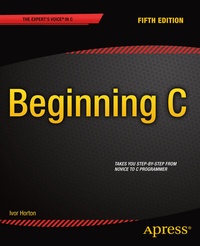
Beginning C
Description

Beginning C, 5th Edition teaches you how to program using the widely-available C language. You'll begin from first-principles and progress through step-by-step examples to become a competent, C-language programmer. All you need are this book and any of the widely available free or commercial C or C++ compilers, and you'll soon be writing real C programs.
C is a foundational language that every programmer ought to know. C is the basis for C# used in Microsoft .NET programming. It is the basis for Objective-C used in programming for the iPhone, the iPad, and other Apple devices. It is the basis for the C++ that is widely used in a great many contexts, including the GNU Project. It underlies the Linux operating system and many of its utilities. Learning C provides a strong foundation for any programming care, and will even help you better understand more modern languages such as Java.
Beginning C is written by renowned author Ivor Horton. The book increases your programming expertise by guiding you through the development of fully working C applications that use what you've learned in a practical context. You'll also be able to strike out on your own by trying the exercises included at the end of each chapter. At the end of the book you'll be confident in your skills with all facets of the widely-used and powerful C language.
- The only beginning-level book to cover the latest ANSI standard in C
- Revised to cover C99 features newly-supported by language compilers
- Emphasizes writing code after the first chapter
- Includes substantial examples relevant to intermediate users
More details
Other editions
New editions
Additional editions
Previous edition
Person
Content
- Programming in C
- First Steps in Programming
- Making Decisions
- Loops
- Arrays
- Applications with Strings and Text
- Pointers
- Structuring Your Programs
- More on Functions
- Essential Input and Output Operations
- Structuring Data
- Working with Files
- Supporting Facilities
- Advanced and Specialized Topics
- A. Computer Arithmetic
- B. ASCII Character Code Definitions
- C. Reserved Words in C
- D. Input and Output Format Specifications
- E. Standard Library Headers
