

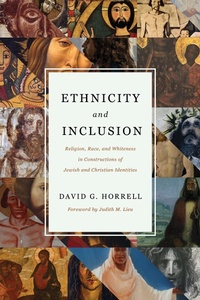
Ethnicity and Inclusion
Religion, Race, and Whiteness in Constructions of Jewish and Christian Identities
Published on 29. October 2020
302 pages
978-1-4674-5970-9 (ISBN)
Description

Some of today's problematic ideologies of racial and religious difference can be traced back to constructions of the relationship between Judaism and early Christianity. New Testament studies, which developed contemporaneously with Europe's colonial expansion and racial ideologies, is, David Horrell argues, therefore an important site at which to probe critically these ideological constructions and their contemporary implications. In Ethnicity and Inclusion, Horrell explores the ways in which "ethnic" (and "religious") characteristics feature in key Jewish and early Christian texts, challenging the widely accepted dichotomy between a Judaism that is ethnically defined and a Christianity that is open and inclusive. Then, through an engagement with whiteness studies, he offers a critique of the implicit whiteness and Christianness that continue to dominate New Testament studies today, arguing that a diversity of embodied perspectives is epistemologically necessary.
More details
Other editions
Additional editions
David G. Horrell
Ethnicity and Inclusion
Religion, Race, and Whiteness in Constructions of Jewish and Christian Identities
Book
10/2020
William B. Eerdmans Publishing Company
€58.00
No shipping information available
Content
- Intro
- Title Page
- Copyright
- Dedication
- Contents
- Foreword by Judith M. Lieu
- Acknowledgments
- Abbreviations
- Introduction
- Contexts of Research
- 1. A Persistent Structural Dichotomy: Jewish Ethnic Particularism and Christian Inclusivism
- 1.1 Ferdinand Christian Baur and the Making of Modern New Testament Scholarship
- 1.2 E. P. Sanders and a New Perspective on Judaism
- 1.3 Social-Scientific Perspectives on Ethnicity and Identity
- 1.4 Conclusions
- 2. Ethnicity, Race, and Ancient Jewish and Christian Identities: Themes in Recent Research
- 2.1 Ethnicity and Race in Antiquity: Jews/Judeans and Greeks
- 2.2 Ethnicity and Race in Early Christian Discourse and Identity
- 2.3 Conclusions
- 3. Ethnicity, Race, and Religion in Social-Scientific Perspective
- 3.1 Ethnicity and Race in History and Theory
- 3.2 The Language of Race
- 3.3 Religion and Ethnicity
- 3.4 Conclusions
- Comparisons of Jewish and Early Christian Perspectives
- 4. Shared Descent: Ancestry, Kinship, Marriage, and Family
- 4.1 Stories of Ancestors: Appeals to Genealogy and Descent
- 4.2 Kinship Relations: A Community of Brothers and Sisters
- 4.3 Marriage Rules: Endogamy as Norm
- 4.4 The Holiness of Children and the Passing on of Christian Identity
- 4.5 Conclusions
- 5. A Common Way of Life: Culture, Practice, and the Socialization of Children
- 5.1 Adhering to a Way of Life as Definitive for Jewish and Christian Identity
- 5.1.1 Way of Life and Jewish Identity
- 5.1.2 Way of Life and Christian Identity
- 5.2 The Socialization of Children into a Way of Life
- 5.2.1 Training Children in the Jewish Way of Life
- 5.2.2 Children and the Christian Way of Life
- 5.3 Displaying a Way of Life through Practice
- 5.3.1 Jewish Practices as Markers of Identity: Circumcision, Food, and Sabbath
- 5.3.2 Christian Practices and Group Identity: Baptism, Eucharist, and Sunday Meeting
- 5.3.3 Practices, Discourse, and Identity by Association
- 5.4 Conclusions
- 6. Homeland: Territory and Symbolic Constructions of Space
- 6.1 Ideologies of Land and Constructions of Space in Early Jewish Texts
- 6.2 Ideologies of Land and Constructions of Space in New Testament Texts
- 6.2.1 Luke-Acts
- 6.2.2 Paul
- 6.2.3 1 Peter
- 6.2.4 Hebrews
- 6.2.5 Revelation
- 6.3 Conclusions
- 7. Becoming a People: Self-Consciousness and Ethnicization
- 7.1 People-Groups in Antiquity: ?????, ?????, ?a??
- 7.2 Jewish Peoplehood: The ?a?? ?e??
- 7.3 Becoming a People: Early Christian Self-Consciousness and Ethnicization
- 7.4 Conclusions
- 8. Mission and Conversion: Joining the People
- 8.1 Proselytes, Sympathizers, and the Attractions of Judaism
- 8.1.1 From Missionary Zeal to Passive Attraction: Shifting Perspectives
- 8.1.2 Evidence for Judaism's Popularity
- 8.1.3 Sympathizers, Godfearers, and Patrons
- 8.1.4 Proselytes: Incomers and Joiners
- 8.1.5 Leaving the People: Defectors and Apostates
- 8.2 Early Christian Models of Mission
- 8.2.1 Matthew 28:18-20 and the Apostolic Commission
- 8.2.2 Paul and the Earliest Communities
- 8.2.3 Witness and Mission in 1 Peter
- 8.3 Conclusions
- Reflections on Location and Epistemology
- 9. Implicit Whiteness and Christian Superiority: The Epistemological Challenge
- 9.1 Retrospect, Summary, and Key Arguments Thus Far
- 9.2 Insights and Questions from Whiteness Studies
- 9.3 Particularizing (White, Western, Christian) New Testament Studies
- 9.3.1 Making Christianness Strange?
- 9.3.2 Whiteness and Constructions of the Early Christian Vision
- 9.3.3 Critique from the "Margins"-and the Center?
- 9.4 Moving Forward?
- Bibliography
- Cover Illustrations Credits
