

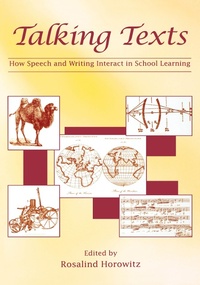
Talking Texts
How Speech and Writing Interact in School Learning
Published on 25. September 2017
520 pages
978-1-351-54715-4 (ISBN)
Description

This volume examines how oral and written language function in school learning , and how oral texts can be successfully inter-connected to the written texts that are used on a daily basis in schools. Rather than argue for the prominence of one over the other, the goal is to help the reader gain a rich understanding of how both might work together to create a new discourse that ultimately creates new knowledge. Talking Texts:
Provides historical background for the study of talk and text
Presents examples of children's and adolescents' natural conversations as analyzed by linguists
Addresses talk as it interfaces with domains of knowledge taught in schools to show how talk is related to and may be influenced by the structure, language, and activities of a specific discipline.
Bringing together seminal lines of research to create a cohesive picture of discourse issues germane to classrooms and other learning settings, this volume is an essential resource for researchers, graduate students, classroom teachers, and curriculum specialists across the fields of discourse studies, literacy and English education, composition studies, language development, sociolinguistics, and applied linguistics.
Provides historical background for the study of talk and text
Presents examples of children's and adolescents' natural conversations as analyzed by linguists
Addresses talk as it interfaces with domains of knowledge taught in schools to show how talk is related to and may be influenced by the structure, language, and activities of a specific discipline.
Bringing together seminal lines of research to create a cohesive picture of discourse issues germane to classrooms and other learning settings, this volume is an essential resource for researchers, graduate students, classroom teachers, and curriculum specialists across the fields of discourse studies, literacy and English education, composition studies, language development, sociolinguistics, and applied linguistics.
Reviews / Votes
"I loved Talking Texts. The book is wonderful. Rosalind Horowitz has put together a great line of authors. They have written about some of the most significant issues in literacy theory and pedagogy. And they present these big ideas in a register that is as engaging as it is authoritative!"--P. David Pearson, Professor, Language and Literacy, Society and Culture, and Dean, Graduate School of Education, University of California, Berkeley."People in composition badly need to learn what these linguists and cognitive psychologists can tell us about the role of speech in writing."--Peter Elbow, Professor of English, Emeritus, University of Massachusetts, Amherst.
"This multi-modal, marks-and-speech-based foundational beginning of a child's mental life provides a solid foundation on which educational theorists and practitioners may depend for generating the educational strategies for talking texts including the coherence (p. 463) and comprehension envisioned by Dr. Rosalind Horowitz."--Teachers College Record, November 2008
"... [This] is an excellent book that, hopefully, will become worn with use as it passes through many hands at every level of academia. Many of the chapters address similar themes and topics, yet their different solutions concerning research projects and studies make the anthology interesting reading even for instructors and scholars already thoroughly familiar with social constructive learning (and teaching) methods."--Education Review, April 2010
More details
Language
English
Place of publication
London
United Kingdom
Publishing group
Taylor & Francis Ltd
Target group
College/higher education
File size
63,03 MB
ISBN-13
978-1-351-54715-4 (9781351547154)
Copyright in bibliographic data and cover images is held by Nielsen Book Services Limited or by the publishers or by their respective licensors: all rights reserved.
Schweitzer Classification
Other editions
Additional editions
Book
06/2007
1st Edition
Routledge
€229.80
Shipment within 10-20 days
Book
06/2007
1st Edition
Routledge
€92.10
Shipment within 10-20 days
Person
Rosalind Horowitz
Content
Contents: Preface. Part I: Creating Discourse and Mind.R. Horowitz, Creating Discourse and Mind: How Talk, Text, and Meaning Evolve. R. Horowitz, D.R. Olson, Texts That Talk: The Special and Peculiar Nature of Classroom Discourse and the Crediting of Sources. Part II: Child, Adolescent, and Family Discourse: Everyday Conversation as Text Outside Classroom Contexts.A. Sheldon, Talk as Text: Gender and Children's Conversational Interaction. A-B. Stenstroem, Teenage Talk: A London-Based Chat and Discussion Compared. S. Blum-Kulka, Dinner Talk: Gaining Cultural Membership in Modern Literate Societies. R.J. Bayley, S. Schecter, Doing School at Home: Mexican Immigrant Families Interpret Texts and Instructional Agendas. Part III: Exemplars of Forms of Talk and Their Evolution Inside School Contexts.K. Nguyen-Jahiel, R. Anderson, M. Waggoner, B. Rowell, Using Literature Discussions to Reason Through Real Life Dilemmas: A Journey Taken by One Teacher and Her Fourth-Grade Students. I.L. Beck, M.G. McKeown, How Teachers Can Support Productive Classroom Talk: Move the Thinking to the Students. W. Saunders, C. Goldenberg, The Effects of Instructional Conversations on Latino Students' Concepts of Friendship and Story Comprehension. D.J. Hacker, A. Graesser, The Role of Dialogue in Reciprocal Teaching and Naturalistic Tutoring. E. Geva, Conjunction Use in School Children's Oral Language and Reading. Part IV: Developing Talk That Interacts With Text in Domains of Knowledge.J. Polman, R. Pea, Transformative Communication in Project Science Learning Discourse. C. Geisler, B. Lewis, Remaking the World Through Talk and Text: What We Should Learn From How Engineers Use Language to Design. P. Van Stapele, The Use of Dialogue in Drama: Reading Dialogue and Observing Performance. D. Hanauer, Poetry Read
