

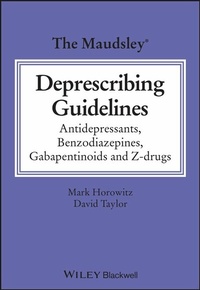
The Maudsley Deprescribing Guidelines
Description

Comprehensive resource describing guidelines for safely reducing or stopping (deprescribing) antidepressants, benzodiazepines, gabapentinoids and z-drugs for patients, including step-by-step guidance for all commonly used medications, covering common pitfalls, troubleshooting, supportive strategies, and more.
Most formal guidance on psychiatric medication relates to starting or switching medications with minimal guidance on deprescribing medication. In 2023, the World Health Organisation and the United Nations called for patients, as a human right, to be informed of their right to discontinue treatment and to receive support to do so.
The Maudsley Deprescribing Guidelines fills a significant gap in guidance for clinicians by providing comprehensive and authoritative information on this important aspect of treatment.
This evidence-based handbook provides an overview of principles to be used in deprescribing. This is derived from fundamental scientific principles and the latest research on this topic, combined with emerging insights from clinical practice (including from patient experts).
Building on the recognised brand of The Maudsley Prescribing Guidelines, and the prominence of the authors' work, including in The Lancet Psychiatry on tapering antidepressants (the most read article across all Lancet titles when it was released). The Maudsley Deprescribing Guidelines covers topics such as:
* Why and when to deprescribe antidepressants, benzodiazepines, gabapentinoids and z-drugs
* Barriers and enablers to deprescribing including physical dependence, social circumstances, and knowledge about the discontinuation process
* Distinguishing withdrawal symptoms, such as poor mood, anxiety, insomnia, and a variety of physical symptoms from symptoms of the underlying disorder that medication was intended to treat
* The difference between physical dependence and addiction/substance use disorder
* Explanation of why and how to implement hyperbolic tapering in clinical practice
* Specific guidance on formulations of medication and techniques for making gradual reductions, including using liquid forms of medication, and other approaches
* Step-by-step guidance for safely stopping all commonly used antidepressants, benzodiazepines, gabapentinoids and z-drugs, including fast, moderate and slow tapering regimens or schedules for each drug, and guidance on how to tailor these to an individual
* Troubleshooting issues which can arise on stopping these medications, including akathisia, withdrawal symptoms, acute or protracted, and relapse.
Written for anyone interested in safe deprescribing of psychiatric medications including psychiatrists, GPs, pharmacists, nurses, medical trainees, and interested members of the public. The Maudsley Deprescribing Guidelines is an essential resource on the subject that provides practical guidance on how to improve patient outcomes in this field of medicine.
More details
Other editions
Additional editions
Persons
Mark Horowitz, BA, BSc(Med), MBBS(Hons), MSc, GDipPsych, PhD, is a trainee psychiatrist and Clinical Research Fellow at North East London NHS Trust, where he runs a psychiatric drug deprescribing clinic. He is an Honorary Research Fellow at University College London and he co-authored the Royal College of Psychiatrists guide on 'Stopping antidepressants'. He has authored multiple academic papers on how to safely stop psychiatric drugs in high impact journals, and lectured on this topic around the world to doctors, pharmacists and the public. He was commissioned by Health Education England to prepare a module on safe deprescribing of antidepressants for prescribers in the National Health Service (NHS). He has lived experience of stopping psychiatric drugs which informs most of his work.
David Taylor, PhD, FFRPS, FRPharmS, FRCPEdin, FRCPsych(Hon), is Director of Pharmacy and Pathology at the South London and Maudsley NHS Trust and Professor of Psychopharmacology at King's College, London. He is the lead author of the Maudsley Prescribing Guidelines in Psychiatry and Editor-in-Chief of Therapeutic Advances in Psychopharmacology. He co-authored the Royal College of Psychiatrists guide on 'Stopping antidepressants'. His pharmacy department ran a medication help-line for a decade which fielded queries largely related to withdrawal from psychiatric drugs. He has personal experience of stopping psychiatric drugs.
Content
Preface ix
Acknowledgements xii
Notes on Using the Maudsley® Deprescribing Guidelines xiii
Abbreviations List xv
Chapter 1 Introduction to Deprescribing Psychiatric Medications 1
Deprescribing as an Intervention 1
The context for deprescribing 2
Why deprescribe? 7
Barriers and facilitators to deprescribing 11
Withdrawal Effects from Psychiatric Medications 13
Mis-diagnosis of withdrawal effects as relapse 13
Pathophysiology of psychiatric drug withdrawal symptoms 16
Clinical aspects of psychiatric drug withdrawal 19
Specific issues in psychiatric drug withdrawal 23
How to Deprescribe Psychiatric Medications Safely 27
The neurobiology of tapering 28
Practical options for prescribing gradually tapering doses 36
Psychological aspects of tapering 43
Tapering psychiatric drugs in practice 45
Further topics 52
Chapter 2 Safe Deprescribing of Antidepressants 57
When and Why to Stop Antidepressants 57
Adverse effects of antidepressants 66
Discussing deprescribing antidepressants with patients 72
Withdrawal Effects from Antidepressants 76
Recent developments in the understanding of antidepressant withdrawal 76
Pathophysiology of antidepressant withdrawal symptoms 80
Clinical aspects of antidepressant withdrawal 87
How common, severe and long- lasting are withdrawal symptoms from antidepressants? 92
Protracted antidepressant withdrawal syndrome 96
Post- SSRI sexual dysfunction 98
Factors influencing development of withdrawal effects 99
Stratfiying risk of antidepressant withdrawal 105
Distinguishing antidepressant withdrawal symptoms from relapse 107
Distinguishing antidepressant withdrawal symptoms from new onset of a physical or mental health condition 111
Withdrawal symptoms during antidepressant maintenance treatment or switching medication 113
How to Deprescribe Antidepressants Safely 115
Tapering antidepressants gradually 119
Hyperbolic tapering of antidepressants 125
Practical options in prescribing gradually tapering doses of antidepressants 131
Psychological aspects of antidepressant tapering 140
Tapering antidepressants in practice 143
Managing complications of antidepressant discontinuation 153
Tapering Guidance for Specific Antidepressants 158
Agomelatine 159
Amitriptyline 163
Bupropion 168
Citalopram 174
Clomipramine 183
Desvenlafaxine 188
Dosulepin 193
Doxepin 198
Duloxetine 203
Escitalopram 209
Fluoxetine 216
Fluvoxamine 223
Imipramine 228
Lofepramine 233
Mirtazapine 238
Moclobemide 243
Nortriptyline 248
Paroxetine 253
Phenelzine 259
Sertraline 264
Tranylcypromine 270
Trazodone 275
Venlafaxine 280
Vilazodone 288
Vortioxetine 292
Chapter 3 Safe Deprescribing of Benzodiazepines and Z-drugs 297
When and Why to Stop Benzodiazepines and Z-drugs 297
Discussing deprescribing benzodiazepines and z-drugs 304
Withdrawal Symptoms from Benzodiazepines and Z-drugs 309
Physical dependence vs addiction in use of benzodiazepines and z-drugs 311
Pathophysiology of benzodiazepine withdrawal syndrome 313
Variety of withdrawal symptoms from benzodiazepines and z-drugs 316
Protracted benzodiazepine withdrawal syndrome 320
Distinguishing benzodiazepine withdrawal symptoms from return of an underlying condition 323
Withdrawal symptoms during benzodiazepine maintenance treatment 326
How to Deprescribe Benzodiazepines and Z-drugs Safely 327
Tapering benzodiazepines and z-drugs gradually 330
Hyperbolic tapering of benzodiazepines and z-drugs 332
Switching to longer-acting benzodiazepines to taper 335
Making up smaller doses of benzodiazepines and z-drugs practically 338
Other considerations in tapering benzodiazepines and z-drugs 342
Psychological aspects of tapering benzodiazepines and z-drugs 345
Tapering benzodiazepines and z-drugs in practice 348
Management of complications of benzodiazepine and z-drug discontinuation 358
Tapering Guidance for Specific Benzodiazepines and Z-drugs 362
Alprazolam 364
Buspirone 375
Chlordiazepoxide 380
Clonazepam 388
Clorazepate 396
Diazepam 404
Estazolam 412
Eszopiclone 418
Flurazepam 423
Lorazepam 429
Lormetazepam 440
Nitrazepam 446
Oxazepam 452
Quazepam 461
Temazepam 467
Triazolam 474
Zaleplon 480
Zolpidem 485
Zopiclone 490
Chapter 4 Safe Deprescribing of Gabapentinoids 495
When and Why to Stop Gabapentinoids 495
Discussing deprescribing gabapentinoids 504
Overview of Gabapentinoid Withdrawal Effects 507
Physical dependence vs addiction in use of gabapentinoids 510
How to Deprescribe Gabapentinoids Safely 512
Principles for tapering gabapentinoids 512
Making up smaller doses of gabapentinoids practically 516
Other considerations in tapering gabapentinoids 520
Psychological aspects of tapering gabapentinoids 523
Tapering gabapentinoids in practice 525
Management of complications of gabapentinoid discontinuation 532
Tapering Guidance for Specific Gabapentinoids 537
Gabapentin 538
Pregabalin 546
Index 553
Chapter 1
Introduction to Deprescribing Psychiatric Medications
Deprescribing as an Intervention
Deprescribing is the planned and supervised process of reducing or stopping medication for which existing or potential harms outweigh existing or potential benefits.1 The term 'deprescribing' originates from geriatric medicine where polypharmacy in frail patients can cause more harm than benefit.1 Deprescribing is increasingly recognised to be a key component of good prescribing - reducing doses when they are too high, and stopping medications when they are no longer needed.2 This process cannot occur in a vacuum of theoretical concerns but should take into account the patient's health, current level of functioning and, importantly, their values and preferences.1 Deprescribing seeks to apply best practice in prescribing to the process of stopping a medication. It requires the same skill and experience as for the process of prescribing from prescribers, as well as support from pharmacists and other healthcare staff to obtain the best results. Importantly, it should place patients at the centre of the process to ensure medicines optimisation.3
There has historically been little attention paid to deprescribing in psychiatry. There is a dearth of research into a structured approach to stopping psychiatric medication, with the exception of some early studies examining stopping benzodiazepines1 and in some specific populations, like people with learning disabilities. The focus of research efforts has been predominantly the prescribing of psychiatric medications - for example, there are estimated to be about 1,000 (published and unpublished) studies on starting antidepressants and only 20 on stopping them.4 Concern about this imbalance is not specific to psychiatry with other medical specialties, such as cardiology, also engaging in a re-appraisal of long-term medication continuation, with support for developing strategies for repeated risk-benefit analyses over time.5
The context for deprescribing
Over-prescription in psychiatry
Despite evidence of benefit for psychiatric drug treatment, there have been concerns raised regarding over-prescription. 1 in 6 people in western countries are prescribed an antidepressant in any given year, with rates rising a few per cent each year.4,6 These increasing prescription numbers are mostly caused by longer periods of prescribing - the median duration of use of antidepressants is now more than 2 years in the UK and more than 5 years in the USA.6 Some commentators have suggested that the increasing duration of prescriptions in part reflect the difficulty people have in stopping these medications due to withdrawal effects.7 In practice, 30-50% of patients do not have evidence-based reasons for the continued prescription of antidepressants,8-10 prompting calls to action to reduce associated risks.6,11 There have been similar concerns about the high rates of antipsychotic use in conditions other than serious mental illness,12 as well as a reconsideration of their open-ended use in psychotic conditions for all patients.13,14 There are long-standing worries about levels of benzodiazepine and z-drug prescribing,15,16 and more recent concerns about gabapentinoid prescribing.17
High rates of medication prescribing has also gained governmental attention in the UK,17 with a particular focus on psychiatric drugs. A government report has noted that 1 in 4 adults in the UK are prescribed at least one dependence forming medication each year, with some patients having difficulties stopping these medications.18 One central concern is that short-term symptom control might be prioritised over long-term functional outcomes, especially as most studies guiding treatment protocols measure symptomatic outcomes over short time periods rather than functional outcomes (or other outcomes often valued by patients) over longer time periods.13,19,20
Alongside this disquiet regarding over-prescription there has been renewed scrutiny of the effectiveness of some psychiatric medications. There is some consensus in the UK and Europe that benzodiazepines and z-drugs have limited effectiveness in the long term, with guidance recommending against long-term treatment for anxiety and insomnia,21 matched by guidance in the USA from some health management organisations.15 Preliminary studies have recently found similar outcomes in the treatment of selected patients with first-episode psychosis with or without antipsychotics in the context of comprehensive psychosocial support,22,23 and non-drug treatment for serious mental illness has attracted increasing interest, including a large randomised controlled trial (RCT).24 There have been calls from clinicians and patients for 'minimal medication' options for the treatment of psychotic conditions, such as have been established in Norway and parts of the USA.25 There has continued to be debate regarding the efficacy of antidepressants26,27 with arguments being made for their use in selected populations.28 Concerns have emerged regarding the efficacy and safety of gabapentinoids.17 In some countries there has been a shift away from a drug-centric approach in some patient groups - for example, in England and Wales the National Institute for Health and Care Excellence (NICE) now recommends that mild depression should not be treated with antidepressants as a first-line treatment, and suggests eight equally effective (and cost-effective) non-pharmacological treatment options for severe depression, alongside medication options.29
In addition to the above, there has also been significant critical attention directed towards the relapse prevention properties of psychiatric drugs.30,31 All psychiatric drug classes are recognised to cause withdrawal effects when stopped that may be misinterpreted as relapse of the initial condition necessitating treatment.32 These withdrawal symptoms are often ignored in discontinuation studies examining relapse prevention properties.30,33,34 As a result there have been questions raised as to whether the relapse prevention properties of psychiatric drugs have been over-stated by mis-classification of withdrawal effects as relapse,30,33,34 indicating we should be cautious in our interpretation of these studies.
Research and guideline establishment in deprescribing
In recent years interest in psychiatric deprescribing has increased exponentially. Numerous studies have been conducted or are ongoing exploring reducing and stopping antipsychotics in first and multi-episode psychotic conditions, in Taiwan, France, Denmark, the Netherlands, England, Australia and Germany, including the establishment of an international research consortium.14 Some of these studies are examining gradual reductions, or hyperbolic dose reductions specifically.14,35 Alongside this there are studies looking at how to help patients stop antidepressants - in the UK,36 the Netherlands37 and in Australia38 - as well as several published studies looking at substitutions for antidepressant treatment like preventative cognitive therapy or mindfulness-based cognitive therapy.39-41
There has been increasing interest in the process of stopping medication based on the pharmacological properties of the drugs,42-45 as well as in the practical means for making gradual dose reduction (for example, using compounded tablets in very small doses).46-48 There has also been increased focus on the non-pharmacological aspects of reducing and stopping medication - the positive and negative impact on people's lives, as well as the barriers and the facilitators.1,49-52
In parallel, there has been increasing institutional interest in deprescribing in some countries. In the UK, in recent years, there has been guidance issued by the Royal College of Psychiatrists on how to safely stop antidepressants,53 as well as guidance from NICE on how to stop antidepressants, benzodiazepines, z-drugs, opioids and gabapentinoids.54 Similar guidance on how to stop antipsychotics has been called for.55 In England, the National Health Service (NHS) has introduced structured medication reviews to reduce the use of unnecessary medication, including some psychiatric drugs,56 and the Department of Health and Social Care has been tasked with upscaling deprescribing capacity in the NHS.18
Many clinicians report an interest in deprescribing and in receiving training for its practice. In total, 75% of UK clinicians working in first-episode psychosis services thought that early discontinuation of antipsychotic medication was beneficial for most patients.57 In patients with multiple psychotic episodes English psychiatrists reported that they would feel comfortable supporting about 20% of their patients to discontinue their antipsychotics, with a minority of psychiatrists comfortable to support greater proportions.58 In a survey 68% of GPs expressed a desire for more training on the withdrawal effects of...
