

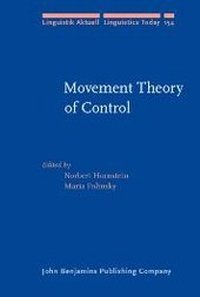
Movement Theory of Control
1st Edition
Published on 29. April 2010
VII, 330 pages
978-90-272-8833-2 (ISBN)
Description

Natural languages offer many examples of "displacement," i.e. constructions in which a non-local expression is critical for some grammatical end. Two central examples include phenomena such as raising and passive on the one hand, and control on the other. Though each phenomenon is an example of displacement, they have been theoretically distinguished. Movement rules have generated the former and formally very different construal rules, the latter. The Movement Theory of Control challenges this differentiation and argues that the operations that generate the two constructions are the same, the differences arising from the positions through which the displaced elements are moved. In the context of the Minimalist Program, reducing the class of basic operations is methodologically prized. This volume is a collection of original papers that argue for this approach to control on theoretical and empirical grounds as well. The papers also develop and constrain the movement theory to account for novel phenomena from a variety of languages.
More details
Other editions
Additional editions
Norbert Hornstein | Maria Polinsky
Movement Theory of Control
Book
04/2010
John Benjamins Publishing Co
€104.94
Shipment within 10-15 days
Persons
Content
- Movement Theory of Control
- Editorial page
- Title page
- LCC Data
- Table of contents
- Abbreviations
- Control as movement
- 1. Preliminaries
- 2. Eliminating PRO
- 2.1 Architectural assumptions
- 2.2 Consequences of PRO-free theory
- 3. Promise and control shift: Applying the logic of minimality
- 3.1 Promise verbs
- 3.2 Control shift
- 4. Visser's generalization
- 4.1 The simple case
- 4.2 The hard case
- 5. Control in nominals
- 6. This volume: An overview
- References
- Part I. Expanding the movement analysis of control
- Movement Theory of Control and CP-infinitives in Polish
- 1. Introduction
- 2. Obligatory Control into CP-infinitives
- 3. Agreement with predicative adjectives in CP-infinitives
- 3.1 Control and case-agreement with predicative adjectives
- 3.2 Predicative adjectives in zeby/so that-infinitives
- 3.3 Agreement with predicative adjectives in interrogative infinitives
- 3.4 CP-infinitives and case-agreement with predicative adjectives
- 4. Genitive of negation and (non)intervention of PRO
- 5. Conclusions
- References
- Obligatory control and local reflexives
- 1. Some facts
- 2. Limitations of binding
- 3. An explicitly conceptual semantics
- 4. Guaranteed sameness and being yourself
- 5. Conclusion
- References
- No objections to Backward Control
- 1. Introduction
- 1.1 Two major innovations and their consequences for the theories of Control and Raising
- 1.2 Implications of BC for the PRO-analysis of Control and Landau's objections
- 1.3 Our contribution
- 2. Control subjunctives in Greek and Romanian
- 3. Backward Control
- 3.1 No restructuring
- 3.2 The subject is truly embedded
- 3.3 An unpronounced subject in the matrix clause
- 4. Case properties of BC in Greek and Romanian
- 4.1 A comparison with Tsez with respect to the Control chain
- 4.2 Multiply Case Marked Chains
- 4.3 Two Cases: An argument against Movement?
- 5. How to account for the BC parameter
- 5.1 A potential answer to question 1
- 5.2 Towards an answer to question 2
- 5.3 BC in Spanish
- 6. Open questions
- References
- Possessor raising through thematic positions
- 1. Introduction
- 2. The impoverishment of the agreement system within the DP domain
- 3. Evidence for a movement analysis for null possessors
- 3.1 Possessor raising in unaccusative predicates
- 3.2 Anaphoric behavior
- 3.3 Locality
- 3.4 Obligatory control properties
- 3.5 Specificity
- 3.6 Relative clauses
- 4. 3rdP null possessors inside adjuncts
- 5. Null possessors inside coordinate structures
- 6. Conclusion
- References
- Part II. Unexplored control phenomena
- Clitic climbing in archaic Chinese
- 1. Introduction
- 2. Positions for object pronouns in subject control contexts
- 2.1 A mixed picture
- 2.2 Breakdown of the data
- 3. Analysis of raising with mo 'none'
- 3.1 Characteristics of mo 'none'
- 3.2 Cliticization and control
- 4. Raising to object?
- 5. Fu and Bu: Two types of 'not'
- 6. Conclusion
- References
- Framing the syntax of control in Japanese (and English)
- Introduction
- 1. Distilling the construction
- 2. Control and the bare ni construction
- 2.1 Making the case for Control
- 2.1.1 Bare ni adjunct requires a possessed noun
- 2.1.2 Possessor of 'NP ni' is a controlled nominal rather than PRO
- 2.1.3 Bare ni adjunct cannot be a matrix subject/topic/focus
- 2.1.4 Bare 'NP ni' phrase has an OC possessor
- 2.2 The category of the adjuncts: Bare ni is PP, ni site is TP
- 3. Event-induced opacity to control
- 3.1 te verbs and bare (renyookei) verbs
- 3.2 Event-induced opacity
- 3.3 Classic cases of control in Japanese
- 4. Exhaustive Control (EC) and the calculus of events
- 4.1 EC and PC in English
- 4.2 Problems with the calculus of tense
- 4.3 Events in place of tense
- 4.4 Bare ni adjuncts and event-based opacity to movement
- Acknowledgements
- References
- Split control and the Principle of Minimal Distance
- 1. Introduction
- 2. Mood particles and obligatory control
- 2.1 Decisives and imperatives
- 2.2 Diagnostic properties of OC
- 2.3 null equivalent of overt indexicals
- 3. Split control and the exhortative use of -(y)oo
- 3.1 Where split control is licensed
- 3.2 Reciprocal and reflexive predicates
- 4. Split control and the PMD
- 4.1 A gap in the mood paradigm
- 4.2 An analysis of split control
- 4.3 A note on the root case
- 5. Conclusions
- References
- Towards a typology of control in DP
- 1. Introduction
- 2. OC in DP
- 2.1 Implicit agents and apparent NOC
- 2.2 The OC nature of the infinitive subject
- 3. NOC in DP
- 4. The predictions for the distribution of OC and NOC in DP
- 5. Problems and prospects
- 6. Conclusions
- References
- Part III. Beyond control
- The argument structure of evaluative adjectives
- 1. Introduction
- 2. Adjectival control
- 3. Evaluative adjectives
- 4. Diagnostics
- 4.1 Argument structure: Raising/control
- 4.2 Reference: Obligatory/non-obligatory control
- 4.3 Entailment
- 4.4 Summary
- 5. Analysis
- 5.1 Adjunct control
- 5.1.1 Thematic structure
- 5.1.2 Adjunction site
- 5.2 Sentential subject alternation
- 5.2.1 Non-local control
- 5.2.2 Alternation
- 5.3 Summary and implications
- 5.4 Accounting for nominals
- 5.5 More alternate mismatches
- 6. Implications for the movement theory of control
- 6.1 Noun complement constructions
- 6.2 Selection
- 7. Conclusion
- References
- Object control in Korean
- 1. Introduction
- 2. Object control in Korean
- 3. Differences between ACC1 and ACC 2
- 4. Structure of ACC1 and ACC2
- 4.1 ACC1
- 4.2 ACC2
- 5. Backward object control or another instance of non-obligatory control?
- 5.1 Basic properties of the nominative construction
- 5.2 Possible analyses of the nominative construction
- 5.3 The nominative construction as non-obligatory control
- 6. Conclusions
- References
- Index
- The series Linguistik Aktuell/Linguistics Today
