

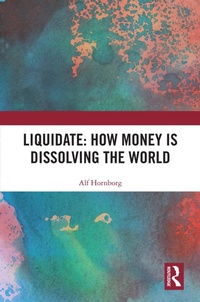
Liquidate: How Money is Dissolving the World
1st Edition
Published on 12. November 2024
280 pages
978-1-040-25147-8 (ISBN)
Description

Liquidate: How Money is Dissolving the World examines the emergence of money and its social and ecological repercussions. It views money as a new phenomenon in the evolution of life that has fundamentally transformed ecosystems and human social relations.
The appearance of coined money around 600 BCE coincided with the first abstract philosophies and religions. This book shows how changes in human-environmental relations have reflected changes in social relations generated by money. The detached modern view of nature mirrors the socially detached modern individual. However, the abandonment of animism has not diminished the human propensity for fetishism - the perception of artefacts such as money tokens as indexes of what they represent. Market prices obscure the asymmetric global resource transfers that make increasingly advanced technologies possible where there is enough money. Our fetishised understandings of money and technologies cannot deal with the escalating production of entropy underlying climate change. They also drive the dramatic reduction of biological and cultural diversity under globalisation. Given these problems, many people reassess premodern and indigenous societies in search of more sustainable ideas on how to organise exchange.
Liquidate: How Money is Dissolving the World will be of interest to scholars working in anthropology, sociology, economics, history, semiotics, comparative religions, and indigenous studies.
The appearance of coined money around 600 BCE coincided with the first abstract philosophies and religions. This book shows how changes in human-environmental relations have reflected changes in social relations generated by money. The detached modern view of nature mirrors the socially detached modern individual. However, the abandonment of animism has not diminished the human propensity for fetishism - the perception of artefacts such as money tokens as indexes of what they represent. Market prices obscure the asymmetric global resource transfers that make increasingly advanced technologies possible where there is enough money. Our fetishised understandings of money and technologies cannot deal with the escalating production of entropy underlying climate change. They also drive the dramatic reduction of biological and cultural diversity under globalisation. Given these problems, many people reassess premodern and indigenous societies in search of more sustainable ideas on how to organise exchange.
Liquidate: How Money is Dissolving the World will be of interest to scholars working in anthropology, sociology, economics, history, semiotics, comparative religions, and indigenous studies.
Reviews / Votes
"Money is quintessentially fungible. It is a sign that has no specific socially agreed upon referent. As such, it amplifies the human propensity for a form of thought that is separate from the sentient world from which we emerge and upon which we depend, a form of thought that has made Culture a veritable force of Nature. Liquidate is a fascinating and masterful exploration of the vexing properties of money as a medium for thought, and how to re-imagine this medium as we face a human-made and planet-wide ecological crisis." - Eduardo Kohn, McGill University, Canada"Money is the most central, and probably misunderstood commodity in modern economies. This book digs beneath the fetish to unearth the real nature of money."- Giorgos Kallis, ICTA-UAB, Spain
"At once wide-ranging and incisive, Alf Hornborg offers a critique of the pivotal role money plays in our modern predicaments from growing inequalities to destruction of our common habitat, to sociability itself. He calls for a redesign of this human artifact." - Stephen Gudeman, University of Minnesota, USA
"Alf Hornborg is a pioneer of ecosemiotics. This is a field that is necessary to live with biodiversity in the coming millennia. The book explains why money as a semiotic force together with excessive energy as a physical force destroys diversity. A must for future designers, it also helps to understand the ecosystem's way to live in balance."- Kalevi Kull, University of Tartu, Estonia
"After the sudden death of David Graeber, Alf Hornborg offers the most radical critique of value, money, and fetishism." - Kohei Saito, University of Tokyo, Japan
More details
Edition
1. Auflage
Language
English
Place of publication
London
United Kingdom
Publishing group
Taylor & Francis Ltd
Target group
College/higher education
ISBN-13
978-1-040-25147-8 (9781040251478)
Copyright in bibliographic data and cover images is held by Nielsen Book Services Limited or by the publishers or by their respective licensors: all rights reserved.
Schweitzer Classification
Other editions
Additional editions
Alf Hornborg
Liquidate: How Money is Dissolving the World
Book
05/2026
1st Edition
Routledge
€57.00
Shipment within 10-20 days

Book
12/2024
Routledge
Unfortunately, price unknown
Article exhausted; check different version
Book
11/2024
1st Edition
Routledge
€197.70
Shipment within 10-20 days
Person
Alf Hornborg is an anthropologist and Professor Emeritus of Human Ecology at Lund University, Sweden.
Content
Part 1 The Semiotics of Money Fetishism 1. The Empty Sign 2. Money and Civilisation 3. The Semiotics of Fetishism Part 2 Money, Materiality, and Entropy 4. Beyond the Veil of Market Prices 5. Technology as Fetish 6. Money, Entropy, and Climate Change Part 3 Diversity, Place, and Resistance 7. The Meltdown of Diversity 8. Civilisation Without Money 9. Visions of Indigenousness 10. Meaningful Money?
