

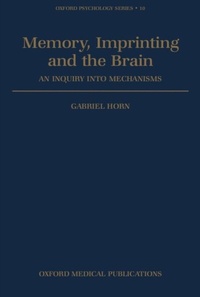
Memory, Imprinting, and the Brain
An Inquiry into Mechanisms
1st Edition
Published on 19. December 1985
330 pages
978-0-19-154560-3 (ISBN)
Description

Ranging from behavioral to molecular levels of analysis, this informative study presents the results of recent research into the biochemistry and neural mechanisms of imprinting. Horn discusses some of the difficulties that researchers have encountered in analyzing the neural basis of memory and describes ways in which these difficulties have been overcome through the analysis of memories underlying habituation and imprinting. He also considers the biochemical consequences of imprinting and its cerebral localization, and examines the relationships between human and animal memory.
More details
Other editions
Additional editions

Software
01/2008
Oxford University Press, USA
€122.77
Article exhausted; check different version
Book
12/1985
Clarendon Press
€146.30
Shipment within 15-20 days
Content
- Intro
- Contents
- 1 Approaches to the analysis of the neural bases of memory
- 1.1 Memory and habituation
- 1.1.1 Some behavioural characteristics of habituation
- 1.1.2 Physiological analysis
- 1.1.3 Cellular mechanisms
- 1.1.4 Possible neuronal networks for habituation
- 1.1.5 Comment
- 1.2 The characteristics of filial imprinting
- 1.3 Summary
- References
- 2 Biochemical consequences of imprinting
- 2.1 Protein metabolism
- 2.2 RNA metabolism
- 2.3 Some ambiguities of interpretation
- 2.4 Summary
- References
- 3 Real effects of learning?
- 3.1 Dividing the brain
- 3.2 Controlling for some effects of sensory stimulation
- 3.3 Biochemical and behavioural variations
- 3.4 Comment
- 3.5 Summary
- References
- 4 Cerebral localization
- 4.1 Probing with radioactive uracil
- 4.2 Probing with radioactive 2-deoxyglucose
- 4.3 Some unanswered questions
- 4.4 Summary
- References
- 5 Brain lesions, acquisition, and retention
- 5.1 Lesions to the IMHV, and the acquisition of a preference
- 5.2 Lesions to the IMHV, and the retention of a preference
- 5.3 One IMHV for acquisition and retention
- 5.4 Other lesions studies
- 5.5 Evaluating the evidence of lesion studies
- 5.6 Summary
- References
- 6 Imprinting and associative learning
- 6.1 Working for a reward of warm air
- 6.2 Working for a view
- 6.3 Recognition memory and associative learning
- 6.4 Is there a special relationship between imprinting and the IMHV?
- 6.5 Summary
- References
- 7 How many stores? Cerebral asymmetry and imprinting
- 7.1 Sequential lesion studies
- 7.2 Modification of hemisphere function
- 7.2.1 A neuronal model
- 7.3 How many stores and what are they for?
- 7.4 Lesions, motivation, and stimulus-response pathways
- 7.5 Summary
- References
- 8 Predispositions and preferences
- 8.1 Brain lesions and preferences
- 8.2 Behavioural analysis of preferences
- 8.2.1 Interaction between acquired preferences and predispositions
- 8.2.2 Conditions for the emergence of a predisposition
- 8.3 Predisposition to what?
- 8.4 What role for the IMHV in the preference for the jungle-fowl?
- 8.4.1 Emerging preferences
- 8.4.2 Recognition of individuals
- 8.5 S' and the jungle-fowl
- 8.6 Summary
- References
- 9 Physiological constraints on memory and imprinting
- 9.1 Effects of stimulating the brain
- 9.2 Effects of age and visual experience on catecholamine levels in parts of the chick forebrain
- 9.3 Noradrenaline and imprinting
- 9.4 Testosterone and imprinting
- 9.5 Double dissociation
- 9.6 Comment and speculation
- 9.7 Summary
- References
- 10 Physiological and morphological consequences of training
- 10.1 Physiological consequenses of training
- 10.2 Morphological consequences of training
- 10.3 Comment and speculation
- 10.3.1 Specific or non-specific consequences of training?
- 10.3.2 Correlations
- 10.3.3 Functions of dendritic spines
- 10.3.4 Constraints on synaptic modification
- 10.3.5 Cellular mechanisms
- 10.3.6 Presynaptic and postsynaptic changes
- 10.3.7 Functional validation
- 10.4 Summary
- References
- 11 A structure for memory?
- 11.1 The connections of the IMHV
- 11.1.1 Connections with sensory systems and the brainstem core
- 11.1.2 Connections with descending control systems
- 11.1.3 Connections with systems involved in agonistic behaviour and the expression of emotions
- 11.2 Chemical and cellular components of the IMHV
- 11.2.1 Neuroactive substances
- 11.2.2 Cellular organization
- 11.3 Comment and speculation: cerebral circuits in birds and mammals
- 11.4 Summary
- References
- 12 Towards a synthesis
- 12.1 Memory
- 12.1.1 Neuropsychological and neuroethological approaches
- 12.1.2 Neurophysiological aspects
- 12.2 Imprinting
- 12.2.1 Sensitive periods in imprinting and the development of the visual cortex
- 12.2.2 Predispositions and acquisitions
- 12.3 Summary
- References
- Appendix: A sketch of the avian brain with particular reference to the domestic chick
- A.1 General form of the chick brain
- A.2 Internal structure of the telencephalon
- A.3 Sensory systems
- A.3.1 The visual system
- A.3.2 The auditory system
- A.3.3 The somatic sensory system
- A.3.4 The olfactory system
- A.4 Projections of the brainstem core
- A.5 Descending pathways from the cerebral hemispheres
- A.6 Summary
- References
- Author index
- A
- B
- C
- D
- E
- F
- G
- H
- I
- J
- K
- L
- M
- N
- O
- P
- R
- S
- T
- U
- V
- W
- Y
- Z
- Subject index
- A
- B
- C
- D
- E
- F
- G
- H
- I
- J
- L
- M
- N
- O
- P
- Q
- R
- S
- T
- U
- V
- W
- Z
