

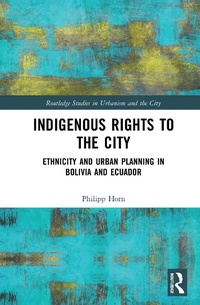
Indigenous Rights to the City
Ethnicity and Urban Planning in Bolivia and Ecuador
Published on 30. January 2019
178 pages
978-1-351-33070-1 (ISBN)
Description

This book breaks new ground in understanding urban indigeneity in policy and planning practice. It is the first comprehensive and comparative study that foregrounds the complex interplay of multiple organisations involved in translating indigenous rights to the city in Latin America, focussing on the cities of La Paz and Quito.
The book establishes how planning for urban indigeneity looks in practice, even in seemingly progressive settings, such as Bolivia and Ecuador, where indigenous rights to the city are recognised within constitutions. It demonstrates that the translation of indigenous rights to the city is a process involving different actor groups operating within state institutions and indigenous communities, which often hold conflicting interests and needs. The book also establishes a set of theoretical, methodological, and practical foundations for envisaging how urban indigenous planning in Latin America and elsewhere should be understood, studied, and undertaken: As a process which embraces conflict and challenges power relations within indigenous communities and between these communities and the state.
This book will appeal to practitioners, researchers, and students working within the fields of urban planning, urban development, and indigenous rights.
The book establishes how planning for urban indigeneity looks in practice, even in seemingly progressive settings, such as Bolivia and Ecuador, where indigenous rights to the city are recognised within constitutions. It demonstrates that the translation of indigenous rights to the city is a process involving different actor groups operating within state institutions and indigenous communities, which often hold conflicting interests and needs. The book also establishes a set of theoretical, methodological, and practical foundations for envisaging how urban indigenous planning in Latin America and elsewhere should be understood, studied, and undertaken: As a process which embraces conflict and challenges power relations within indigenous communities and between these communities and the state.
This book will appeal to practitioners, researchers, and students working within the fields of urban planning, urban development, and indigenous rights.
More details
Series
Language
English
Place of publication
London
United Kingdom
Publishing group
Taylor & Francis Ltd
Target group
Professional and scholarly
College/higher education
Product notice
Reflowable
Illustrations
10 Tables, black and white; 9 Line drawings, black and white; 6 Halftones, black and white; 15 Illustrations, black and white
File size
3,60 MB
ISBN-13
978-1-351-33070-1 (9781351330701)
Copyright in bibliographic data and cover images is held by Nielsen Book Services Limited or by the publishers or by their respective licensors: all rights reserved.
Schweitzer Classification
Other editions
Additional editions
Book
09/2020
1st Edition
Routledge
€54.46
Shipment within 15-20 days
Book
02/2019
1st Edition
Routledge
€205.90
Shipment within 10-20 days
Person
Philipp Horn is a Lecturer in the Department of Urban Studies and Planning at the University of Sheffield, UK. His research interests centre around urban indigeneity; ethno-racial justice; participatory planning; and inclusive urban development in cities of the global South, with a regional focus on Latin America.
Content
1. Introduction: From inhabitants of the forest to the concrete jungle
Part one: Concepts and context
2. The emergence of urban indigeneity and the indigenous right to the city
3. Indigeneity in urban policy and planning practice
4. The making of two indigenous cities
Part two: Experiences from La Paz, Bolivia and Quito, Ecuador
5. Urban indigeneity as lived experience
6. Urban indigeneity in policy and planning practice
7. Claiming indigenous rights to the city
8. Conclusion
Part one: Concepts and context
2. The emergence of urban indigeneity and the indigenous right to the city
3. Indigeneity in urban policy and planning practice
4. The making of two indigenous cities
Part two: Experiences from La Paz, Bolivia and Quito, Ecuador
5. Urban indigeneity as lived experience
6. Urban indigeneity in policy and planning practice
7. Claiming indigenous rights to the city
8. Conclusion
