

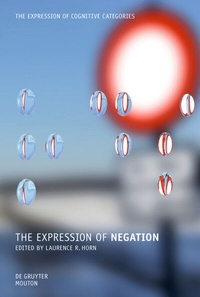
The Expression of Negation
Description

Negation is a sine qua non of every human language but is absent from otherwise complex systems of animal communication. In many ways, it is negation that makes us human, imbuing us with the capacity to deny, to contradict, to misrepresent, to lie, and to convey irony. The apparent simplicity of logical negation as a one-place operator that toggles truth and falsity belies the intricate complexity of the expression of negation in natural language. Not only do we find negative adverbs, verbs, copulas, quantifiers, and affixes, but the interaction of negation with other operators (including multiple iterations of negation itself) can be exceedingly complex to describe, extending (as first detailed by Otto Jespersen) to negative concord, negative incorporation, and the widespread occurrence of negative polarity items whose distribution is subject to principles of syntax, semantics, and pragmatics. The chapters in this book survey the patterning of negative utterances in natural languages, spanning such foundational issues as how negative sentences are realized cross-linguistically and how that realization tends to change over time, how negation is acquired by children, how it is processed by adults, and how its expression changes over time. Specific chapters offer focused empirical studies of negative polarity, pleonastic negation, and negative/quantifier scope interaction, as well as detailed examinations of the form and function of sentential negation in modern Romance languages and Classical Japanese.
Reviews / Votes
"This work constitutes important reading for specialists on negation and thoseinterested in grammatical systems."Pierre Larrivée in: Linguist List 21.5023More details
Other editions
Additional editions
Person
Content
2 - Introduction [Seite 8]
3 - Typology of negation [Seite 16]
4 - The Acquisition of Negation [Seite 46]
5 - On the diachrony of negation [Seite 80]
6 - Multiple negation in English and other languages [Seite 118]
7 - Quantifier-negation interaction in English: A corpus linguistic study of all...not constructions [Seite 156]
8 - Negative and positive polarity items: An investigation of the interplay of lexical meaning and global conditions on expression [Seite 194]
9 - Negation as a metaphor-inducing operator [Seite 232]
10 - Negation in Classical Japanese [Seite 264]
11 - Negation and polarity in the new millennium: A bibliography [Seite 294]
12 - Contributors [Seite 338]
13 - Index of subjects [Seite 340]
14 - Index of languages [Seite 342]
15 - Index of persons [Seite 344]
