

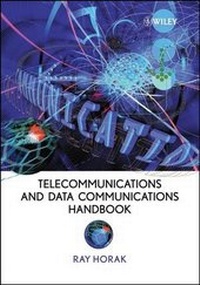
Telecommunications and Data Communications Handbook
Description

Reviews / Votes
"I found the book to be a well written wealth of knowledge."(ACUTA Journal of Communications Technology in HigherEducation, Summer 2008) I recently had the pleasure of reviewing Ray Horak's book,Telecommunications and Data Communications Handbook. Thebook's 791 pages, divided into 15 chapters, cover everythingfrom legacy technology such as basic telephone switching to leadingedge technologies such as DWDM optical networks, 3G wirelessnetworks, and IPTV converged video. I have read other Horak booksin the past, but this one is the most comprehensive one that he hasdone to date. The book appears to be best suited as either a text book for atelecommunications class or a reference book. Using Texasterminology, the book is a mile wide but not very deep. You wouldbe hard pressed to find a topic that was not discussed in thealmost 800 pages of the book, but most topics are covered in lessthan one page. It is an encyclopedic work, not the reference thatyou would use if you needed a comprehensive understanding of anyspecific technology. On the other hand, if one of your peers bringsup a new technology during the course of a conversation (forexample MMS), and you want to know what he or she is talking aboutto avoid appearing uninformed, this book could prove to beinvaluable. In other words, it doesn't paint the wholepicture in high resolution, but it provides a lot more than asnapshot. A few of the topics that I found of the most interest included thesections on Broadband over Power Line (BPL), HiperLAN, VDSL, IEEE802.16 WiMAX and IPTV. There are a few topics that I would like tohave seen covered that were not, but this leaves open theopportunity for the next edition. Overall, I found the book to be a well written wealth of knowledge.I plan to use it as the text for my undergraduate course intelecommunications in the spring. --Reviewed by Walt Magnussen, Director of Telecommunications,Texas A&M University (ACUTA: Journal of CommunicationsTechnology in Higher Education, Summer 2008) "If you can have one book on voice and data communications, thisis the book to have." (The Prepaid Press, May 14th,2008) "The book is very well written and accessible to the averagereader." (Computing Reviews, May 6, 2008) "Readers wanting to gain insight into the terminology of thefield would be advised to consult this outstanding reference book."(American Reference Books Annual, March 2008) "A must-have acquisition for both beginners andpractioners...highly recommended." (CHOICE, February2008)More details
Other editions
Additional editions
Person
Content
Acknowledgments.
About the Author.
1 FUNDAMENTALS OF THE TECHNOLOGY: CONCEPTS AND DEFINITIONS.
1.1 Fundamental Defi nitions.
1.2 Dedicated, Switched, and Virtual Circuits.
1.3 Two-Wire versus Four-Wire Circuits.
1.4 Bandwidth.
1.5 Analog versus Digital.
1.6 Loading Coils, Amplifi ers, and Repeaters.
1.7 Conversion Process: Modems and Codecs.
1.8 Multiplexers (Muxes).
1.9 Switches and Switching: The Basics . . . and Then Some.
1.10 Signaling and Control.
References.
2 FUNDAMENTALS OF TRANSMISSION SYSTEMS: TECHNOLOGIES AND APPLICATIONS.
2.1 Electromagnetic Spectrum.
2.2 Transmission Media Selection Criteria.
2.3 Twisted Pair: Introduction to Telephone Wire.
2.4 Shielded Copper.
2.5 Coaxial Cable.
2.6 Microwave Radio.
2.7 Satellite Radio.
2.8 Free Space Optics.
2.9 Fiber Optics.
2.10 Powerline Carrier.
2.11 Hybrid Transmission Systems.
References.
3 VOICE COMMUNICATIONS SYSTEMS: KTS, PBX, CENTREX, AND ACD.
3.1 Key Telephone Systems.
3.2 Private Branch Exchanges.
3.3 Centrex.
3.4 Automatic Call Distributors.
3.5 Computer Telephony.
3.6 IP Systems.
3.7 Futures.
References.
4 MESSAGING SYSTEMS.
4.1 Facsimile (Fax) Systems.
4.2 Voice Processing Systems.
4.3 Electronic Mail (E-Mail).
4.4 Instant Messaging.
4.5 Mobile Messaging: SMS and MMS.
4.6 Unifi ed Messaging and Unifi ed Communications.
References.
5 PUBLIC SWITCHED TELEPHONE NETWORK.
5.1 Network Characteristics.
5.2 Numbering Plan Administration.
5.3 Domains.
5.4 Signaling and Control: Expanded View.
5.5 Network Services.
5.6 Portability: A Special Issue.
5.7 Equal Access: Another Special Issue.
5.8 VoIP: Next-Generation PSTN.
References.
6 FUNDAMENTALS OF DATA COMMUNICATIONS.
6.1 Functional Domains.
6.2 DCE: Expanded View.
6.3 Protocol Basics.
6.4 Network Architectures.
6.5 Security.
References.
7 CONVENTIONAL DIGITAL AND DATA NETWORKS.
7.1 Dataphone Digital Service.
7.2 Switched 56.
7.3 Virtual Private Networks: In the Classic Sense.
7.4 Digital Carrier Systems and Networks.
7.5 X.25 and Packet Switching.
7.6 Integrated Services Digital Network.
References.
8 LOCAL AREA NETWORKS: CONNECTIVITY AND INTERNETWORKING.
8.1 LANs Defi ned.
8.2 LAN Dimensions.
8.3 LAN Equipment.
8.4 LAN Operating Systems.
8.5 Virtual LANs.
8.6 Remote LAN Access.
8.7 LAN Standards and Standards Bodies.
8.8 Life in the Fast LAN: The Need for Speed.
8.9 Wireless LANs.
8.10 Minding Your Ps and Qs.
8.11 IEEE 1394 and FireWire.
8.12 Nonstandard LANs.
8.13 Broadband over Power Line.
8.14 Storage Area Networks.
References.
9 BROADBAND NETWORK INFRASTRUCTURE.
9.1 Access Technologies.
9.2 SONET/SDH.
9.3 IEEE 802.17, Resilient Packet Ring.
References.
10 BROADBAND NETWORK SERVICES.
10.1 Frame Relay.
10.2 Switched Multimegabit Data Service.
10.3 Asynchronous Transfer Mode.
10.4 Metropolitan Ethernet.
10.5 Broadband ISDN.
10.6 Advanced Intelligent Networks (AINs).
References.
11 WIRELESS NETWORKING: EMPHASIS ON MOBILITY.
11.1 Wireless Defi ned.
11.2 Standards and Regulations.
11.3 Advantages and Disadvantages of Wireless.
11.4 Cell Concept: Frequency Reuse.
11.5 Multiplexing and Access Techniques.
11.6 Specialized Mobile Radio.
11.7 Paging.
11.8 Cordless Telephony and Wireless Offi ce Telecommunications Systems.
11.9 Cellular Radio.
11.10 Packet Data Radio Networks.
11.11 Satellite Systems: LEOs, MEOs, and GEOs.
11.12 And That's Not All.
References.
12 VIDEO AND MULTIMEDIA NETWORKING.
12.1 Video Communications: Defi ned and Evolved.
12.2 Video Basics.
12.3 Analog TV Standards.
12.4 Digital TV and High-Defi nition TV.
12.5 Bandwidth and Compression.
12.6 Video Standards.
12.7 Internet Protocol TeleVision (IPTV).
12.8 The H.320 Family of Multimedia Standards.
12.9 Session Initiation Protocol.
12.10 H.248: Media Gateway Control.
12.11 Videoconferencing Systems.
12.12 Videoconferencing Equipment.
12.13 WAN Videoconferencing Networks.
12.14 Video over IP.
12.15 Multimedia Conferencing.
Applications and Benefits.
References.
13 THE INTERNET AND WORLD WIDE WEB.
13.1 The Internet Defined.
13.2 Internet Physical Topology.
13.3 Internet Access.
13.4 Internet Standards, Administration, and Regulation.
13.5 IP Addressing.
13.6 Domain Name System.
13.7 Internet Protocols.
13.8 Internet Applications.
13.8.9 Internet Telephony.
13.10 Internet2.
13.11 World Wide Web.
13.12 Intranets and Extranets.
13.13 Internet Security: A Special Issue.
13.14 Misuse and Content.
13.15 Internet Oddities, Screwball Applications, and Some Really Good Ideas.
13.16 The Dark Side: An Editorial.
References.
14 NETWORK CONVERGENCE.
14.1 Convergence Defined.
14.2 Driving Forces.
14.3 Conventional Convergence: Wireline Networks.
14.4 The Race Is On: Mergers and Acquisitions (M&As).
14.5 One Potato, Two Potato, Three Potatoe, Four . . . .
14.6 NexGen Convergence: Wireline and Wireless Networks.
References.
15 REGULATION: ISSUES AND (SOME) ANSWERS.
15.1 Telecommunications Act of 1996.
15.2 Rates and Tariffs.
15.3 The Internet.
15.4 Number Portability.
15.5 Laws and Sausages.
References.
APPENDIX A ACRONYMS, ABBREVIATIONS, CONTRACTIONS, INITIALISMS, AND SYMBOLS.
APPENDIX B STANDARDS ORGANIZATIONS AND SPECIAL INTEREST GROUPS (SIGs).
INDEX.
