

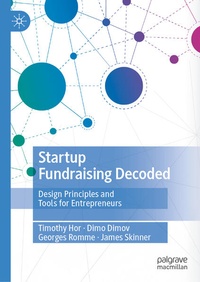
Startup Fundraising Decoded
Description

This book addresses the critical challenge of securing early-stage funding for startups, from pre-seed through Series A. The book is structured around three central design principles-Why, When, and How-guiding entrepreneurs through the complex landscape of startup fundraising. The methodology combines Design Science with real-world case studies, offering both theoretical and practical frameworks that are rigorously tested and refined. This approach will particularly interest readers seeking evidence-based strategies to increase the likelihood of fundraising success.
Special features in the book include a "Fundraising Canvas" to help entrepreneurs map out their fundraising strategy effectively, numerous case studies providing insights into real-life application of the book's frameworks, and innovative didactic approaches, including sections tailored for academic audiences in each chapter.
More details
Other editions
Additional editions
Persons
Dr. Timothy Hor is a battle-tested entrepreneur who secured funding for his X-Internet startup through post-dot-com challenges. He transformed his fundraising journey into rigorous and relevant academic research, developing RaiiSET-the framework underpinning this book. As Assistant Professor at RMIT University, he brings these real-world insights to researching and teaching innovation and entrepreneurship.
Professor Dimo serves as a Professor of Management at the University of Bath. Recognized as a top 2% global entrepreneurship researcher, he uniquely bridges venture capital theory with practice. His groundbreaking studies focus on VC firm performance and entrepreneurial journeys, providing the evidence-based foundation for this book. Furthermore, as the founder of the Journal of Business Venturing Insights, Professor Dimov actively champions research that directly empowers entrepreneurs.
Professor Georges Romme is a pioneering figure who established Design Science in entrepreneurship education and innovation at Eindhoven University of Technology. He specializes in the crucial work of translating complex organizational theory into actionable frameworks specifically designed for technology ventures. His extensive expertise in new venture creation and innovation design forms the practical, application-focused methodology that underpins this book.
Professor James Skinner serves as the Dean of Newcastle Business School, specializing in bridging innovation ecosystems and organizational change. His research on value creation across complex networks-informed by his experience advising high-profile organizations like the International Olympic Committee and Chelsea FC-lends the book its strategic approach to stakeholder engagement in fundraising.
Content
Chapter 1: Introduction - The Brutal Journey of Startup Fundraising.- Part I: Foundations of Startup Fundraising.- Chapter 2: Navigating the Startup Funding Cycle.- Chapter 3: Startup Fundraising with Clarity and Purpose.- Part II: Discern WHY - Strategic Clarity.- Chapter 4: Discerning Your Business Goals.- Chapter 5: Your Beliefs and Values.- Part III: Determine WHEN - Investment Readiness.- Chapter 6: Determining Your Investment Readiness.- Chapter 7: External Factors - When the Market says 'Yes'.- Part IV: Enact HOW - Process Savviness.- Chapter 8: Organizing Network Ties & Establishing Legitimacy.- Chapter 9: Engaging Potential Investors.- Chapter 10: Negotiating and Closing the Deal.- Part V: Applying RaiiSET Across Funding Stages.- Chapter 11: Zero to Pre-Seed - Foundation Building.- Chapter 12: Pre-Seed to Seed - Early-Stage Strategies.- Chapter 13: Seed to Series A - Scaling Up.
