

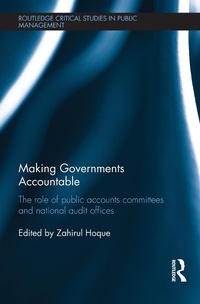
Making Governments Accountable
The Role of Public Accounts Committees and National Audit Offices
Published on 15. May 2015
342 pages
978-1-317-66697-4 (ISBN)
Description

Over the past two decades, there has been a paradigm shift in public administration and public sector accounting around the world, with increasing emphasis on good governance and accountability processes for government entities. This is all driven both by economic rationalism, and by changing expectations of what governments can and should do. An important aspect of this accountability and governance process is the establishment and effective functioning of a Public Accounts Committee (PAC), a key component of democratic accountability.
With contributions from renowned scholars and practitioners, and using case studies from around the world, this research-based collection examines the rationales for current roles of the PACs and explores the links between PACs and National Audit Offices. It also compares PAC practices from developing and developed countries such as Africa, Asia, Pacific islands, and Europe with both Westminster and non-Westminster models of government.
This will be valuable reading for academics, researchers, and advanced students in public management, public accounting and public sector governance.
With contributions from renowned scholars and practitioners, and using case studies from around the world, this research-based collection examines the rationales for current roles of the PACs and explores the links between PACs and National Audit Offices. It also compares PAC practices from developing and developed countries such as Africa, Asia, Pacific islands, and Europe with both Westminster and non-Westminster models of government.
This will be valuable reading for academics, researchers, and advanced students in public management, public accounting and public sector governance.
Reviews / Votes
'This book considering the role of Public Accounts Committees and national audit offices provides a timely and original contribution to the literature. Its significance lies in its focus on matters of governance and accountability at the government level, an area that has not been well studied in the accounting domain. This particular text significantly extends our understanding by providing consideration of these institutions in regions across the globe and in continents that are, despite their importance to the global economy, very much under-researched. To add to the richness of the material, practitioners as well as academics have contributed to the book. This should be a 'must read' for researchers, students and practitioners working in the area.' - Jane Broadbent, Professor, Royal Holloway, University of London, UK'This research monograph is an excellent analysis of the importance of public accounts committee and audit offices in making governments accountable in contemporary times. The selection of papers by leading international authors, provides a contemporary perspective that is geared to comprehend the current and future challenges and provides sign-posts for students, academics and public sector actors to strategically act on these challenges.' - James Guthrie, Professor, Macquarie University, Australia and University of Bologna, Italy
'This book gives a unique insight into the way in which public sector accounts committees and national audit offices contribute to accountability in the public sector. Its uniqueness particularly stems from the types of contributions, from both practitioners and academics, and covers practices in developed countries, such as the UK, Australia and Denmark as well as developing countries, like India, Bangladesh and Kenya.' - Jan van Helden, Emeritus Professor, University of Groningen, The Netherlands
'Democratic accountability for the authorisation and use of public monies is one of the bedrocks of our various systems of modern government. This book has produced an excellent collection of studies of these systems, covering some 14 countries/regions across the globe and even including Sweden which operates without a public accounts committee. Their expert analyses reveal the investigative roles of public accounts committees, how well they work with other accountability agents, their effectiveness and the benefits overall to good governance. With an informative introduction, this volume offers a definitive contribution which will be of interest to scholars of various disciplines, parliamentary practitioners, accountability actors, interest groups and the media, as well as the general reader interested in how modern-day accountabilities are exercised.' - John Wanna, Professor, Australian National University, Australia
More details
Series
Language
English
Place of publication
London
United Kingdom
Publishing group
Taylor & Francis Ltd
Target group
College/higher education
Illustrations
17 Tables, black and white; 8 Line drawings, black and white; 8 Illustrations, black and white
File size
3,30 MB
ISBN-13
978-1-317-66697-4 (9781317666974)
Copyright in bibliographic data and cover images is held by Nielsen Book Services Limited or by the publishers or by their respective licensors: all rights reserved.
Schweitzer Classification
Other editions
Additional editions
Zahirul Hoque
Making Governments Accountable
The Role of Public Accounts Committees and National Audit Offices
Book
12/2020
1st Edition
Routledge
€59.41
Shipment within 15-20 days
Zahirul Hoque
Making Governments Accountable
The Role of Public Accounts Committees and National Audit Offices
Book
05/2015
1st Edition
Routledge
€232.40
Shipment within 10-20 days
Person
Zahirul Hoque is Professor and Head of the Department of Accounting at La Trobe Business School, Australia and the founding Editor-in-Chief of Journal of Accounting & Organizational Change (Emerald).
Content
Foreword Preface Part I: Introduction and Context 1. Public Accountability: The role of the Auditor General in Legislative oversight 2. Partnering with the Auditor-General's Office to Improve the Effectiveness of a Public Accounts Committee: An Auditor-General's perspective 3. Government Accountability in Sri Lanka: The roles of parliamentary oversight committees and Auditor General's office 4. Parliamentarians' Relations with the Auditor General of Canada during Sheila Fraser's Mandate (2001-2011) 5. Danish Public Sector Performance Audit: An SAI and PAC Tango Part II: Public Accounts Committees in Europe 6. The Public Accounts Committee of the House of Commons 7. In the Absence of a Public Accounts Committee: The Swedish experience Part III: Public Accounts Committees in Australia and the Pacific 8. Pragmatism, Black Letter Law and Australian Public Accounts Committees 9. Making a Public Accounts Committee Effective: A Chair's perspective from the state of New South Wales, Australia 10. Public Accounts Committees in the Pacific - A PEFA Perspective Part IV: Public Accounts Committees in Asian Regions 11. The Development of Public Accounts Committees of Bangladesh's Parliament: An overview 12. The Role of the Public Accounts Committee in Enhancing Government Accountability in Malaysia 13. Responses to Public Accounts Committee of India: A textual analysis 14. Promoting Public Sector Accountability in Indonesia: An historical overview 15. The Public Accounts Committees in Thailand: A short note Part V: Public Accounts Committees in African Regions 16. Evolution and Effectiveness of the Kenyan Public Accounts Committee 17. Strengthening PACs in Small Parliaments: Perspectives from the Caribbean
