

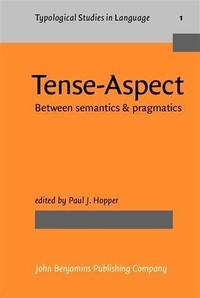
Tense-Aspect
Between semantics & pragmatics
1st Edition
Published on 1. January 1982
IX, 350 pages
978-90-272-8647-5 (ISBN)
Description

The verbal categories of tense and aspect have been studied traditionally from the point of view of their reference to the timing and time-perspective of the speaker's reported experience. They are universal categories both in terms of the semantic-functional domain they cover as well as in terms of their syntactic and morphological realization. Nevertheless, their treatment in contemporary linguistics is often restricted and narrow based, often involving mere recapitulatoin of traditional semantic and morphotactic studies.
The present volume arises out of a symposium held at UCLA in May 1979, in which a group of linguists gathered to re-open the subject of tense-and-aspect from a variety of perspectives, including - in addition to the traditional semantics - also discourse-pragmatics, psycholinguistics, child language, Creolization and diachronic change. The languages discussed in this volume include Russian, Turkish, English, Indonesian, Ameslan, Eskimo, various Creoles, Mandari, Hebrew, Bantu and others. The emphasis throughout is not only on the description of language-specific tense-aspect phenomenon, but more on the search for universal categories and principles which underlie the cross-language variety of tense and aspect. In particular, many of the participants address themselves to the relationship between propositional-semantics and discourse-pragmatics, in so far as these two functional domains interact within tense-aspect systems.
The present volume arises out of a symposium held at UCLA in May 1979, in which a group of linguists gathered to re-open the subject of tense-and-aspect from a variety of perspectives, including - in addition to the traditional semantics - also discourse-pragmatics, psycholinguistics, child language, Creolization and diachronic change. The languages discussed in this volume include Russian, Turkish, English, Indonesian, Ameslan, Eskimo, various Creoles, Mandari, Hebrew, Bantu and others. The emphasis throughout is not only on the description of language-specific tense-aspect phenomenon, but more on the search for universal categories and principles which underlie the cross-language variety of tense and aspect. In particular, many of the participants address themselves to the relationship between propositional-semantics and discourse-pragmatics, in so far as these two functional domains interact within tense-aspect systems.
More details
Other editions
Additional editions
Book
01/1982
John Benjamins Publishing Co
€137.80
Shipment within 10-15 days
Content
- TENSE-ASPECT: BETWEEN SEMANTICS & PRAGMATICS
- Editorial page
- Title page
- Copyright page
- PREFACE
- Table of contents
- I. TENSE AND ASPECT IN DISCOURSE
- ASPECT BETWEEN DISCOURSE AND GRAMMAR: AN INTRODUCTORY ESSAY FOR THE VOLUME
- REFERENCES
- THE DISCOURSE MOTIVATION FOR THE PERFECT ASPECT: THE MANDARIN PARTICLE LE
- FOOTNOTES
- REFERENCES
- THE FUNCTION OF INUKTITUT VERB MODES IN NARRATIVE TEXTS
- NOTES
- REFERENCES
- APPENDIX
- ASPECT IN CONVERSATIONAL INDONESIAN
- 1. Introduction
- 2. Definition of aspect
- 3. Aspectual Meaning of NG- and DI- Verb Prefixes in Conversation
- 4. The Function of Discourse-Conditioned Aspect in Conversation
- 5. Aspect in Contemporary Narrative and Drama
- 6. Summary
- NOTES
- APPENDIX
- REFERENCES
- II. THE CREATION OF TENSE AND ASPECT
- UNIVERSALS OF ASPECT AND PARTS OF SPEECH: PARALLELS BETWEEN SIGNED AND SPOKEN LANGUAGES
- 1. Reduplications: spoken analogs of signed repetition and two-hand-active signs
- 2. Non - redup licative aspects in A SL
- NOTES
- BIBLIOGRAPHY
- TENSE-ASPECT-MODALITY: THE CREOLE PROTOTYPE AND BEYOND
- 1. Introduction
- 2. The Creole tense-aspect-modal system
- 3. The prototype in situ
- 4. The Creole prototype and diachronic change
- 5. Conclusion
- NOTES
- REFERENCES
- III. TENSE AND ASPECT AS COGNITIVE CATEGORIES
- ASPECT, TRANSITIVITY AND VIEWPOINT
- NOTES
- REFERENCES
- TENSE, ASPECT, AND MODALITY IN THE USE OF THE TURKISH EVIDENTIAL
- ABSTRACT
- FOOTNOTES
- REFERENCES
- FIGUREAND GROUND: THE INTERRELATIONSHIPS OF LINGUISTIC CATEGORIES
- NOTES
- REFERENCES
- IV. TENSE AND ASPECT AS SEMANTIC AND GRAMMATICAL CATEGORIES
- THE "PERFECT" AS A UNIVERSAL AND AS A LANGUAGE-SPECIFIC CATEGORY
- NOTES
- BIBLIOGRAPHY
- REMARKS ON ENGLISH ASPECT
- Content Predicates
- The Auxiliary
- FOOTNOTES
- INVARIANCE AND THE SYNTAX OF RUSSIAN ASPECT
- NOTES
- REFERENCES
- V. AFTERWORD
- ON CROSS-LINGUISTIC CATEGORIES AND RELATED PROBLEMS A Discussant's Notes on the Tense/Aspect Symposium
- FOOTNOTES
- REFERENCES
- INDEX TO REFERENCES
