

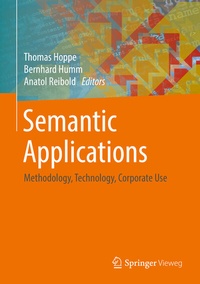
Semantic Applications
Description

This book describes methodologies for developing semantic applications. Semantic applications are software applications which explicitly or implicitly use the semantics, i.e. the meaning of a domain terminology, in order to improve usability, correctness, and completeness. An example is semantic search, where synonyms and related terms are used for enriching the results of a simple text-based search. Ontologies, thesauri or controlled vocabularies are the centerpiece of semantic applications.
The book includes technological and architectural best practices for corporate use. The authors are experts from industry and academia with experience in developing semantic applications.
More details
Other editions
Additional editions
Persons
Thomas Hoppe works as Data Scientist and Knowledge Engineer. He is lecturer at the Computer Science Department of the Hochschule für Technik und Wirtschaft Berlin - University of Applied Sciences, Germany. In 2008 he founded, together with three associates, Ontonym GmbH. Furthermore, in 2014 he founded Datenlabor Berlin.
Bernhard Humm is a professor at the Computer Science Department of Hochschule Darmstadt - University of Applied Sciences, Germany. He coordinates the Ph.D. programme and is the managing director of the institute of applied informatics, Darmstadt (aiDa). He is running several national and international research projects in co-operation with industry and research organizations.
Anatol Reibold studied mathematics and mechanical engineering at the University of Novosibirsk. Currently he works as a supply chain analyst and business mathematician at Raiffeisen Waren-Zentrale Rhein-Main eG. He is also one of the co-founders of OntoPort and their chief data scientist.
Content
Introduction.- Ontology Development.- Compliance using Metadata.- Variety Management for Big Data.- Text Mining in Economics.- Generation of Natural Language Texts.- Sentiment Analysis.- Building Concise Text Corpora from Web Contents.- Ontology-Based Modelling of Web Content.- Personalized Clinical Decision Support for Cancer Care.- Applications of Temporal Conceptual Semantic Systems.- Context-Aware Documentation in the Smart Factory.- Knowledge-Based Production Planning for Industry 4.0.- Information Exchange in Jurisdiction.- Supporting Automated License Clearing.- Managing cultural assets: Implementing typical cultural heritage archive's usage scenarios via Semantic Web technologies.- Semantic Applications for Process Management.- Domain-Specific Semantic Search Applications.
