

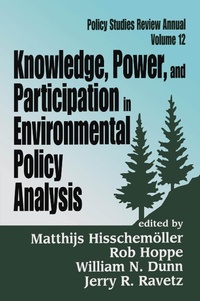
Knowledge, Power, and Participation in Environmental Policy Analysis
1st Edition
Published on 16. January 2018
500 pages
978-1-351-32571-4 (ISBN)
Description

This volume probes practical dilemmas and competing re- search perspectives in environmental policy analysis. Scholars working in different fields, research traditions, societies, and policy domains offer significant insights into the processes and consequences of environmental policy making.
Part 1, "Coping with Boundaries," describes present-day conflict between experts and greater public participation in environmental policy. It shows that the institutionalization of increasingly complex environmental problems has led to a conflict between technocracy and democracy. Part 2, "The Transnational Challenge," examines modes of cooperation between grassroots movements, scientists, and regional authorities in the United States and Canada. These and other modes of cooperation laid the foundations for the Great Lakes Water Quality Agreement, increased the effectiveness of air pollution treaties, and increased climate change. Part 3, "Bio-Hazards: Policies and Paralysis," deals with environmental prob-lems closest to the everyday concerns of the public at large because they have immediate implications for food safety and other values. Part 4, "The Citizens' Perspective," focuses on citizen vis-a-vis environmental policy, noting that in order to make policies work citizens must be willing and able to participate in policy-making and cooperate in implementing environmental choices. Part 5, "Confronting Ordinary and Expert Knowledge," explores opportunities and constraints affecting public participation in evaluation of science. Part 6, "Developments in Research Programming," addresses such questions as whether scientists still have opportunities to do the research they want without being interrupted or disturbed by policy makers and other stakeholders. Part 7, "Policy Sciences' Aspirations," explores different avenues for improving environmental policy.
Volume twelve in the PSRA series should inspire further investigations of the relations among knowledge, power, and participation in environmental policy. It will be of timely interest to environmentalists, policy-makers, scholars, and the general public.
Part 1, "Coping with Boundaries," describes present-day conflict between experts and greater public participation in environmental policy. It shows that the institutionalization of increasingly complex environmental problems has led to a conflict between technocracy and democracy. Part 2, "The Transnational Challenge," examines modes of cooperation between grassroots movements, scientists, and regional authorities in the United States and Canada. These and other modes of cooperation laid the foundations for the Great Lakes Water Quality Agreement, increased the effectiveness of air pollution treaties, and increased climate change. Part 3, "Bio-Hazards: Policies and Paralysis," deals with environmental prob-lems closest to the everyday concerns of the public at large because they have immediate implications for food safety and other values. Part 4, "The Citizens' Perspective," focuses on citizen vis-a-vis environmental policy, noting that in order to make policies work citizens must be willing and able to participate in policy-making and cooperate in implementing environmental choices. Part 5, "Confronting Ordinary and Expert Knowledge," explores opportunities and constraints affecting public participation in evaluation of science. Part 6, "Developments in Research Programming," addresses such questions as whether scientists still have opportunities to do the research they want without being interrupted or disturbed by policy makers and other stakeholders. Part 7, "Policy Sciences' Aspirations," explores different avenues for improving environmental policy.
Volume twelve in the PSRA series should inspire further investigations of the relations among knowledge, power, and participation in environmental policy. It will be of timely interest to environmentalists, policy-makers, scholars, and the general public.
More details
Series
Edition
1. Auflage
Language
English
Place of publication
London
United Kingdom
Publishing group
Taylor & Francis Ltd
Target group
College/higher education
File size
33,82 MB
ISBN-13
978-1-351-32571-4 (9781351325714)
Copyright in bibliographic data and cover images is held by Nielsen Book Services Limited or by the publishers or by their respective licensors: all rights reserved.
Schweitzer Classification
Other editions
Additional editions
Rob Hoppe
Knowledge, Power, and Participation in Environmental Policy Analysis
Polcy Stades Review Annual
Book
02/2018
1st Edition
Routledge
€89.43
Shipment within 10-20 days
Rob Hoppe
Knowledge, Power, and Participation in Environmental Policy Analysis
Polcy Stades Review Annual
Book
07/2001
1st Edition
Transaction Publishers
€215.77
Article not available at the moment
Content
1: Knowledge, Power, and Participation in Environmental Policy Analysis: An Introduction; 1: Coping with Boundaries; 2: Beyond Technocratic Environmentalism: Citizen Inquiry in Sustainable Development; 3: Coping with Intractable Controversies: The Case for Problem Structuring in Policy Design and Analysis 1; 4: Democratic Expertise: Integrating Knowledge, Power, and Participation; 5: Toward a "Best Practice" of Constructing "Serviceable Truths"; II: The Transnational Challenge; 6: The Great Lakes Water Quality Agreement: Its Past Successes and Uncertain Future; 7: Effectiveness of Air Pollution Treaties: The Role of Knowledge, Power, and Participation; 8: From Arrhenius to the Kyoto Protocol: Climate Change and the Interplay between Science and Policy; III: Bio-Hazards: Policies and Paralysis; 9: Frame-Reflective Policy Analysis in Practice: Co-Evolution of a Policy Regime and an Intractable Controversy in Biotechnology; 10: The Genetically Modified Maize Debacle: A Case Study of Policymakers' Failure to Deal with Scientific Uncertainty Even After BSE; 11: Civilization and Madness: The Great BSE Scare of 1996 1; IV: The Citizens' Perspective; 12: Description and Explanation of the Greening of the World: A Methodological and Theoretical Challenge for Survey Methodology (As Illustrated by Research in Brazil and Mexico); 13: Public Perceptions of Environmental Risks and Willingness to Act; V: Confronting Ordinary and Expert Knowledge; 14: Integrated Assessment Modeling and the Participatory Challenge: The Case of Climate Change; 15: Participation and Expert Knowledge: A Case Study Analysis of Scientific Models and Their Publics; VI: Developments in Research Programming; 16: Steering Research Toward Policy: The Case of Social Science and Environmental Change; 17: Aggregation Machines-A Political Science of Science Approach to the Future of the Peer Review System; VII: Policy Sciences'Aspirations; 18: Using the Method of Context Validation to Mitigate Type III Errors in Environmental Policy Analysis; 19: Knowledge Use and Political Choice in Dutch Environmental Policy: A Problem Structuring Perspective on Real Life Experiments in Extended Peer Review; 20: Models of Risks: An Exploration
