

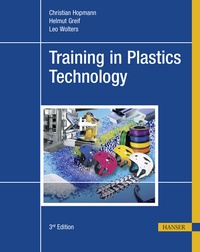
Training in Plastics Technology
3rd Edition
Published on 8. December 2023
288 pages
978-1-56990-935-5 (ISBN)
Description

This text- and workbook provides a clearly written, comprehensive introduction to the major topics associated with plastics technology, from basic chemistry and processing methods to the problem of waste and the issue of recycling plastics.
Guiding questions at the beginning of each lesson help the reader to work through the material in a targeted manner; success checks at the end of each lesson enable the reader to review what he/she has learned. It thus facilitates independent, self-paced learning, meeting the requirements of modern vocational training.
Reviews / Votes
"This text- and workbook introduces the world of plastics technology. The key topics, from basic chemistry and processing methods to the problem of waste and the issue of recycling plastics, are explained in an easy-to-understand manner. The book is divided into educational units (lessons), with each covering a distinct subject area. Students can arrange these units flexibly to fit their individual educational objectives. [...] The book has been comprehensively revised in the present 3rd edition in terms of technical and didactic aspects and has been supplemented by additional chapters." Technical Gazette, 31, 6(2024)More details
Other editions
Additional editions
Christian Hopmann | Helmut Greif | Leo Wolters
Training in Plastics Technology
Book
12/2023
3rd Edition
Hanser Publications
€99.99
Available immediately
Persons
Author
Prof. Christian Hopmann is, since 2011, Director of the Institute of Plastics Processing (IKV) in Industry and Craft at RWTH Aachen University, Germany. He studied Mechanical Engineering with a particular focus on Plastics Processing at RWTH Aachen and received his doctoral degree, supervised by Prof. Walter Michaeli, in 2000. In 2005, he started his industrial career at RKW AG Rheinische Kunststoffwerke (today: RKW SE). From January 2010 until April 2011 he was Managing Director of RKW Sweden AB in Helsingborg, Sweden.
ISNI:
ISNI:
Dr. Helmut Greif is former Managing Director of AGIT mbH (Aachener Gesellschaft für Innovation und Technologietransfer; Aachen Association for Innovation and Technology Transfer).
ISNI:
ISNI:
Leo Wolters is the former head of the training and further education department of the Institute for Plastics Processing (IKV) in Aachen, which has been the leading center for plastics processing in Germany for more than 60 years.
Content
- Intro
- Preface to the Third Edition
- Editor's Preface to the Second Edition
- The Authors
- Translation
- Notes How to Use this Book
- Notes Abbreviations and Symbols
- Introduction Plastic - An Artificial Material?
- Contents
- Lesson 1 Plastics Fundamentals
- 1.1 What are "Plastics"?
- 1.2 What are Plastics Made of?
- 1.3 How to Classify Plastics?
- 1.4 How are Plastics Identified?
- 1.5 What are the Physical Properties of Plastics?
- 1.6 Performance Review - Lesson 1
- Lesson 2 Raw Materials and Polymer Synthesis
- 2.1 Raw Materials for Plastics
- 2.2 Monomers and Polymers
- 2.3 Polyethylene Synthesis
- 2.4 Methods of Polymer Synthesis
- 2.5 Performance Review - Lesson 2
- Lesson 3 Classification of Plastics
- 3.1 Bonding Forces in Polymers and Their Temperature Behavior
- 3.2 Identification of Categories of Plastics
- 3.3 Thermoplastics
- 3.4 Cross-Linked Plastics (Elastomers and Thermosets)
- 3.5 Fabrication and Processing Methods
- 3.6 Methods for Shaping Thermoplastics
- 3.7 Performance Review - Lesson 3
- Lesson 4 Deformation Behavior of Plastics
- 4.1 Behavior of Thermoplastics
- 4.2 Amorphous Thermoplastics
- 4.3 Semicrystalline Thermoplastics
- 4.4 Behavior of Cross-Linked Plastics
- 4.5 Performance Review - Lesson 4
- Lesson 5 Time-Dependent Behavior of Plastics
- 5.1 Behavior of Plastics Under Load
- 5.2 Effect of Time on Mechanical Behavior
- 5.3 Recovery Behavior of Plastics
- 5.4 Dependence of Plastics on Temperature and Time
- 5.5 Performance Review - Lesson 5
- Lesson 6 Physical Properties
- 6.1 Density
- 6.2 Thermal Conductivity
- 6.3 Electrical Conductivity
- 6.4 Transparency
- 6.5 Material Characteristics of Plastics
- 6.6 Performance Review - Lesson 6
- Lesson 7 Fundamentals of Rheology
- 7.1 Fundamentals
- 7.2 Flow and Viscosity Curves
- 7.3 Flow Behavior of Plastic Melts
- 7.4 Melt Flow Index (MFI)
- 7.5 Performance Review - Lesson 7
- Lesson 8 Plastic Applications
- 8.1 Fundamentals
- 8.2 Requirements Criteria - Material Selection - Manufacturing Processes
- 8.3 Examples of Plastic Applications
- 8.4 Performance Review - Lesson 8
- Lesson 9 Plastics Compounding
- 9.1 Fundamentals
- 9.2 Metering
- 9.3 Mixing
- 9.4 Plasticizing
- 9.5 Pelletizing
- 9.6 Crushing
- 9.7 Performance Review - Lesson 9
- Lesson 10 Extrusion
- 10.1 Fundamentals
- 10.2 Extrusion Lines
- 10.3 Coextrusion
- 10.4 Extrusion Blow Molding
- 10.5 Blown Film Process
- 10.6 Performance Review - Lesson 10
- Lesson 11 Injection Molding
- 11.1 Fundamentals
- 11.2 Injection Molding Machine
- 11.3 The Injection Mold
- 11.4 Process Flow
- 11.5 Other Injection Molding Processes
- 11.6 Examples and Products
- 11.7 Performance Review - Lesson 11
- Lesson 12 Fiber-Reinforced Composites (FRC)
- 12.1 Fundamentals
- 12.2 Materials
- 12.3 Process Flow
- 12.4 Hand Lay-Up
- 12.5 Automated Processing Methods
- 12.6 Performance Review - Lesson 12
- Lesson 13 Plastic Foams
- 13.1 Fundamentals
- 13.2 Properties of Foams
- 13.3 Foam Production
- 13.4 Examples and Products
- 13.5 Performance Review - Lesson 13
- Lesson 14 Thermoforming
- 14.1 Fundamentals
- 14.2 Process Steps
- 14.3 Technical Installations
- 14.4 Examples and Products
- 14.5 Performance Review - Lesson 14
- Lesson 15 Additive Manufacturing
- 15.1 Fundamentals
- 15.2 Plastics for Additive Manufacturing
- 15.3 Operating Steps and Process Parameters
- 15.4 Examples and Products
- 15.5 Performance Review - Lesson 15
- Lesson 16 Plastic Welding
- 16.1 Fundamentals
- 16.2 Process Steps
- 16.3 Welding Processes
- 16.4 Examples and Products
- 16.5 Performance Review - Lesson 16
- Lesson 17 Machining Plastics
- 17.1 Fundamentals
- 17.2 Cutting Processes
- 17.3 Performance Review - Lesson 17
- Lesson 18 Bonding of Plastics
- 18.1 Fundamentals
- 18.2 Bondability and Adhesive Joints
- 18.3 Classification of Adhesives
- 18.4 Bonding Process
- 18.5 Examples and Products
- 18.6 Performance Review - Lesson 18
- Lesson 19 Plastic Waste
- 19.1 Fundamentals
- 19.2 Plastics Production and Its Applications
- 19.3 Plastic Products and Lifetime
- 19.4 Avoiding and Recycling Plastic Waste
- 19.5 Circular Economy in Plastics Business
- 19.6 Performance Review - Lesson 19
- Lesson 20 Plastics Recycling
- 20.1 Fundamentals
- 20.2 Mechanical Recycling
- 20.3 Chemical Recycling
- 20.4 Thermal Recovery
- 20.5 Recycling of Plastic Waste
- 20.6 Examples and Products
- 20.7 Performance Review - Lesson 20
- Lesson 21 Qualification in Plastics Processing
- 21.1 Fundamentals
- 21.2 Plastics Training in Industry
- 21.3 Plastics Training in the Skilled Trades/Crafts Sector
- Appendix Selected Literature
- Appendix Glossary of Plastics Technology
- Appendix Answers
Preface
The Authors
Translation
Notes How to Use this Book
Notes Abbreviations and Symbols
Introduction Plastic - An Artificial Material?
Lesson 1 Plastics Fundamentals
Lesson 2 Raw Materials and Polymer Synthesis
Lesson 3 Classification of Plastics
Lesson 4 Deformation Behavior of Plastics
Lesson 5 Time-Dependent Behavior of Plastics
Lesson 6 Physical Properties
Lesson 7 Fundamentals of Rheology
Lesson 8 Plastic Applications
Lesson 9 Plastics Compounding
Lesson 10 Extrusion
Lesson 11 Injection Molding
Lesson 12 Fiber-Reinforced Composites (FRC)
Lesson 13 Plastic Foams
Lesson 14 Thermoforming
Lesson 15 Additive Manufacturing
Lesson 16 Plastic Welding
Lesson 17 Machining Plastics
Lesson 18 Bonding of Plastics
Lesson 19 Plastic Waste
Lesson 20 Plastics Recycling
Lesson 21 Qualification in Plastics Processing
Appendix Selected Literature
Appendix Glossary of Plastics Technology
Appendix Answers
