

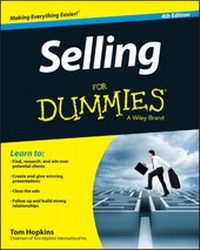
Selling For Dummies
Description

More details
Other editions
Additional editions
Person
Content
Introduction
Welcome to Selling For Dummies, 4th Edition. Although this book is about selling products and services to businesses and consumers, it goes beyond that knowledge. This book is really about people skills. After all, knowing how to get along well with others is a vital skill - especially if your career involves persuading them toward ownership of your ideas, concepts, products, or services.
If all you want to do is discover how the masters of sales accomplish what they accomplish, you would be able to do that just by reading this book. But if you want to achieve that master's status in sales for yourself, then you have to do more than a one-time read-through. Think of this book as a reference tool - it's designed to help you discover the basic techniques of sales and establish a strong foundation of good habits on which to build a great career. So don't save a space for this book on the top shelf of your bookcase with all the other dust collectors. Keep it within easy reach so when you need to refer back to one of its pearls of wisdom for encouragement, you won't have far to go.
To be successful in sales, you must be flexible, have good listening skills, and be willing to put others' needs before your own. With the selling skills covered here in your arsenal, you'll have more happiness and satisfaction in all areas of your life, not just in your selling career (although your career will certainly benefit, too).
About This Book
Selling For Dummies, 4th Edition, can help you get more happiness and contentment out of your life right now by helping you gain more respect, earn more money and more recognition for the job you do. It can help you get more agreement from your friends and family, have more control in negotiations, and of course, garner more sales. Above all, this book is a reference tool, so you don't have to read it from beginning to end. Instead, you can turn to any part of the book that gives you the information you need when you need it. And you can keep coming back to the book over and over throughout your selling days.
As the original dummy in sales, I'm the perfect person to write this book. I started my selling career in real estate at age 19. Real estate may have been a great career choice, but at the time I owned neither a suit nor a car. All I had was a band uniform and a motorcycle. And believe me, selling real estate on a motorcycle wasn't easy; rather than loading up the prospective buyers in my car, I had to ask them to follow me to the properties and hope they didn't get lost along the way. When they finally came to their senses and realized that this kid couldn't possibly be for real, they'd keep going straight when I'd make a turn. (To make things even worse, wearing a woolen band uniform in Southern California's summer heat didn't allow me to present the coolest image, either.)
But I stuck it out because I knew there was big money to be made in the selling business - if I could just find out what the successful people were doing that I wasn't. I learned it all the hard way, through trial and error. Early in my career, a professional, experienced salesperson told me I had to learn how to close, meaning "to close the sale." I responded, "I don't have many clothes." See why I only averaged $42 a month in my first six months of selling real estate?
Needless to say, I've come a long way since then, and it thrills me to give you the chance to benefit from the mistakes I made, as well as from the subsequent success I've had. Yes, I've had successes. I achieved my goal of becoming a millionaire by the age of 30, beating my own deadline by nearly three years! At age 27, I was one of the most successful real estate agents in the whole country - a guy who started without a decent suit or a vehicle with four wheels! Just goes to show you that it doesn't matter how much of a dummy you are on this subject when you start. With this book by your side, serving as a reference for all the selling situations you encounter, you'll master the selling, persuasion, and people skills you need to really shine.
Foolish Assumptions
When writing this book, I assumed that its readers would either already be in sales careers or considering going into sales. It doesn't matter whether you're selling corporate jets or cookies, the basic selling strategies apply simply because you're selling to people.
I also assumed that you like people in general and that you enjoy working with them. You're not a hermit or a recluse, you don't have an extreme case of anthropophobia (a fear of people), and you aren't painfully shy.
Another assumption is that you're interested in learning and willing to experiment and apply the strategies in this book. If you're not serious about at least trying something new to get different results than you're getting now, you might as well give this book to someone else. This book contains answers, strategies, and tactics for successfully selling products and services, but they won't work until you put them to work.
Conventions Used in This Book
To help you navigate this book, I include the following conventions:
- Boldface highlights key words in bulleted lists and action steps that you should follow in a specific order.
- Defined terms and words I choose to emphasize are in italics.
- Web addresses appear in monofont.
When this book was printed, some of the Web addresses I reference may have needed to break across two lines of text. If that happened, rest assured that there are no extra characters (such as hyphens) to indicate the break. So, when using one of these Web addresses, just type in exactly what you see in this book, pretending as though the line break doesn't exist.
I also use some terms interchangeably in this book. For example, the people you look for to present your offering to may be called prospects or buyers in one area. In other areas, I refer to them as potential clients, which I believe creates a more positive, powerful mental image about who they are.
Icons Used in This Book
Icons are those little pictures in the margins throughout this book, and they're meant to draw your attention to key points that are of help to you along the way. Here's a list of the icons I use and what they signify.
When you see this icon, you can bet that stories from my years of experience in selling and from my students' experiences are nearby. And, oh, what stories I have to share. . . .
This icon highlights phrases to say to go beyond the basics and become a true champion at selling. This icon highlights sample exchanges between you and your prospective client so you can see exactly how a conversation can develop if you know just what to say.
I once had a college professor who told us that he didn't care whether we were awake or slept in his class as long as we learned the things he highlighted with red flags - because those were the areas we'd be tested on. So instead of being the typical warning that red flags usually indicate, this icon highlights the crucial pieces of information and skills you need for selling anything. When you see this flag in the margin, take notice. Great selling tips are at hand.
Some things are so important that they bear repeating. So this icon - like a string tied around your finger - is a friendly reminder of information you'll want to commit to memory and use over the long haul.
When you see this icon in the margin, the paragraph next to it contains valuable information on making the sales process easier or faster - anything from prospecting to closing and beyond.
This icon highlights things you want to avoid and common mistakes salespeople make. An important part of achieving success is simply eliminating the mistakes. And the information marked by this icon helps you do just that.
Beyond the Book
In addition to the material in the book you're reading right now, this product also comes with additional access-anywhere content on the web. You'll find more information on the free Cheat Sheet at www.dummies.com/cheatsheet/Selling. I include links to relevant articles on the parts pages of this book as well, which you should also check out at www.dummies.com/extras/Selling.
Where to Go from Here
Glance through the Table of Contents and find the part, chapter, or section that resonates with where you currently are in your selling career. That's the best place to begin.
To benefit the most from the material in this book, do a little self-analysis to see where you're the weakest. I know admitting your faults is tough, even to yourself. But reading the material that covers your weaker areas is likely to bring you the greatest amount of success.
Studies by my company, Tom Hopkins International, show that most traditional salespeople lack qualification skills. They waste a lot of time presenting to people who can't make decisions on what they're selling. If you're in traditional sales and you aren't sure whether qualification is your weakness, Chapter 9 is a great place to start.
The most successful people in life...
