

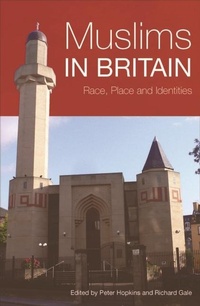
Muslims in Britain
Description

Following the events of 11th September 2001 in the USA, and more especially, the bombings on the London underground on 7th July 2005 and the incident at Glasgow Airport on 30th June 2007, an increasing amount of public attention has been focused upon Muslims in Britain. Against the backdrop of this debate, this book sets out a series of innovative insights into the everyday lives of Muslims living in contemporary Britain, in an attempt to move beyond prevalent stereotypes concerning what it means to be ''Muslim''.
Combining original empirical research with theoretical interventions, this collection offers a range of reflections on how Muslims in Britain negotiate their everyday lives, manage experiences of racism and exclusion, and develop local networks and global connections. The authors explore a broad range of themes including gender relations; educational and economic issues; migration and mobility; religion and politics; racism and Islamophobia; and the construction and contestation of Muslim identities. Threaded through the treatment of these themes is a unifying concern with the ways in which geography matters to how Muslims negotiate their daily experiences as well as their racialised, gendered and religious identities. Above all, attention is focused upon the role of the home and local community, the influence of the economy and the nation, and the power of transnational connections and mobilities in the everyday lives of Muslims in Britain.
Includes contributions from: Louise Archer, Yahya Birt, Sophie Bowlby, Claire Dwyer, Richard Gale, Peter Hopkins, Lily Kong, Sally Lloyd-Evans, Sean McLoughlin, Sharmina Mawani, Tariq Modood, Anjoom Mukadam, Caroline Nagel, Deborah Phillips, Bindi Shah, and Lynn Staeheli
Key Features
- Draws on theoretically-informed empirical research
- Brings together work with a focus on gender studies with research on landscapes, communities and networks
- Explores issues including gender relations, political activism, local communities, migration and the labour market
- Chapters are united by an overarching concern with the ways in which geography matters to how Muslims negotiate their daily experiences as well as their racialised, gendered and religious identities
More details
Other editions
Additional editions

Content
- Cover
- Copyright
- Contents
- Acknowledgements
- Contributors
- Tables
- Figures
- Chapter 1 Introduction: Muslims in Britain - race, place and the spatiality of identities
- SECTION 1 Gender, place and culture
- Chapter 2 Creating home spaces: young British Muslim women's identity and conceptualisations of home
- Chapter 3 'You seem very westernised to me':place, identity and othering of Muslim workers in the UK labour market
- Chapter 4 Rethinking the identities of young British Pakistani Muslim women: educational experiences and aspirations
- Chapter 5 Race, 'face' and masculinity: the identities and local geographies of Muslim boys
- SECTION 2 Landscapes, communities and networks
- Chapter 6 British Arab perspectives on religion, politics and 'the public'
- Chapter 7 The Multicultural city and the politics of religious architecture: urban planning, mosques and meaning-making in Britain
- Chapter 8 Holy places, contested spaces: British Pakistani accounts of pilgrimage to Makkah and Madinah
- Chapter 9 Excess baggage or precious gems? The migration of cultural commodities
- Chapter 10 Situating Muslim geographies
- Chapter 11 Muslims and the politics of difference
- Chapter 12 Islamophobia in the construction of British Muslim identity politics
- Afterword
- INDEX
