

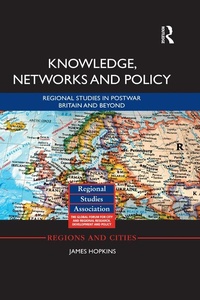
Knowledge, Networks and Policy
Regional Studies in Postwar Britain and Beyond
Published on 8. May 2015
310 pages
978-1-317-70210-8 (ISBN)
Description

'The region' has been used to understand and propose solutions to phenomena and problems outside the dominant spatial scale of the twentieth century - the nation state. Its influence can be seen in multiple social science disciplines and in public policy across the globe. But how was this knowledge organised and how were its concepts transmuted into public policy? This book charts the development of the academic field of Regional Studies and the application of its concepts in public policy through its learned society, the Regional Studies Association.
In their modern form, learned societies often play a complementary role to universities, offering networks that operate in the spaces between and beyond universities, connecting specialised academics and knowledge and making it possible for them to have impact outside the academy. In contrast to the geographically tangible and popularly understood role of the university, contemporary learned societies are nebulous networks that transcend barriers and whose contribution is difficult to discern. However, the production and dissemination of knowledge would be stunted were it not for the learned society connecting scholars through a network of publications and events.
This book traces the intellectual history of regional studies and regional science from the 1960s into the 2000s and the impact of the regional concept in public policy through the changing priorities of government in the UK and Europe. By approaching the history through the Regional Studies Association, it interrogates the role and function of the 'learned society' model of organisation in contemporary academia and importance as a knowledge exchange vehicle for public policy influence.
In their modern form, learned societies often play a complementary role to universities, offering networks that operate in the spaces between and beyond universities, connecting specialised academics and knowledge and making it possible for them to have impact outside the academy. In contrast to the geographically tangible and popularly understood role of the university, contemporary learned societies are nebulous networks that transcend barriers and whose contribution is difficult to discern. However, the production and dissemination of knowledge would be stunted were it not for the learned society connecting scholars through a network of publications and events.
This book traces the intellectual history of regional studies and regional science from the 1960s into the 2000s and the impact of the regional concept in public policy through the changing priorities of government in the UK and Europe. By approaching the history through the Regional Studies Association, it interrogates the role and function of the 'learned society' model of organisation in contemporary academia and importance as a knowledge exchange vehicle for public policy influence.
Reviews / Votes
'This book provides a definite story of an international learned society, the Regional Studies Association, capturing in a rich and critically engaging way the interface between the study of regions and the evolution of that knowledge's impact on regional development policy.' - Gordon Dabinett, Professor for Regional Studies, University of Sheffield, UKMore details
Series
Language
English
Place of publication
London
United Kingdom
Publishing group
Taylor & Francis Ltd
Target group
College/higher education
Illustrations
40 Tables, black and white; 22 Line drawings, black and white; 5 Halftones, black and white; 27 Illustrations, black and white
File size
2,36 MB
ISBN-13
978-1-317-70210-8 (9781317702108)
Copyright in bibliographic data and cover images is held by Nielsen Book Services Limited or by the publishers or by their respective licensors: all rights reserved.
Schweitzer Classification
Other editions
Additional editions
Book
07/2018
1st Edition
Routledge
€72.30
Shipment within 10-20 days
Book
01/2015
1st Edition
Routledge
€251.50
Shipment within 15-20 days
Person
James A. Hopkins is University Historian at the University of Manchester, UK.
Content
1.Introduction 2. In search of the Learned society 3. Britain and the 'regional problem' in the 1960s 4. Establishing the Association, 1965-1979 5. Fundamental change: Neo-liberalism and European expansion, 1980-1996 6. Forty years and more: a member-services association, 1997-2010 7. Forty years and more: a member-services association, 1997-2010 Appendix 1. Membership of the RSA 1966-2005 Appendix 2. Regional Studies Association Conferences, 1965-2005 Appendix 3. List of RSA branches and branch activity Appendix 4. Editors of Regional Studies and Newsletter, and Chairs and Vice-Chairs of the RSA Appendix 5. RSA Income, Expenditure and Assets, 1965-2005 Appendix 6. Revenue from Journal, Conferences and Membership Appendix 7. Geographical and Disciplinary origins of authors in Regional Studies 1967-2005 Appendix 8. Papers published per year in Regional Studies, 1967-2005 Appendix 9. Topic coverage in Regional Studies, 1967-2005 Appendix 10. RSA Study and Working Groups
