

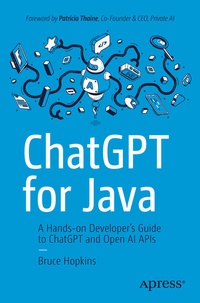
ChatGPT for Java
Description

Embrace the future of software development! ChatGPT for Java is the perfect starting point for Java developers to learn how to build intelligent applications using ChatGPT and Open AI APIs.
This book takes you from the ground up to demonstrate how to use ChatGPT programmatically. You will learn the basics of ChatGPT and OpenAI APIs, including how to authenticate, send prompts, generate responses, test in the Playground, and handle errors. Each chapter includes practical exercises which demonstrate different API functionalities and bring your concepts to life. You will learn how to AI-enable your own applications using models such as GPT-4, GPT-3.5, Whisper, DALL-E, and many more.
As a result, developers will understand that generative AI tools will not replace software development jobs! Instead, you will leverage ChatGPT as your Java AI-pair programmer to increase speed and productivity. You will also learn how ChatGPT can provide powerful Natural Language Processing (NLP) capabilities to your Java apps in order to understand various formats of unstructured text. Step-by-step, you will apply the concepts covered to create your own intelligent chatbots that can automatically process messages from either Slack on Discord.
With this book, Java developers will be empowered to take their applications to new heights by leveraging the power of AI as this exciting field continues to evolve and transform.
What You Will Learn
- Authenticate with the ChatGPT and OpenAI APIs and learn how to engineer and send prompts
- Test your prompts in the ChatGPT Playground
- How to use multiple artificial intelligence models
- Harness the power the temperature, top_p, and other parameters that can ONLY be accessed by developers to create more unique and engaging responses from ChatGPT
- Create intelligent bots for Slack or Discord servers
- Incorporate context into prompts for betterresponses and apply advanced features of the APIs.
- Explore future directions for ChatGPT and OpenAI
Who This Book Is For
Beginning and intermediate Java developers who have a basic understanding of Java programming concepts and are interested in learning how to add intelligence to their applications by using ChatGPT programmatically. No prior experience with ChatGPT or OpenAI APIs is required.
More details
Other editions
Additional editions
Person
Bruce Hopkins is a technical writer and world-renown expert. He is both an Oracle Java Champion as well as an Intel Software Innovator. Bruce is also the author of the Apress book, Bluetooth for Java.
Content
Chapter 1: Introducing ChatGPT for Java Developers.- Chapter 2: Using ChatGPT as Your Java Pair-Programmer.- Chapter 3: Using AI in the Enterprise!:Creating a Text Summarizer for Slack Messages.- Chapter 4: Multimodal AI: Creating a Podcast Visualizer with Whisper and DALL·E 3.- Chapter 5: Creating an Automated Community Manager Bot with Discord and Java.- Chapter 6: Enhancing Our Bot for Both Q&A and Content Moderation.
