

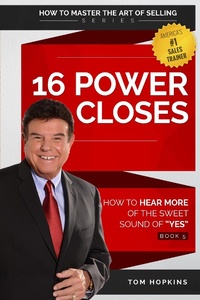
16 Power Closes
Description

ATTENTION SALES REPS: What's that beautiful sound you hear? Is it the babbling of a clear, cold brook? Is it the laughter of an innocent child? Is it the tender refrain of a meadowlark? No!
It's the sweet sound of "YES" - the sweetest sound in Sales!
Learn how to smoothly create an abundance of closing opportunities and get more Yesses than ever before. The hallmark of every master closer is knowing several ways to close deals. Now you can know just when to act, when to hold back, and exactly when to close. Learning this one simple approach means you'll be able to close more sales in less time - with happier customers every time!
But where do you start?
No one knows the answer to that question better than the legendary Tom Hopkins, who earned more than one million dollars in commissions during the first three years of his Sales career. Over the course of the past 25+ years, he's been teaching others to do the same.
16 Power Closes: How to Hear More of the Sweet Sound of "YES" will show you in crystal-clear detail the exact steps you need to take in every sale. You'll learn not just How but Why, plus how to close with integrity and pride. Discover 16 ways to take any prospect through each step methodically, and get to that sweetest of sounds, the word "YES".
In this timely book, Tom reveals all there is to know about:
- Getting over the Objection Connection
- What to do before closing for more sweet success
- 16 Power Closes for Sales champions - and those who want to be!
Now you can turn any objection into a closing opportunity. Use the winning tactics in this book, and never again fear hearing the word "No" from your prospects. You'll know for all time how to hear more of that sweet sound of "YES".
All prices
More details
Person
Tom Hopkins is world-renowned as The Builder of Sales Champions. His selling skills and sales strategies have helped millions of sales professionals and business owners in industries from A to Z to serve more clients, make more sales and earn millions in income.
Tom got his start in real estate sales when he was just 19 years of age. After an initial period of abject failure, he started learning the communication skills that made him the #1 real estate agent in the US within 7 years.
Since 1976 he has been teaching others his simple, yet powerful strategies and tactics through live events, books, CDs and video. Millions have turned their cars into classrooms, listening to Tom's advice on the way to appointments with potential new clients.
Tom has authored 18 books including: How to Master the Art of Selling, Selling for Dummies and his latest release, When Buyers Say No (April 2014).
Content
CHAPTER 1
Most new or average salespeople have a dream. In the dream, they meet smiling, happy people. They build rapport, qualify, and give a dynamic presentation. At the end of the presentation, the smiling folks can't wait to own the product. They claps their hands. They whip out their checkbooks or credit cards, sign on the dotted line, and shake hands profusely with the salesperson for showing them the greatest thing since sliced bread. Yep, that's a dream all right.
Let me give you a short lesson that will take you far in sales. If the people you're talking with don't object to anything during your time together, they're either not listening or not qualified. In other words, they won't buy!
Objections (concerns) are nothing more than ways for your potential client to slow things down-to keep themselves from making rash decisions-from feeling as if they're being "sold." Objections are a common aspect of every sale you'll attempt to make. Accept this fact and you'll open your mind to the ways to handle, address, and overcome objections that I'll cover in this chapter.
Until you learn how to handle objections, you're not going to approach your potential in sales. Champions have an affection for even the peskiest objection because it's something concrete. They know they've reached the Klondike and are digging for gold when they start hearing objections.
Make the Handling of Objections an Integral and Expected Part of Your Selling Sequence
I hope that you'll highlight this achievement-oriented statement:
Objections are the rungs of the ladder to sales success.
When you climb to the top of that ladder, they own what you're selling. There just isn't any other way to where you want to climb except by grasping and overcoming the most common concerns. If you decide to overcome objections by learning the material in this book, you'll learn to love objections as much as I do-because they announce buying intention and point the way to closing the sale.
What Is an Objection?
Objections are statements by potential clients that they want to know more. Of course, objections don't usually come out sounding like a polite request for additional information. People aren't trying to make it quite that easy for you. They usually are sincerely objecting-they don't realize they're just asking for more information. It's your job to know that, and to know what to do about it.
There are two kinds of objections, minor and major. Please keep this in mind at all times:
Minor objections are defense mechanisms.
People use them to slow things down. They don't mean that they don't want to buy; they just want to mull things over before committing themselves. Maybe they need clarification on something. Perhaps they've thought of a need they forgot to tell you about. It doesn't matter the reason. It's always a good sign when someone gives you a concern. And you don't necessarily have to address all of them. Trust me. There are people who look at selling situations as opportunities to debate. They'll toss objections at you all day long if you'll allow it.
If you sell frequently to couples, you'll have one of them start to go along with your demonstration and then the other one suddenly starts objecting and fighting you. Sometimes the other spouse, the one who's going along, is more surprised than you are. The fighting spouse may only want to catch his or her breath, or make sure that you can answer minor objections eloquently before things get any thicker.
Of course, not all concerns should be overcome. You'll often encounter conditions that prevent the purchase.
Major concerns are things such as: The new SUV doesn't fit in the garage. Your product doesn't come in a color that complements the decorating style of the potential client. In other words, your product has limitations that simply don't fill enough of the needs of the client.
What Is a Condition?
A condition is a valid reason for not going ahead. It's not an objection to overcome, it's a total block to the sale that you must accept and walk away from. Champions are quick to recognize conditions. The major aim of qualifying is to determine whether there are any conditions that make the sale impossible and further attempts to sell pointless. So Champions, being expert qualifiers, never destroy their enthusiasm by trying to overcome conditions that can't be overcome.
One of the most common conditions for large purchases, of course, is that the prospects don't have the money and can't qualify for a loan.
Even skilled qualifiers may occasionally be well into their selling sequence and then encounter what appears to be a condition. When this happens, treat it like an objection. That is, try to break it down. If it doesn't break down, it's a condition, and you'll need to develop the ability to swallow hard and then quickly and courteously disconnect from the prospects who, you've just discovered, can't own.
Some of us have a severe challenge here. If we spend time with people and get into our selling sequence with them, we get emotionally involved to the point where we lose our ability to see the difference between an objection that can be overcome and a condition that can't.
In this, sales is like poker. Professional poker players are quick to throw in a losing hand, no matter how much they've already bet on it. Average poker players stay in the game and keep on calling bets with hands they know have little chance to win. Instead of accepting a small loss and getting out, they stay in and take a greater loss.
As Reinhold Niebuhr said, "Give us serenity to accept what cannot be changed, courage to change what should be changed, and wisdom to distinguish the one from the other." Have the wisdom-and sometimes it also takes courage-to pleasantly and quickly withdraw from losing situations.
You'll appear more professional for doing so and, hopefully, when conditions change in the future for these people, they can become clients of yours. If nothing else, by being extremely professional you will earn the right to ask them for qualified referrals to friends, associates, or relatives who might not have the same conditions. So, all is not lost. It's just different.
Now let me repeat what an objection is. An objection is a request for more information. Believe me, I won't waste my time objecting to small things unless I'm really considering taking the product or service-I'm the same as most buyers on that point. But understand this: Potential buyers who object really can't see how your offering will suit their needs. Your job is to use your superior knowledge of what you're selling to show them how it can satisfy their needs.
Take a bright highlighting pen and make this point stand out:
If no conditions exist and they don't buy, it's my fault.
It's important to understand and agree with that concept. You represent a fine-quality product, or a service that's conducted with skill and integrity. When people own it, they benefit. Let them. Do your job. Help those people enjoy the benefits that only you can bring them.
Do you realize how many salespeople won't let their prospects benefit from their offering? These salespeople won't do what has to be done in the way of practice, planning, and performance to permit their prospects to benefit from owning what they sell.
I love the profession of selling. It's been my entire life. I know what a leading part it plays in maintaining our national prosperity and way of life. What I think is sad is the large number of salespeople who damage our profession because they buckle when they hear an objection. These klutzes don't realize that by failing to overcome objections, they not only fail themselves and their families, but they also fail their companies, the public, and our nation's future. Prospects came to you in need of the product or service-or you found them in need of it-and if they don't get it, they lose. Everyone else loses, too.
As I fly around the country, I talk to people who aren't in the selling profession. When I say that I train salespeople, some of them look at me as if I'm doing something wrong. I don't accept any shade of that idea. We have the most honorable profession there is. Selling means helping people benefit and grow. Yet average salespeople sit and wait. When they finally meet a prospect, the slightest breeze of objection blows them away- and that prospect walks off without the benefits.
I hope you'll decide right now that you'll no longer buckle under and then blow away. Make today the day you take the material in this book (or in my audio and video programs) and start working with all your energy to learn and then shape it to serve your unique requirements. When you've made it yours, you'll love objections like I do because you'll know in your bones that finding and overcoming them is the only way you'll ever get the yes you're looking for. You'll learn to go in hoping to hear the nos you've got to hear before you use your skills and get the yes.
Two Don'ts and One Do That Every Champion Lives By
Here are two things that no Champion ever does, and...
