

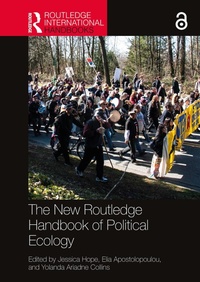
The New Routledge Handbook of Political Ecology
1st Edition
Published on 30. December 2025
526 pages
978-1-040-44323-1 (ISBN)
Description

The New Routledge Handbook of Political Ecology offers a state-of-the-art exploration of contemporary political ecology, grounded in the field's radical foundations and its longstanding connections to political activism.
This book is organised around the field's engagement with contemporary political issues, spanning across 56 chapters. Section One explores Decolonising Political Ecology, Section Two examines Activism & Praxis, and Section Three focuses on the Making of Twenty-first Century Natures. Adopting an inclusive, cross-disciplinary approach, the book features a gender-balanced and ethnically diverse range of authors, including contributions from scholars at various career stages. This diverse representation is reflective of commitment to challenging established hierarchies within political ecology - not only in the topics we examine but also in recognizing the varying perspectives researchers themselves bring to the field. This editorial strategy has proven intellectually enriching, resulting in a dynamic collection that broadens and deepens our understanding of what political ecology is and what it can achieve.
Together, as editors and 97 contributors, we contribute a forward-looking overview of contemporary Political Ecology, offering an essential reference for scholars conducting research that is relevant, ethical, critical, and, hopefully, transformative, as well as for activists and communities involved in environmental conflicts and struggles around the world.
This book is organised around the field's engagement with contemporary political issues, spanning across 56 chapters. Section One explores Decolonising Political Ecology, Section Two examines Activism & Praxis, and Section Three focuses on the Making of Twenty-first Century Natures. Adopting an inclusive, cross-disciplinary approach, the book features a gender-balanced and ethnically diverse range of authors, including contributions from scholars at various career stages. This diverse representation is reflective of commitment to challenging established hierarchies within political ecology - not only in the topics we examine but also in recognizing the varying perspectives researchers themselves bring to the field. This editorial strategy has proven intellectually enriching, resulting in a dynamic collection that broadens and deepens our understanding of what political ecology is and what it can achieve.
Together, as editors and 97 contributors, we contribute a forward-looking overview of contemporary Political Ecology, offering an essential reference for scholars conducting research that is relevant, ethical, critical, and, hopefully, transformative, as well as for activists and communities involved in environmental conflicts and struggles around the world.
Reviews / Votes
"This impressive handbook is a landmark text. It brings together an exciting and diverse range of authors to interrogate political ecology today and set out future directions for the field. It explores several specific examples - oceans, conservation, infrastructure, agriculture, genomics and more - to bring challenging theoretical approaches to light."Prof Rosaleen Duffy, University of Sheffield, UK
"In this new volume, Hope, Apostolopoulou and Collins present us with a new vision of political ecology. Pushing beyond the field's Anglo-American roots and traditional focus on place-based case studies, the chapters in this volume reflect political ecology's diversification and embrace of decolonial theory, praxis, and activism."
Prof Thomas Perreault, Syracus University, North America
"This is a new handbook of political ecology speaking to a new era of climate breakdown, revamped colonialism, and a revanchist patriarchy. Political ecology still offers the concepts to make sense of what is going on, and how things could get better".
Prof Giorgos Kallis, ICTA-UAB, Spain
More details
Series
Edition
1. Auflage
Language
English
Place of publication
London
United Kingdom
Publishing group
Taylor & Francis Ltd
Target group
College/higher education
Professional and scholarly
Product notice
Reflowable
Illustrations
4 Tables, black and white; 4 Line drawings, black and white; 3 Halftones, color; 29 Halftones, black and white; 3 Illustrations, color; 33 Illustrations, black and white
File size
17,50 MB
ISBN-13
978-1-040-44323-1 (9781040443231)
Copyright in bibliographic data and cover images is held by Nielsen Book Services Limited or by the publishers or by their respective licensors: all rights reserved.
Schweitzer Classification
Other editions
Additional editions
Jessica Hope | Elia Apostolopoulou | Yolanda Ariadne Collins
The New Routledge Handbook of Political Ecology
Book
12/2025
1st Edition
Routledge
€374.40
Shipment within 10-20 days
Persons
Jessica Hope is a Lecturer in Sustainable Development at the University of St Andrews, Scotland. Her ERC funded research develops infrastructural political ecology, investigating road building and its alternatives in the Western Amazon in sites crucial for responses to climate change - Indigenous territories, conservation areas and cities. She is an editor at Geoforum.
Elia Apostolopoulou is a Senior Lecturer at the Centre for Environmental Policy at Imperial College London. Her research bridges Political Ecology and Human and Urban Geography, focusing on how infrastructure projects and investments in the built environment shape socionatures, places, and livelihoods, often intensifying environmental, social, and spatial injustices. A significant aspect of her work is understanding the responses of affected communities and the role of grassroots activism in fostering resistance and opening pathways for radically different futures. Elia is also a Senior Associate at the University of Cambridge and an editor at Dialogues in Human Geography.
Y Ariadne Collins is Lecturer of International Relations at the University of St Andrews, Scotland, UK. Her work lies at the intersection of climate change governance, environmental policy and international development. More specifically, she analyses the interplay between market-based conservation and post-colonial development.
Elia Apostolopoulou is a Senior Lecturer at the Centre for Environmental Policy at Imperial College London. Her research bridges Political Ecology and Human and Urban Geography, focusing on how infrastructure projects and investments in the built environment shape socionatures, places, and livelihoods, often intensifying environmental, social, and spatial injustices. A significant aspect of her work is understanding the responses of affected communities and the role of grassroots activism in fostering resistance and opening pathways for radically different futures. Elia is also a Senior Associate at the University of Cambridge and an editor at Dialogues in Human Geography.
Y Ariadne Collins is Lecturer of International Relations at the University of St Andrews, Scotland, UK. Her work lies at the intersection of climate change governance, environmental policy and international development. More specifically, she analyses the interplay between market-based conservation and post-colonial development.
Content
1Editors' introduction 2 A Call for Acknowledgement Respect and Care in using Radical Feminist Conceptualizations of Territory from Latin America 3 Colonial Residue REDD+ Territorialisation and the Racialized Subject in Guyana and Suriname 4 Convivial Conservation Through Historical Reparations 5 Decolonial Thought and Political Ecology coexistence and divergence 6 Decolonization in the field chains of responsibility and ecological justice 7 Decolonising Knowledge Production in Political Ecology 8 Indigenous Political Ecologies centering sovereignty and relationality 9 Political Ecology of Fire decolonial perspectives 10 Re-Thinking Infrastructural Environments from colonial modernity to the more-than-human 11 The Coloniality of Forestry decolonial possibilities and African environmental ethics 12 Territorial Ecologies the turn toward Territories of Ecological Dignity 13 Towards an Ethnical Collaborative Practice in Political Ecology 14 Accumulation by Defossilization and Coloniality of the Energy Transition lithium territories and resistance in Jujuy Argentina 15 Convivial Conservation implementing intellectual collaborative and communicative praxis in a research project 16 Degrowth 17 End of a cis-hetero discipline Strategies for a queer political ecology 18 Energy justice a multilateral view 19 From Pemba to Barranquilla a feminist political ecology of the urban home 20 Grassroots activism in wetland spaces ecological stewardship regenerative praxis creative imaginations 21 Injustice in Urban Greening and Green Gentrification 22 Planetary Governance or Planetary Struggle A Political Ecology of Grassroots Praxis 23 Promoting interdisciplinarity intersectionality community-engagement and decoloniality in neoliberal conservation research 24 Publishing in political ecology rethinking unequal relationships and social justice 25 The EJ Atlas co-production of knowledge for engaged research to support environmental justice movements education and policy-making 26 The political ecology of collective urban gardening transmutations across space time and class 27 Troubling waterscapes Counter-mapping as a feminist methodology to rethink human-water relations 28 Working Class Environmentalisms 29 Young Peoples Political Ecologies 30 Austerity and Anti-austerity Environmentalism insights from Greece during and after the crisis 31 30 BY 30 Political ecology and the 30 by 30 conservation target 32 Conservation Data Justice 33 Neoliberal Conservation 34 Political ecologies of violent conflict 35 From colonialism to sovereignty political ecologies of the energy transition 36 Geopolitical Ecology Socio-ecological relations of bombs banks & BINGOs 37 The Blue Economy 38 The Grounds of Extraction 39 Europes Leaking Infrastructure 40 Political Ecologies of Modern and Non-modern Infrastructures 41 The Political Ecology of Soybean Infrastructure in Brazil 42 New State Capitalism political ecology of states protecting farmland 43 Political Ecology of Climate Apocalypse four scenarios on class conflict 44 Sustainable Development political ecology and a zombie environmentalism 45 A Feral Atlas 46 Should Political Ecology Be More-Than-Human 47 Why Political Ontology is Not About the Nonhuman but About What Haunts It 48 A Popular-Political Ecology of Waste 49 A Volumetric Political Ecology of Atmospheres 50 More-than-human political ecologies as a matter of care 51 Political Ecologies of Wild Animal Life 52 Political Ecology and the Genome
