

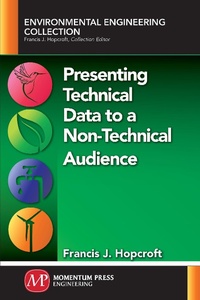
Presenting Technical Data to a Non-Technical Audience
Description

Project management is an evolving profession. Originally considered part and parcel of the design function, the practice of project management has evolved into a separate classification of professional practice. Professional project managers of today use sophisticated computer programs to achieve in seconds what took days to accomplish and evaluate in the past.
Cost estimating and project scheduling have become key elements in assuring on-budget and on-time delivery of final projects. Key to those is how well the project manager addresses environmental issues that arise. Those issues need to be considered from the planning stages of a project to the end-of-life stages of the project and the disposal of the remnants of the project decades in the future.
More details
Other editions
Additional editions
Person
Content
- Cover
- PRESENTING TECHNICAL DATA TO A NON-TECHNICAL AUDIENCE
- Contents
- List of Figures
- List of Tables
- Acknowledgments
- Chapter 1: Introduction
- Chapter 2: Presenting Large Data Sets
- Chapter 3: Presenting Statistical Data
- 3.1. Background
- 3.2. Probability as Basis of Statistics
- 3.3. Consideration of Randomness of Data
- 3.4. Lying with Statistics
- 3.5. Use of Incomplete Data Sets or Omitting Known Relevant Data
- Chapter 4: Misleading Graphics
- 4.1. Introduction
- 4.2. Lying with Images
- 4.2.1 Misleading Use of Size
- 4.2.2. Misleading Use of the Time Scale
- 4.3. Standardization of Units
- 4.4. Selective Use of Data
- Chapter 5: Presentation Concepts
- 5.1. Issues
- 5.2. Tables
- 5.3. Charts
- 5.4. Diagrams
- 5.5. Pictures and Photographs
- 5.6. Use of Photographs to Skew Public Opinion
- 5.7. The Narrative
- 5.7.1. Verbal Presentations
- 5.7.2. Written Presentations
- Chapter 6: Use of Power Point and Similar Programs
- 6.1. Concepts
- 6.2. Use of Color on Slides
- 6.3. Selection of Font and Font Size
- 6.4. Slide Design
- 6.5. Sound
- 6.6. Transitions
- 6.7. Videos
- 6.8. Optional Presentation Programs
- Chapter 7: Presentation of the Presenter
- 7.1. Introduction
- 7.2. Dress Code
- 7.3. The Meaning of the Dress Code Concepts
- 7.3.1. Business Formal Attire
- 7.3.2. Traditional Business Attire
- 7.3.3. Smart Casual Business Attire
- 7.3.4. Business Casual Attire
- 7.3.5. Casual Business Attire
- 7.4. Actions at the Podium
- 7.4.1. Speaking
- 7.4.2. The Use of a Written Script
- 7.4.3. Use of a Microphone
- 7.4.4. Movements on Stage
- 7.4.5. Eye Contact
- 7.4.6. Question and Answer Sessions
- Chapter 8: When There Is More Than One Presenter Acting as a Team
- 8.1. Introduction
- 8.2. Allocation of Time
- 8.3. Time Utilization
- 8.4. Transitions between Speakers
- Chapter 9: Dealing with Presentations to a Hostile Audience
- Appendix
- Bibliography
- About the Author
- Index
- Ad Page
- Back Cover
