

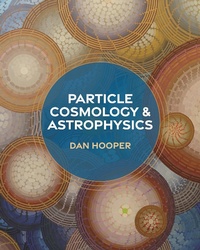
Particle Cosmology and Astrophysics
Description

A graduate-level introduction to the interface between particle physics, astrophysics, and cosmology
This book explores the exciting interface between the fields of cosmology, high-energy astrophysics, and particle physics, at a level suitable for advanced undergraduate- to graduate-level students as well as active researchers. Without assuming a strong background in particle physics or quantum field theory, the text is designed to be accessible to readers from a range of backgrounds and presents both fundamentals and modern topics in a modular style that allows for flexible use and easy reference. It offers coverage of general relativity and the Friedmann equations, early universe thermodynamics, recombination and the cosmic microwave background, Big Bang nucleosynthesis, the origin and detection of dark matter, the formation of large-scale structure, baryogenesis and leptogenesis, inflation, dark energy, cosmic rays, neutrino and gamma-ray astrophysics, supersymmetry, Grand Unified Theories, sterile neutrinos, and axions. The book also includes numerous worked examples and homework problems, many with solutions. Particle Cosmology and Astrophysics provides readers with an invaluable entrée to this cross-disciplinary area of research and discovery.
- Accessible to advanced undergraduate to graduate students, as well as researchers in cosmology, high-energy astrophysics, and particle physics
- Does not assume a strong background in particle physics or quantum field theory and contains two chapters specifically for readers with no background in particle physics
- Broad scope, covering many topics across particle physics, astrophysics, and particle cosmology
- Modular presentation for easy reference and flexible use
- Provides more than 200 homework problems, many with solutions
- Ideal for course use or self-study and reference
More details
Other editions
Additional editions
Person
Content
- Cover
- Contents
- Foreword: Edward W. Kolb and Michael Turner
- Constants, Parameters, and Reference Tables
- Frequently Used Equations
- Preface
- I: Preliminaries
- 1. Our Universe
- 1.1. A brief history of our universe
- 1.2. The empirical pillars of modern cosmology
- 1.3. Cosmic concordance
- 1.4. Open questions and outstanding puzzles
- 2. General Relativity and the Friedmann Equations
- 2.1. Spacetime and the metric
- 2.2. Tensor notation in general relativity
- 2.3. The friedmann equations
- 2.4. Matter, radiation, and pressure
- 2.5. Static universes and the cosmological constant
- 2.6. The evolution of energy
- 2.7. The expansion history of the universe
- 2.8. Distances in an expanding universe
- Problems
- 3. A Crash Course in Particle Physics
- 3.1. The Standard Model of particle physics
- 3.2. Feynman diagrams
- 3.3. Conservation laws
- 3.4. Phase transitions in the Standard Model
- 3.5. Amplitudes
- 3.6. Relativistic kinematics and four-vectors
- 3.7. Decays and scattering
- Problems
- 4. Thermodynamics for Cosmologists
- 4.1. Equilibrium thermodynamics
- 4.2. Entropy
- 4.3. Chemical potentials
- 4.4. Departures from equilibrium
- 4.5. Neutrino decoupling
- 4.6. Evolution after decoupling
- 4.7. The boltzmann equation
- Problems
- 5. The Interactions of High-Energy Particles in Astrophysics
- 5.1. Interactions of high-energy electrons
- 5.2. Interactions of high-energy nucleons and nuclei
- 5.3. Interactions of high-energy photons
- Problems
- II: Cosmology
- 6. Recombination and Photon Decoupling
- 6.1. Photon scattering
- 6.2. The ionization history of the early universe
- 6.3. Reionization
- 6.4. The surface of last scattering
- Problems
- 7. The Cosmic Microwave Background
- 7.1. The spectrum of the CMB
- 7.2. Temperature anisotropies
- 7.3. The angular power spectrum of the CMB
- 7.4. The evolution of density perturbations
- 7.5. Features of the CMB's angular power spectrum
- 7.6. Extracting cosmological parameters
- 7.7. CMB polarization
- 7.8. The current state of CMB measurements
- 7.9. Dark radiation
- Problems
- 8. Big Bang Nucleosynthesis
- 8.1. Proton and neutron freeze out
- 8.2. Nuclear abundances in equilibrium
- 8.3. From nucleons to helium
- 8.4. Beyond helium
- 8.5. The primordial element abundances
- 8.6. BBN as a probe of exotic physics
- Problems
- 9. Dark Matter
- 9.1. Dynamical evidence for dark matter
- 9.2. MACHOs and gravitational microlensing
- 9.3. What about modified gravity?
- 9.4. Requirements of a dark matter candidate
- 9.5. The abundance of a thermal relic
- 9.6. Asymmetric dark matter
- 9.7. Nonthermal production mechanisms
- Problems
- 10. The Formation of Large-Scale Structure
- 10.1. Gravitational collapse
- 10.2. Pressure and the Jeans length
- 10.3. The evolution of structure in an expanding universe
- 10.4. The matter power spectrum
- 10.5. From density perturbations to dark matter halos
- 10.6. Hot, warm, and cold dark matter
- 10.7. Baryon acoustic oscillations
- 10.8. Adiabatic and isocurvature perturbations
- Problems
- 11. Neutrino Masses and Oscillations
- 11.1. Neutrino masses
- 11.2. Neutrino mixing and oscillations
- 11.3. Neutrino oscillations in the presence of matter
- Problems
- 12. Baryogenesis and Leptogenesis
- 12.1. The matter-antimatter asymmetry
- 12.2. The Sakharov conditions
- 12.3. Baryogenesis in grand unified theories
- 12.4. Sphalerons
- 12.5. Baryogenesis via leptogenesis
- 12.6. Electroweak baryogenesis
- 12.7. Topological defects
- Problems
- 13. Inflation
- 13.1. Motivations for inflation
- 13.2. A common solution: accelerated expansion
- 13.3. The dynamics of a slowly rolling scalar field
- 13.4. Primordial perturbations from inflation
- 13.5. Gravitational waves and primordial B-modes
- 13.6. Examples of inflationary models
- 13.7. Reheating
- 13.8. Present and future probes of inflation
- 13.9. Eternal inflation
- Problems
- 14. Dark Energy
- 14.1. The cosmological constant problem
- 14.2. Dark energy and accelerating expansion
- 14.3. Dynamical dark energy
- 14.4. Observational probes of dark energy
- 14.5. Dark energy and the anthropic principle
- Problems
- III: Particle Astrophysics
- 15. Cosmic Rays
- 15.1. The cosmic-ray spectrum
- 15.2. Cosmic-ray propagation
- 15.3. Cosmic-ray acceleration
- 15.4. Ultra-high energy cosmic rays
- Problems
- 16. Gamma-Ray and Neutrino Astrophysics
- 16.1 Why gamma rays?Why neutrinos?
- 16.2. The astrophysical production and propagation of gamma rays
- 16.3. The astrophysical production and propagation of neutrinos
- 16.4. Astrophysical sources of high-energy gamma rays and neutrinos
- Problems
- 17. Particle Dark Matter Candidates
- 17.1. Supersymmetric dark matter
- 17.2. Sterile neutrinos
- 17.3. Axions
- 17.4. Dark matter in hidden sectors
- Problems
- 18. Direct Dark Matter Searches
- 18.1. Dark matter scattering with nuclei
- 18.2. Dark matter scattering cross sections
- 18.3. Direct detection constraints and their impact
- 18.4. Axion detection
- Problems
- 19. Searches for Dark Matter Annihilation and Decay
- 19.1. Motivations for indirect searches
- 19.2. Dark matter annihilation and the CMB
- 19.3. Gamma rays from dark matter annihilation
- 19.4. Cosmic rays from dark matter annihilation
- 19.5. Decaying dark matter
- Problems
- 20. Collider Physics for Astronomers
- 20.1. Why collide particles?
- 20.2. Electron and proton colliders
- 20.3. Particle detection at the LHC
- 20.4. Cross sections and event rates at the LHC
- 20.5. The LHC and the early universe
- Problems
- Bibliography
- Solutions to Selected Problems
- Index
- A
- B
- C
- D
- E
- F
- G
- H
- I
- J
- K
- L
- M
- N
- O
- P
- Q
- R
- S
- T
- U
- V
- W
- X
- Y
- Z
