

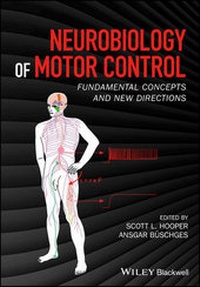
Neurobiology of Motor Control
Description

More details
Other editions
Additional editions
Persons
Content
List of Contributors xiii
About the Cover xvii
1 Introduction 1
Ansgar Büschges and Scott L. Hooper
References 5
2 Electrophysiological Recording Techniques 7
Scott L. Hooper and Joachim Schmidt
2.1 Introduction 7
2.2 Terminology 8
2.3 Intracellular and Patch Clamp Recording 9
2.3.1 Recording Electrodes 9
2.3.2 Current-Clamp:Measuring Transmembrane Potential 12
2.3.3 Voltage Clamp: Measuring Transmembrane Current 15
2.3.3.1 Voltage Clamp with Transmembrane Potential as Reference 15
2.3.3.2 Voltage Clamp with Preparation (Bath) Ground as Reference 16
2.4 Extracellular Recording and Stimulation 17
2.5 A Brief History of Electrophysiological Recording 21
2.6 Concepts Important to Understanding Neuron Recording Techniques 27
2.6.1 Membrane Properties 27
2.6.2 Intracellular Recording 29
2.6.3 Extracellular Recording 32
2.6.3.1 Intracellular Action Potential Shape 33
2.6.3.2 Axon Embedded in Uniform, Infinite Volume Conductor 33
2.6.3.3 Variations in Extracellular Action Potential Shape Induced by Non-Uniform, Non-Infinite Volume Conductors 42
2.6.3.4 Bipolar Recording 44
2.6.3.5 Extracellular Action Potential Summary 46
Acknowledgements 47
References 47
3 Multi-Unit Recording 55
Arthur Leblois and Christophe Pouzat
3.1 Introduction 55
3.2 Chapter Organization and Expository Choices 56
3.3 Hardware 57
3.4 Spike Sorting Methods 60
Endnotes 69
References 70
4 The "New Math" of Neuroscience: Genetic Tools for Accessing and Electively Manipulating Neurons 75
Andreas Schoofs,Michael J. Pankratz, and Martyn Goulding
4.1 Introduction 75
4.2 Restricting Gene Expression to Specific Neurons 76
4.2.1 Promoter Bashing, Enhancer Trapping: Binary Systems for Targeted Gene Expression 77
4.2.2 Intersectional Strategies 81
4.2.3 Temporally Inducible Systems 82
4.3 Tracing, Manipulating, and Monitoring Neurons 84
4.3.1 Tracing Neuronal Projections and Connections with Fluorescent Reporters 84
4.3.2 Viral Tracers for Mapping Neural Connections 85
4.3.3 Manipulating Neuronal Function 87
4.3.4 Monitoring Neuronal Activity 90
4.4 Case Studies 92
4.5 Future Perspective 98
References 98
5 Computer Simulation-Power and Peril 107
Astrid A. Prinz and Scott L. Hooper
5.1 Introduction 107
5.2 Why Model? 107
5.3 Modeling Approaches 110
5.4 Model Optimization and Validation 118
5.5 Beyond Purely ComputationalModels 120
5.6 Fundamental Concepts and Frequently Used Models in Motor Control 121
5.6.1 How to Predict the Future 121
5.6.2 Neuron Models 123
5.6.3 Synapse Models 127
5.6.4 Muscle Models 128
5.6.5 Biomechanical Models 128
5.7 The Future 129
Acknowledgements 130
References 130
6 Evolution of Motor Systems 135
Paul S. Katz and Melina E. Hale
6.1 Introduction 135
6.2 Phylogenetics 136
6.3 Homology and Homoplasy 138
6.4 Levels of Biological Organization 139
6.5 Homologous Neurons 139
6.6 Deep Homology 142
6.7 Homoplasy 145
6.8 Convergence in Central Pattern Generators 150
6.9 Evolutionary Loss 152
6.10 Evolution of Novel Motor Behaviors 152
6.11 Three Scenarios for the Evolution of Novel Behavior 154
6.11.1 Generalist Neural Circuitry 154
6.11.2 Rewired Circuitry 157
6.11.3 Functional Rewiring with Neuromodulation 159
6.12 Motor System Evolvability 161
6.13 Neuron Duplication and Parcellation 162
6.14 Divergence of Neural Circuitry 164
6.15 Summary and Conclusions 165
Acknowledgements 165
References 165
7 Motor Pattern Selection 177
7.1 Introduction to Motor Pattern Selection in Vertebrates and Invertebrates 178
Hans-Joachim Pflüger and Sten Grillner
References 179
7.2 Selection of Action-A Vertebrate Perspective 181
Sten Grillner and Brita Robertson
7.2.1 Introduction 181
7.2.2 Control of Locomotory Outputs 182
7.2.3 The Organization and Role of the Basal Ganglia 184
7.2.4 ConceptualModel of the Organization Underlying Selection of Behavior 187
7.2.5 The Organization of Motor Control From Cortex (Pallium in Lower Vertebrates) 189
7.2.6 The Relative Role of Different Forebrain Structures for Selection of Behavior 189
Acknowledgements 190
References 191
7.3 Motor Pattern Selection and Initiation in Invertebrates with an Emphasis on Insects 195
Hans-Joachim Pflüger
7.3.1 Introduction 195
7.3.2 Organization Principles of Relevant Sensory Systems 196
7.3.3 Movement-Generating Neural Networks in Invertebrates 196
7.3.4 Motor Pattern Selection in Invertebrates 197
7.3.4.1 Probabilistic "Selection": Intrinsically Variable CPGs in Mollusk Feeding 197
7.3.4.2 Selection via CPG Coordination 198
7.3.4.3 Selection by Neuromodulators or Neurohormones 198
7.3.4.4 Selection by Command Neurons Not in the Brain 201
7.3.4.5 The Brain is Crucial in the Motor Selection Process 202
7.3.5 Two Case Studies 207
7.3.6 Concluding Remarks on Invertebrates 213
7.3.7 Are There Common Themes between Motor Pattern Selection in
Invertebrates and Vertebrates? 213
References 216
8 Neural Networks for the Generation of RhythmicMotor Behaviors 225
Ronald M. Harris-Warrick and Jan-Marino Ramirez
8.1 Introduction 225
8.2 Concept of the Central Pattern Generator 225
8.3 Overall Organization of Rhythmic Motor Networks 227
8.4 Identification of CPG Neurons and Synapses: The "Wiring Diagram" 234
8.5 Cellular PropertiesThat Shape Network Output: Building Blocks for Network Operation 238
8.6 Combined Neural Mechanisms for Rhythmogenesis 240
8.7 Ionic Currents Shaping CPG Network Neuron Intrinsic Firing Properties 241
8.7.1 Role of Outward Currents in Regulating Pacemaker and Network Activity 241
8.7.2 Role of Inward Currents in the Generation of Pacemaker and Network Activity 243
8.7.3 Interaction of Inward and Outward Currents in the Generation of Pacemaker Activity 245
8.7.4 Homeostatic Plasticity and the Balance between Different Ion Channel Types 245
8.7.5 Rapid Changes in Extracellular Ion Concentrations during Rhythmic Network Function 246
8.8 Role of Network Synaptic Properties in Organizing Rhythmic Behaviors 246
8.9 Variable Output from Motor Networks 249
8.10 Conclusions 252
Acknowledgements 253
References 253
9 Sensory Feedback in the Control of Posture and Locomotion 263
Donald H. Edwards and Boris I. Prilutsky
9.1 Introduction 263
9.2 History and Background of Feedback Control 264
9.3 Classical Control Theory 264
9.4 Nervous System Implementation in the Control of Posture and Limb Movements 267
9.5 Organization and Function in Arthropods 274
9.5.1 Locomotory System Gross Anatomy 274
9.5.2 Proprioceptors and Exteroceptors 274
9.5.3 Arthropod Nervous Systems 275
9.5.4 Postures and Movement Commands 275
9.5.5 Sensory Feedback in the Maintenance of Posture 275
9.5.6 Sensory Feedback in Movement andWalking 276
9.6 Organization and Function in Vertebrates 282
9.6.1 Sensory Feedback in the Maintenance of Posture 282
9.6.2 Sensory Feedback and its Integration with Motor Commands in
Movement 285
9.7 Conclusions 293
Acknowledgements 294
Endnote 294
References 294
10 Coordination of Rhythmic Movements 305
Jean-Patrick Le Gal, Réjean Dubuc, and Carmen Smarandache-Wellmann
10.1 Introduction 305
10.2 Overview of Invertebrate CPGs 306
10.2.1 Stomatogastric Nervous System: Feeding Circuits in Decapod Crustacea 308
10.2.2 Leech Locomotion 315
10.2.3 Crayfish Swimmeret System 317
10.2.4 Insect Locomotion 319
10.2.5 MultipleMechanisms Mediate Coordination in Invertebrate Systems 321
10.3 Overview of Vertebrate CPGs 321
10.3.1 General Characteristic of Vertebrate CPGs 322
10.3.1.1 Locomotor CPGs 322
10.3.1.2 Respiratory CPGs 323
10.3.1.3 Feeding CPGs 324
10.3.2 CPG Interactions within One Motor Function 324
10.3.2.1 Unit Generators in Limbless Swimming Vertebrates 324
10.3.2.2 Unit Generators in Mammalian Limbs 325
10.3.3 CPGs Interactions for Different Motor Functions 327
10.3.3.1 Coordination of Respiration and Swallowing 327
10.3.3.2 Coordination of Locomotion and Respiration 328
10.4 Conclusion 331
References 332
11 Prehensile Movements 341
Till Bockemühl
11.1 Introduction: Prehension as Goal-Directed Behavior 341
11.2 The Redundancy Problem in Motor Control 343
11.3 Redundancy Occurs on Multiple Levels of the Motor System 346
11.4 Overcoming the Redundancy Problem 349
11.4.1 InvariantMovement Features 350
11.4.2 Increasing the Number of Task Conditions 352
11.4.3 Reducing the Number of DOFs 357
References 361
12 Muscle, Biomechanics, and Implications for Neural Control 365
Lena H. Ting and Hillel J. Chiel
12.1 Introduction 365
12.2 Behavioral Context Determines How Motorneuron Activity Is Transformed into Muscle Force and Power 366
12.2.1 The Neuromuscular Transform Is History-Dependent 367
12.2.1.1 Motorneurons Are Subject to Neuromodulation and History-Dependence That Can Significantly Alter Their Output 368
12.2.1.2 Presynaptic Neurotransmitter Release at the Neuromuscular Junction Is History-Dependent 368
12.2.1.3 Post-SynapticMuscle Excitation Is History-Dependent and Subject to Modulation 368
12.2.1.4 Contractile Dynamics of Cross-Bridge Interactions Are History Dependent 369
12.2.1.5 The Molecular Motors of Muscles Give Rise to the Functional and History-Dependent Properties of Muscle Force Generation 369
12.2.2 Muscle Power Depends on Behavioral Context 371
12.2.3 Muscle Specialization Reflects Behavioral Repertoire 373
12.3 Organismal Structures Transform Muscle Force into Behavior 374
12.3.1 Effects of Muscle Force Depend on the Properties of the Body and the Environment 375
12.3.1.1 The Relative Importance of Inertial, Viscous, and Spring-Like Forces Affect the Role of Muscle Force 375
12.3.1.2 Muscle Function Depends on Behavioral Context and Environmental Forces 377
12.3.1.3 Biomechanical Affordances and Constraints of Body Structures Affect Muscle Functions 377
12.3.2 Muscles Are Multi-Functional 381
12.3.3 Specialization of Biomechanical Structures Reflect Behavioral Repertoire 385
12.4 Biomechanics Defines Meaningful Patterns of Neural Activity 387
12.4.1 Organismal Structures Are Multi-Functional 389
12.4.2 Many Functionally-Equivalent Solutions Exist for Sensorimotor Tasks 392
12.4.3 Structure and Variability in Motor Patterns Reflect Biomechanics 394
12.4.4 Specialization of Neuromechanical Systems Reflect Behavioral Repertoire 399
12.5 Conclusions 401
Acknowledgements 402
References 402
13 Plasticity and Learning in Motor Control Networks 417
John Simmers and Keith T. Sillar
13.1 Introduction 417
13.2 Homeostatic Motor Network Assembly 418
13.3 Short-Term Motor Learning Conferred by Sodium Pumps 420
13.3.1 Swimming CPG Network Plasticity in Xenopus Frog Tadpoles 420
13.3.2 Comparative Aspects of Na+ Pump Contribution to Neural Network Function 425
13.4 CPG Network Plasticity and Motor Learning Conferred by Operant Conditioning 426
13.5 Discussion and Conclusions 432
References 436
14 Bio-inspired Robot Locomotion 443
Thomas Buschmann and Barry Trimmer
14.1 Introduction 443
14.2 Mechanical Engineering Background and a Biological Example 444
14.3 Legged Robots with Skeletal Structures 446
14.3.1 Mechanism Design, Sensing, and Actuation 446
14.3.2 Basic Dynamics of Legged Locomotion 447
14.3.3 Trajectory-OrientedWalking Control 448
14.3.4 Limit CycleWalkers 450
14.3.5 CPG-Based Control and Step-Phase Control 451
14.4 Soft Robots 452
14.4.1 Limitations and Advantages of Soft Materials 452
14.4.2 The Challenges 453
14.4.2.1 Actuators 453
14.4.2.2 Sensors 455
14.4.2.3 Control of Soft Robots 456
14.4.3 Bioinspired Locomotion in Soft Robots 459
14.5 Conclusion and Outlook 463
References 463
Index 473
Chapter 1
Introduction
Ansgar Büschges1 and Scott L. Hooper2
1Biozentrum Köln, Institute für Zoologie, Universität zu Köln, Köln, Germany
2Neuroscience Program, Department of Biological Sciences, Ohio University, Athens, OH, USA
It is de rigueur in a review or book on motor control to quote Sherrington's (1924) statement that "To move things is all that mankind can do". Although strictly true, this quotation discounts the central role in human experience of such actionless phenomena as ideation, emotion, and consciousness. However, it is nonetheless true that movement is an absolute requirement for animal survival and reproduction and, as the only observable output of the nervous system, is the defining basis of behavior. Movement is also self-defining, and hence allows analyzing nervous system function on the objective basis of its performance alone without reference to experimenter defined classifications. Disorders of movement also have great clinical importance, and production of functional and robust movement is a central problem in robotics. Because movements must be chosen among, and because almost all motor networks receive sensory input and information about internal state and "decide" how to alter their output in response, studying such networks may also provide insight into how the networks underlying "higher" abilities such as ideation function.
Despite this, many researchers, as well as lay people, take the generation of motor behavior for granted, often rendering it as the outcome of simple and automatic neural processes that can be summarized with large arrows pointing "south" from an animal's brain accompanied by the words "motor system". Only when confronted with particularly outstanding motor performances, e.g., the graceful movements of a dancer or an acrobat, do we appreciate the complexity of generating motor output. This disparity was well captured more than 200 years ago in von Kleist's (1810) essay Über das Marionetten Theater (On the Marionette Theater): "He asked me if indeed I hadn't found some of the movements of the puppets.to be exceedingly graceful in the dances. I could not refute this observation", a recognition that led Kleist to elaborate further on the potential mechanistic background of this observation. This text highlights how the ordinariness of movement can prevent us from appreciating how difficult it is to produce (something of which roboticists are well aware), and thus how extraordinary it is that nervous systems can do so.
The last general textbook covering how nervous systems do so, at least with respect to locomotion, was Neural Control of Locomotion (Orlovsky et al. 1999). This exceptional book described the neural networks and mechanisms that generate locomotion in mollusks, insects, anurans, lower vertebrates, mammals, and man. This book was the first comprehensive comparative account of how nervous systems generate locomotion. Such an overview had been lacking for decades and its detail and depth made and make it exceptional.
However, the book's concentration on locomotion meant that it, by design, did not cover the full range of movements animals produce. More importantly, dramatic advances in motor science have occurred since it was published. These advances represent a sea change in that motor research up to the 1990s primarily involved ever more elegant and detailed application of classical anatomical and single unit electrophysiological techniques. In the last two decades, alternatively, a much broader palette of methods has become available or practicable, including multi-unit recordings, molecular neurogenetics, computer simulation, and new approaches for studying how muscles and body anatomy transform motor neuron activity into movement. This broadening of experimental options has been exceptionally fruitful. However, it also means that researchers in motor control must be multi-competent, sufficiently informed and trained to be able to select from these multiple methodological options the optimal approach for the research question at hand.
It is important to make this observation because human nature and the process by which researchers are typically trained (prolonged and intensely concentrated research on a narrowly-defined question in an individual mentor's lab) work against achieving such multi-competence. Instead, as with a person with a hammer seeing every problem as a nail, it leads to researchers using the methods they know in preference to ones that might be better, but about which the researcher only peripherally knows. This is not a new observation, and conscious efforts are being made in training programs to train new researchers across fields. Nonetheless, in our experience barriers still exist between molecular biologists, electrophysiologists, muscle researchers, modelers, biomechanicists, and roboticists. It is a truism that reducing such barriers would serve all well. The question is, how to do so?
This book, in part, is an attempt to contribute to this effort. Its intended audience is all workers in movement production, from molecular biologists to roboticists. Workers in each group will have most knowledge of fields nearest their own .thus an electrophysiologist from a biology program likely has greatest understanding of molecular biology, and perhaps least of robotics. A biomechanicist likely finds it easier to communicate with a roboticist than a molecular biologist. And in our experience, modelers, at least those whose training was in classical mathematics, always speak a foreign language.
We therefore begin this book with four chapters covering basic knowledge on electrophysiological techniques, methods for large ensemble recordings, neurogenetic and molecular techniques, and computer simulation. These chapters are obviously not intended for experts in the field (although we hope they will be useful for beginning students in their labs, and the molecular biology and simulation chapters include case studies that will interest even experts in the fields). Rather, we hope that these chapters will allow workers outside each chapter's field to better understand and critically assess the field's literature, to understand the later chapters in the book, and encourage workers to reach outside their comfort zone and consider applying different methodological approaches to their research. We believe that writing these chapters, with their at least partially pedagogical nature, was likely a considerable change from the more purely research oriented reviews the authors would be typically asked to write. We are therefore particularly grateful to the highly distinguished colleagues in the field of motor control who were willing to take on this burden.
Hooper and Schmidt cover classical (i.e., not multi-unit) electrophysiological recording techniques. The first sections of this chapter are practical, and provide the information necessary for readers to understand and interpret intracellular and extracellular recording in the contemporary literature without a detailed explanation of theory. It is very difficult for modern readers to appreciate just how difficult it was for these techniques to be developed. The authors therefore next provide a brief history of extracellular and intracellular recording. The authors end the chapter with a detailed explanation of the theory underlying both recording techniques, and potential pitfalls that can occur with them.
Lebois and Pouzat cover multi-unit recordings.recordings in which electrodes that record the activity of multiple neurons are introduced into nervous tissue. The ability to do so strongly depends on proper electrode design and use, which the authors therefore first cover. Given that these electrodes record the activity of many neurons, advanced techniques are required to identify the individual activities of the many neurons being recorded from. The authors explain these techniques in detail in the chapter's second part.
Schoofs, Pankratz, and Goulding cover the use of molecular genetic tools to study neural network topology and function. They begin with a detailed explanation of the techniques available in invertebrates and vertebrates to observe and alter neuron activity. They then provide four cases studies, two in Drosophila and two in mice, in which these techniques were used to make novel findings in motor control that would have been presently impossible to achieve with other methods.
Prinz and Hooper cover computational simulation. The authors first provide a relatively high level overview of both the great power, and also the potential pitfalls, of simulation, making use throughout of case studies relevant to motor control. Because computer simulation may not be a part of the training of many of the book's intended audience, the authors then provide a detailed and basic explanation of how simulation is performed and how it is applied to neurons, synapses, muscles, and biomechanics.
In planning this book we also aimed to reduce another set of barriers: those between workers in different experimental preparations, of which the greatest is between workers in invertebrates and vertebrates. Doing so is important on both historical and scientific grounds. First, many to perhaps most discoveries made in one of these groups have been later found to be also present in the other. Second, recent data suggest a deep homology between (bilaterian) invertebrate and vertebrate motor control structures. This observation suggests that the last common ancestor of these two groups (the urbilatarian) had a...
