

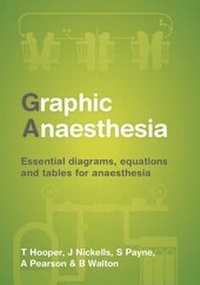
Graphic Anaesthesia
Essential diagrams, equations and tables for anaesthesia
Published on 21. September 2015
262 pages
978-1-907904-80-6 (ISBN)
Description

Graphic Anaesthesia is a compendium of the diagrams, graphs, equations and tables needed in anaesthetic practice.
Each page covers a separate topic to aid rapid review and assimilation. The relevant illustration, equation or table is presented alongside a short description of the fundamental principles of the topic and with clinical applications where appropriate. All illustrations have been drawn using a simple colour palette to allow them to be easily reproduced in an exam setting.
The book includes sections covering:
- physiology
- pharmacodynamics and kinetics
- physics
- equipment
- anatomy
- drugs
- clinical measurement
- statistics.
By combining all the illustrations, equations and tables with concise, clinically relevant explanations, Graphic Anaesthesia is therefore:
- the ideal revision book for all anaesthetists in training
- a valuable aide-memoire for senior anaesthetists to use when teaching and examining trainees.
From reviews:
"Graphic Anaesthesia is a well-written, easy-to-read book, ideal for trainees studying for primary FRCA examinations. It will be an ideal companion for preparing for exams." Ulster Medical Journal, May 2016
"Graphic Anaesthesia is an excellent revision tool that allows trainees approaching exams to prepare in an efficient and simple format. It is a refreshing and unique resource that should be included on any essential revision reading list." European Journal of Anaesthesiology 2016; 33: 610.
"The diagrams are very clear, the explanations accurate and concise and to pack 245 items into a small reference book is no mean feat.. Each diagram is drawn in just four colours to enable them to be reproduced easily from memory. This intuitive approach was an eye-opener to me and a valuable lesson in simplicity without losing any essential detail. This is something from which many educators could learn and indeed transfer that skill.This is a quality book that could be a useful investment across the spectrum of practitioners involved in anaesthesia and the teaching of anaesthesia." Journal of Perioperative Practice March 2017, volume 27, issue 3
Each page covers a separate topic to aid rapid review and assimilation. The relevant illustration, equation or table is presented alongside a short description of the fundamental principles of the topic and with clinical applications where appropriate. All illustrations have been drawn using a simple colour palette to allow them to be easily reproduced in an exam setting.
The book includes sections covering:
- physiology
- pharmacodynamics and kinetics
- physics
- equipment
- anatomy
- drugs
- clinical measurement
- statistics.
By combining all the illustrations, equations and tables with concise, clinically relevant explanations, Graphic Anaesthesia is therefore:
- the ideal revision book for all anaesthetists in training
- a valuable aide-memoire for senior anaesthetists to use when teaching and examining trainees.
From reviews:
"Graphic Anaesthesia is a well-written, easy-to-read book, ideal for trainees studying for primary FRCA examinations. It will be an ideal companion for preparing for exams." Ulster Medical Journal, May 2016
"Graphic Anaesthesia is an excellent revision tool that allows trainees approaching exams to prepare in an efficient and simple format. It is a refreshing and unique resource that should be included on any essential revision reading list." European Journal of Anaesthesiology 2016; 33: 610.
"The diagrams are very clear, the explanations accurate and concise and to pack 245 items into a small reference book is no mean feat.. Each diagram is drawn in just four colours to enable them to be reproduced easily from memory. This intuitive approach was an eye-opener to me and a valuable lesson in simplicity without losing any essential detail. This is something from which many educators could learn and indeed transfer that skill.This is a quality book that could be a useful investment across the spectrum of practitioners involved in anaesthesia and the teaching of anaesthesia." Journal of Perioperative Practice March 2017, volume 27, issue 3
More details
Other editions
Additional editions
Tim Hooper | James Nickells | Sonja Payne
Graphic Anaesthesia
Essential diagrams, equations and tables for anaesthesia
Book
09/2015
Scion Publishing Ltd
€65.79
Article exhausted; check for reprint
Persons
Author
Consultant in Intensive Care Medicine, Anaesthesia and Prehospital Care, Southmead Hospital, Bristol
Consultant in Anaesthesia, Southmead Hospital, Bristol
Specialist Trainee in Anaesthesia, Severn Deanery
Specialist Trainee in Anaesthesia, Severn Deanery
Consultant in Intensive Care Medicine and Anaesthesia, Southmead Hospital, Bristol
Content
1. PHYSIOLOGY
1.1 Cardiac; 1.2 Circulation; 1.3 Respiratory; 1.4 Neurology; 1.5 Renal; 1.6 Gut; 1.7 Acid-base; 1.8 Metabolic; 1.9 Endocrine; 1.10 Body fluids; 1.11 Haematology; 1.12 Cellular; 1.13 Muscle
2. ANATOMY
2.1 Abdominal wall; 2.2 Antecubital fossa; 2.3 Autonomic nervous system; 2.4 Base of skull; 2.5 Brachial plexus; 2.6 Bronchial tree; 2.7 Cardiac vessels - cardiac veins; 2.8 Cardiac vessels - coronary arteries; 2.9 Circle of Willis; 2.10 Cranial nerves; 2.11 Cross-section of neck at C6; 2.12 Cross-section of spinal cord; 2.13 Dermatomes; 2.14 Diaphragm; 2.15 Epidural space; 2.16 Femoral triangle; 2.17 Fetal circulation; 2.18 Intercostal space; 2.19 Internal jugular vein; 2.20 Laryngeal innervation; 2.21 Larynx; 2.22 Limb muscle innervation (myotomes); 2.23 Lumbar plexus; 2.24 Nose; 2.25 Orbit; 2.26 Rib; 2.27 Sacral plexus; 2.28 Sacrum; 2.29 Spinal nerve; 2.30 Thoracic inlet and first rib; 2.31 Vertebra
3. PHARMACODYNAMICS AND KINETICS
3.1 Clearance; 3.2 Compartment model - one and two compartments; 3.3 Compartment model - three compartments; 3.4 Dose-response curves; 3.5 Elimination; 3.6 Elimination kinetics; 3.7 Half-lives and time constants; 3.8 Meyer-Overton hypothesis; 3.9 Volume of distribution; 3.10 Wash-in curves for volatile agents
4. DRUGS
4.1 Anaesthetic agents - etomidate; 4.2 Anaesthetic agents - ketamine; 4.3 Anaesthetic agents - propofol; 4.4 Anaesthetic agents - thiopentone; 4.5 Local anaesthetics - mode of action; 4.6 Local anaesthetics - properties; 4.7 Neuromuscular blockers - mode of action; 4.8 Neuromuscular blocking agents - depolarizing; 4.9 Neuromuscular blocking agents - non-depolarizing; 4.10 Opioids - mode of action; 4.11 Opioids - properties; 4.12 Volatile anaesthetic agents - mode of action; 4.13 Volatile anaesthetic agents - physiological effects; 4.14 Volatile anaesthetic agents - properties
5. PHYSICS
5.1 Avogadro's hypothesis; 5.2 Beer-Lambert law; 5.3 Critical temperatures and pressure; 5.4 Diathermy; 5.5 Doppler effect; 5.6 Electrical safety; 5.7 Electricity; 5.8 Exponential function; 5.9 Fick's law of diffusion; 5.10 Gas laws - Boyle's law; 5.11 Gas laws - Charles' law; 5.12 Gas laws - Gay-Lussac's (Third Perfect) law; 5.13 Gas laws - ideal gas law and Dalton's law; 5.14 Graham's law; 5.15 Heat; 5.16 Henry's law; 5.17 Humidity; 5.18 Laser; 5.19 Metric prefixes; 5.20 Power; 5.21 Pressure; 5.22 Raman effect; 5.23 Reflection and refraction; 5.24 SI units; 5.25 Triple point of water and phase diagram; 5.26 Types of flow; 5.27 Wave characteristics; 5.28 Wheatstone bridge; 5.29 Work
6. CLINICAL MEASUREMENT
6.1 Bourdon gauge; 6.2 Clark electrode; 6.3 Damping; 6.4 Fuel cell; 6.5 Monitoring of neuromuscular blockade; 6.6 Oximetry - paramagnetic analyser; 6.7 pH measuring system; 6.8 Pulse oximeter; 6.9 Severinghaus carbon dioxide electrode; 6.10 Temperature measurement; 6.11 Thermocouple and Seebeck effect
7. EQUIPMENT
7.1 Bag valve mask resuscitator; 7.2 Breathing circuits - circle system; 7.3 Breathing circuits - Mapleson's classification; 7.4 Cleaning and contamination; 7.5 Continuous renal replacement therapy - extracorporeal circuit; 7.6 Continuous renal replacement therapy - modes; 7.7 Gas cylinders; 7.8 Humidifier; 7.9 Oxygen delivery systems - Bernoulli principle and Venturi effect; 7.10 Piped gases; 7.11 Scavenging; 7.12 Vacuum-insulated evaporator; 7.13 Vaporizer; 7.14 Ventilation - pressure-controlled; 7.15 Ventilation - volume-controlled
8. STATISTICS
8.1 Mean, median and mode; 8.2 Normal distribution; 8.3 Number needed to treat; 8.4 Odds ratio; 8.5 Predictive values; 8.6 Sensitivity and specificity; 8.7 Significance tests; 8.8 Statistical variability; 8.9 Type I and type II errors
1.1 Cardiac; 1.2 Circulation; 1.3 Respiratory; 1.4 Neurology; 1.5 Renal; 1.6 Gut; 1.7 Acid-base; 1.8 Metabolic; 1.9 Endocrine; 1.10 Body fluids; 1.11 Haematology; 1.12 Cellular; 1.13 Muscle
2. ANATOMY
2.1 Abdominal wall; 2.2 Antecubital fossa; 2.3 Autonomic nervous system; 2.4 Base of skull; 2.5 Brachial plexus; 2.6 Bronchial tree; 2.7 Cardiac vessels - cardiac veins; 2.8 Cardiac vessels - coronary arteries; 2.9 Circle of Willis; 2.10 Cranial nerves; 2.11 Cross-section of neck at C6; 2.12 Cross-section of spinal cord; 2.13 Dermatomes; 2.14 Diaphragm; 2.15 Epidural space; 2.16 Femoral triangle; 2.17 Fetal circulation; 2.18 Intercostal space; 2.19 Internal jugular vein; 2.20 Laryngeal innervation; 2.21 Larynx; 2.22 Limb muscle innervation (myotomes); 2.23 Lumbar plexus; 2.24 Nose; 2.25 Orbit; 2.26 Rib; 2.27 Sacral plexus; 2.28 Sacrum; 2.29 Spinal nerve; 2.30 Thoracic inlet and first rib; 2.31 Vertebra
3. PHARMACODYNAMICS AND KINETICS
3.1 Clearance; 3.2 Compartment model - one and two compartments; 3.3 Compartment model - three compartments; 3.4 Dose-response curves; 3.5 Elimination; 3.6 Elimination kinetics; 3.7 Half-lives and time constants; 3.8 Meyer-Overton hypothesis; 3.9 Volume of distribution; 3.10 Wash-in curves for volatile agents
4. DRUGS
4.1 Anaesthetic agents - etomidate; 4.2 Anaesthetic agents - ketamine; 4.3 Anaesthetic agents - propofol; 4.4 Anaesthetic agents - thiopentone; 4.5 Local anaesthetics - mode of action; 4.6 Local anaesthetics - properties; 4.7 Neuromuscular blockers - mode of action; 4.8 Neuromuscular blocking agents - depolarizing; 4.9 Neuromuscular blocking agents - non-depolarizing; 4.10 Opioids - mode of action; 4.11 Opioids - properties; 4.12 Volatile anaesthetic agents - mode of action; 4.13 Volatile anaesthetic agents - physiological effects; 4.14 Volatile anaesthetic agents - properties
5. PHYSICS
5.1 Avogadro's hypothesis; 5.2 Beer-Lambert law; 5.3 Critical temperatures and pressure; 5.4 Diathermy; 5.5 Doppler effect; 5.6 Electrical safety; 5.7 Electricity; 5.8 Exponential function; 5.9 Fick's law of diffusion; 5.10 Gas laws - Boyle's law; 5.11 Gas laws - Charles' law; 5.12 Gas laws - Gay-Lussac's (Third Perfect) law; 5.13 Gas laws - ideal gas law and Dalton's law; 5.14 Graham's law; 5.15 Heat; 5.16 Henry's law; 5.17 Humidity; 5.18 Laser; 5.19 Metric prefixes; 5.20 Power; 5.21 Pressure; 5.22 Raman effect; 5.23 Reflection and refraction; 5.24 SI units; 5.25 Triple point of water and phase diagram; 5.26 Types of flow; 5.27 Wave characteristics; 5.28 Wheatstone bridge; 5.29 Work
6. CLINICAL MEASUREMENT
6.1 Bourdon gauge; 6.2 Clark electrode; 6.3 Damping; 6.4 Fuel cell; 6.5 Monitoring of neuromuscular blockade; 6.6 Oximetry - paramagnetic analyser; 6.7 pH measuring system; 6.8 Pulse oximeter; 6.9 Severinghaus carbon dioxide electrode; 6.10 Temperature measurement; 6.11 Thermocouple and Seebeck effect
7. EQUIPMENT
7.1 Bag valve mask resuscitator; 7.2 Breathing circuits - circle system; 7.3 Breathing circuits - Mapleson's classification; 7.4 Cleaning and contamination; 7.5 Continuous renal replacement therapy - extracorporeal circuit; 7.6 Continuous renal replacement therapy - modes; 7.7 Gas cylinders; 7.8 Humidifier; 7.9 Oxygen delivery systems - Bernoulli principle and Venturi effect; 7.10 Piped gases; 7.11 Scavenging; 7.12 Vacuum-insulated evaporator; 7.13 Vaporizer; 7.14 Ventilation - pressure-controlled; 7.15 Ventilation - volume-controlled
8. STATISTICS
8.1 Mean, median and mode; 8.2 Normal distribution; 8.3 Number needed to treat; 8.4 Odds ratio; 8.5 Predictive values; 8.6 Sensitivity and specificity; 8.7 Significance tests; 8.8 Statistical variability; 8.9 Type I and type II errors
