

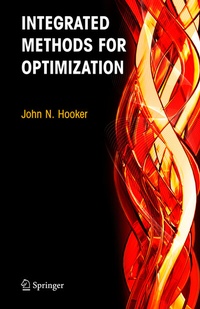
Integrated Methods for Optimization
Description

Integrated Methods for Optimization integrates the key concepts of Mathematical Programming and Constraint Programming into a unified framework that allows them to be generalized and combined. The unification of MP and CP creates optimization methods that have much greater modeling power, increased computational speed, and a sizeable reduction computational coding. Hence the benefits of this integration are substantial, providing the Applied Sciences with a powerful, high-level modeling solution for optimization problems. As reviewers of the book have noted, this integration along with constraint programming being incorporated into a number of programming languages, brings the field a step closer to being able to simply state a problem and having the computer solve it.
John Hooker is a leading researcher in both the Optimization and Constraint Programming research communities. He has been an instrumental principal for this integration, and over the years, he has given numerous presentations and tutorials on the integration of these two areas. It is felt by many in the field that the future Optimization courses will increasingly be taught from this integrated framework.
Reviews / Votes
From the reviews:
"Presents a synthesis of the integer programming and constraint programming approaches. . The book includes numerous examples and exercises. Hooker has done a particularly good job of organizing the . array of options within the framework. . the book will help readers to understand the algorithms used within various software packages . . This book is highly recommended, both as a reference for researchers working at the intersection of constraint programming and integer programming and as a textbook for graduate level courses . ." (Brian Borchers, MathDL, March, 2007)
"The book describes how many methods of mixed integer programming, constraint programming, continuous global optimization and local search fall into a common framework, which the author calls the 'search-infer-and-relax framework'. . is very well written, and well structured for its near 500 pages. The material is illustrated by numerous examples. . The book will be useful for practitioners inside the integer programming and the constraint programming communities, and for teachers and students of modelling and optimization classes." (Mechthild Opperud, Mathematical Reviews, Issue 2007 g)
"The book deals primarily with the unification of mathematical programming and constraint programming. It brings the methods of both fields under one roof, so that they and their combinations are all available to solve a problem. The book is intended for those who wish to learn about optimization from an integrated point of view, including researchers, software developers, and practitioners. It is also for postgraduate students interested in a unified treatment of the field." (Paulo Mbunga, Zentralblatt MATH, Vol. 1122 (24), 2007)
"Hooker presents a search-infer-and-relax framework for solving optimization problems, particularly combinatorial optimization problems. . This book and the whole area of integrated methods for combinatorialoptimization would be a good choice for an advanced graduate course. It provides a very accessible and detailed treatment of constraint programming for someone whose background is in optimization. . I found this book very enlightening with regard to the structures used in constraint programming, and especially as to how those structures can be exploited." (John E. Mitchell, SIAM Review, Vol. 50 (1), 2008)
"This is a very carefully written and interesting book. The author takes as his starting point the relatively recently created opportunity to bring together mathematical programming methods of optimization and constraint (logic) programming. . The book has been carefully proof-read and flows well. Although the book has been written in some senses as an advanced text book at PhD level, with exercises included, OR practitioners of optimization and all interested in modelling and solving structured deterministic problems will enjoy this book." (JM Wilson, Journal of the Operational Research Society, Vol. 59 (5), 2008)
More details
Other editions
New editions
Additional editions
Person
John Hooker is a leading researcher in both the Optimization and Constraint Programming research communities. He has been an instrumental principal for this integration, and over the years, he has given numerous presentations and tutorials on the integration of these two areas. It is felt by many in the field that the future Optimization courses will increasingly be taught from this integrated framework.
Prof. Hooker has published two earlier books on the methodologies of Optimization and Constraint Programming. The first was Optimization Methods for Logical Inference (Wiley 1999) and the second was Logic Based Methods for Optimization: Combining Optimization and Constraints Satisfaction (Wiley 2000). This book will be his third book in this evolving area and it is the book that completes the process of integrating these two methodologies into a single set of methods
