

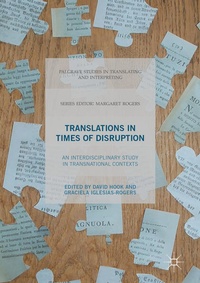
Translations In Times of Disruption
Description

This book throws light on the relevance and role played by translations and translators at times of serious discontinuity throughout history. Topics explored by scholars from different continents and disciplines include war, the disintegration of transnational polities, health disasters and revolutions - be they political, social, cultural and/or technological. Surprisingly little is known, for example, about the role that translated constitutions had in instigating and in shaping political crises at both a local and global level, and how these events had an effect on translations themselves. Similarly, the role that translations played as instruments for either building or undermining empires, and the extent to which interpreters could ease or hamper negotiations and foster new national identities has not been adequately acknowledged. This book addresses all these issues, among others, through twelve studies focused not just on texts but also on instances of verbal and non-verbal communications in a range of languages from around the world. This interdisciplinary work will engage scholars working in fields such as Translation Studies, History, Modern Languages, English, Law, Politics and Social Studies.
Reviews / Votes
"This collection offers a magnificent overview of translation as a mechanism of interpretation and mediation between the transnational world of ideas and practices, and conflictive local circumstances. Essential reading not only to specialists in translation theory but also to historians working in the booming fields of global and transnational history." (Dr. Eduardo Zimmermann, Universidad de San Andrés, Buenos Aires, Argentina.)"This collection of essays, produced by a number of well-established scholars as well as promising younger researchers from different countries and disciplines (history, law, medicine, etc.), explores the crucial role played by translators of diverse non-literary texts as agents of history. The result is a wide-ranging, compelling and engaging volume." (Dr. Francisco J. Romero Salvadó, University of Bristol, UK)
"A magnificent collection of essays that prove the worth of translation as a tool for interdisciplinary research. Readers will find in this truly engaging volume a trove of well-researched material, which demonstrates how a translated text can influence, condition or even determine how we look at history and society." (Dr. Javier Muñoz-Basols, University of Oxford, UK)
More details
Other editions
Additional editions
Persons
David Hook is Faculty Research Fellow at the Faculty of Medieval and Modern Languages of the University of Oxford. He is an active and eminent scholar; a volume of essays in his honour was published by the Hispanic Seminary of Medieval Studies, New York, in November 2013.
Graciela Iglesias-Rogers is Senior Lecturer in Modern European and Global Hispanic History at the University of Winchester and Associate Lecturer in Modern European and Latin American History at the Faculty of History, University of Oxford. She is also a former Reuters fellow with a long career as a leading foreign correspondent.
Content
Chapter 1. Introduction: Translations in Times of Disruption; David Hook and Graciela Iglesias-Rogers.- Chapter 2. Can constitutions be translated?: The case of the Cadiz Constitution in German; Horst Dippel.- Chapter 3. From Philos Hispaniae to Karl Marx: The first English translation of a Liberal Codex; Graciela Iglesias-Rogers.- Chapter 4. Distant disruption: Some Italian editions of the Costituzione Politica della Monarchia Spagnuola and their significance; David Hook.- Chapter 5. Translating into stone: The monument to the Constitution of Cadiz in Saint Augustine, Florida; M. C. Mirow.- Chapter 6. Translating the US Constitution for the federal cause in New Granada at the time of independence; Eduardo Posada-Carbó.- Chapter 7. Translations of medical texts of the Habsburg Monarchy in the long eighteenth century; Teodora Daniela Sechel.- Chapter 8. Translation, interpretation and the Danish Conquest of England, 1016; Emily A. Winkler.- Chapter 9. 'A True Translation': Translation as a weapon in the Peninsular War; 1808-1814; Alicia Laspra-Rodríguez.- Chapter 10. Anglo-Spanish transfers in Peninsular War poetry; 1808-1814: Translating and zero-translating; Agustín Coletes-Blanco.- Chapter 11. Globalization and the translation of minority languages in film subtitling; Gemma Martínez-Garrido.- Chapter 12. Resistance to the original: Polish translation at the turn of 1989; Kasia Szymanska.
