

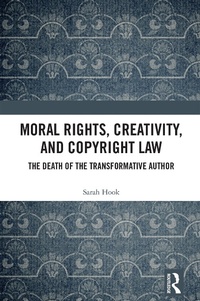
Moral Rights, Creativity, and Copyright Law
The Death of the Transformative Author
1st Edition
Published on 29. December 2023
188 pages
978-1-003-83503-5 (ISBN)
Description

This book argues that moral rights provisions in copyright law rest on a misunderstanding, or romanticisation, of the role of the author.
The Romantic conception of authorship, as a lone genius, creating from nothing, sensitive and vulnerable, has helped publishers push for strong copyright reform. But is this conception borne out in practice - especially in a world of meme culture, of artificial intelligence generated art and poetry, and of open source and fan fiction? This book probes the romantic vignette of the author through its legal adoption. Moral rights are rights that attach to the non-economic - for example, intellectual or emotional - interests of an author in their work. Much like defamation, moral rights see the right of reputation as superior to the right of freedom of expression. However, unlike defamation, moral rights are not protecting against defamatory actions against a person. In most jurisdictions, they are provisions set within copyright regimes; regimes whose purpose is to incentivise innovation. Challenging the way we think about authorship and how it should be protected by law, the book draws on a wide range of historical and contemporary examples to demonstrate how moral rights can constitute a barrier to transformative creativity. While authors and artists require strong rights to protect their ability to earn an income and incentivise creativity, moral rights, the book argues, may in turn actually harm their ability to do so.
This timely criticism of moral rights will appeal to researchers, students, policy makers and lawyers working in the area of intellectual property law, as well as legal theorists, sociolegal scholars and legal historians with relevant interests.
The Romantic conception of authorship, as a lone genius, creating from nothing, sensitive and vulnerable, has helped publishers push for strong copyright reform. But is this conception borne out in practice - especially in a world of meme culture, of artificial intelligence generated art and poetry, and of open source and fan fiction? This book probes the romantic vignette of the author through its legal adoption. Moral rights are rights that attach to the non-economic - for example, intellectual or emotional - interests of an author in their work. Much like defamation, moral rights see the right of reputation as superior to the right of freedom of expression. However, unlike defamation, moral rights are not protecting against defamatory actions against a person. In most jurisdictions, they are provisions set within copyright regimes; regimes whose purpose is to incentivise innovation. Challenging the way we think about authorship and how it should be protected by law, the book draws on a wide range of historical and contemporary examples to demonstrate how moral rights can constitute a barrier to transformative creativity. While authors and artists require strong rights to protect their ability to earn an income and incentivise creativity, moral rights, the book argues, may in turn actually harm their ability to do so.
This timely criticism of moral rights will appeal to researchers, students, policy makers and lawyers working in the area of intellectual property law, as well as legal theorists, sociolegal scholars and legal historians with relevant interests.
More details
Edition
1. Auflage
Language
English
Place of publication
London
United Kingdom
Publishing group
Taylor & Francis Ebooks
Target group
College/higher education
Illustrations
1 Line drawings, black and white; 1 Illustrations, black and white
ISBN-13
978-1-003-83503-5 (9781003835035)
Copyright in bibliographic data and cover images is held by Nielsen Book Services Limited or by the publishers or by their respective licensors: all rights reserved.
Schweitzer Classification
Other editions
Additional editions
Book
05/2025
1st Edition
Routledge
€67.00
Shipment within 10-20 days
Book
12/2023
1st Edition
Routledge
€216.10
Shipment within 10-20 days
Person
Sarah Hook is Senior Lecturer in the School of Law at Western Sydney University, Australia.
Content
1. Introduction 2. The Author-Work Bind 3. The Death of the Author and Contemporary Writing Practices 4. The History of Moral Rights 5. Examining the Benefits to a Right of Integrity 6. Curbing the Creative Commons 7. Conclusion: The Death of the Transformative Author
