

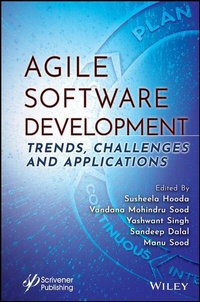
Agile Software Development
Description

A unique title that introduces the whole range of agile software development processes from the fundamental concepts to the highest levels of applications such as requirement analysis, software testing, quality assurance, and risk management.
Agile Software Development (ASD) has become a popular technology because its methods apply to any programming paradigm. It is important in the software development process because it emphasizes incremental delivery, team collaboration, continuous planning, and learning over delivering everything at once near the end. Agile has gained popularity as a result of its use of various frameworks, methods, and techniques to improve software quality. Scrum is a major agile framework that has been widely adopted by the software development community.
Metaheuristic techniques have been used in the agile software development process to improve software quality and reliability. These techniques not only improve quality and reliability but also test cases, resulting in cost-effective and time-effective software. However, many significant research challenges must be addressed to put such ASD capabilities into practice. With the use of diverse techniques, guiding principles, artificial intelligence, soft computing, and machine learning, this book seeks to study theoretical and technological research findings on all facets of ASD. Also, it sheds light on the latest trends, challenges, and applications in the area of ASD.
This book explores the theoretical as well as the technical research outcomes on all the aspects of Agile Software Development by using various methods, principles, artificial intelligence, soft computing, and machine learning.
Audience
The book is designed for computer scientists and software engineers both in research and industry. Graduate and postgraduate students will find the book accessible as well.
More details
Other editions
Additional editions
Persons
Susheela Hooda, PhD, is an assistant professor in the Department of Computer Science & Engineering, Chitkara University Institute of Engineering & Technology, Punjab, India.
Vandana Mohindru Sood, PhD, is an assistant professor in the Department of Computer Science & Engineering, Chitkara University Institute of Engineering & Technology, Punjab, India.
Yashwant Singh, PhD, is an associate professor & Head of the Department of Computer Science and Information Technology, Central University of Jammu, J&K, India.
Sandeep Dalal, PhD, is an assistant professor in the Department of Computer Science & Applications, Maharshi Dayanand University, Rohtak, Haryana, India.
Manu Sood, PhD. is a professor in the Department of Computer Science, Himachal Pradesh University, Shimla, India.
Content
Chapter 1 Agile Software Development in the Digital World - Trends and Challenges
Chapter 2 Agile Framework Adaptation Issues in Various Sectors
Chapter 3 Vulnerability Assessment Tools for IoT: An Agile Approach
Chapter 4 Interoperable Agile IoT
Chapter 5 Functional and Non-Functional Requirements in Agile Software Development
Chapter 6 Minimizing Cost, Effort, and Implementation Complexity for Adopting Security Requirements in an Agile Development Process for Cyber-Physical Systems
Chapter 7 A Systematic Literature Review on Test Case Prioritization Techniques
Chapter 8 A Systematic Review of the Tools and Techniques
Chapter 9 Distributed Agile Software Development (DASD) Process
Chapter 10 Task Allocation in Agile-Based Distributed Project Development Environment
Chapter 11 Software Quality Management by Agile Testing
Chapter 12 A Deep Drive into Software Development Agile Methodologies for Software Quality Assurance
Chapter 13 Factors and Techniques for Software Quality Assurance in Agile Software Development
Chapter 14 Classification of Risk Factors in Distributed Agile Software Development Based on User Story
Chapter 15 Software Effort Estimation with Machine Learning - A Systematic Literature Review
Chapter 16 Improving the Quality of Open Source Software
Chapter 17 Artificial Intelligence Enables Agile Software Development Life Cycle
Chapter 18 Machine Learning in ASD: An Intensive Study of Automated Disease Prediction Systems
Index
Preface
Agile Software Development (ASD) has become a popular technology because its methods apply to any programming paradigm. It is important in the software development process because it emphasizes incremental delivery, team collaboration, continuous planning, and learning over delivering everything at once near the end. Before finalizing anything, Agile goes through several iterations based on feedback. As a result, the process becomes more dynamic because everyone is working toward a common goal. Agile has gained popularity as a result of its use of various frameworks, methods, and techniques to improve software quality. Scrum is a major agile framework that has been widely adopted by the software development community.
Metaheuristic techniques have been used in the agile software development process to improve software quality and reliability. These techniques not only improve quality and reliability but also test cases, resulting in cost-effective and time-effective software. However, many significant research challenges must be addressed to put such ASD capabilities into practice. With the use of diverse techniques, guiding principles, artificial intelligence, soft computing, and machine learning, this book seeks to study theoretical and technological research findings on all facets of ASD. Also, it sheds light on the latest trends, challenges, and applications in the area of ASD.
This book will benefit the software development community by providing conceptual and technological solutions to problems that commonly arise when developing software. Furthermore, the 18 chapters herein were written by eminent experts in the fields of software testing, quality, and reliability in ASD. Following is a summary of the information presented in each chapter of the book.
- Chapter 1 provides a theoretical foundation for ASD and discovers problems and challenges that small, medium and large agile projects face when it comes to requirement engineering, and structuring probable proposals for improving the overall RE process. The goal of this chapter is also to discover the challenges of putting Agile into reality in the digital era.
- Chapter 2 sheds light on issues concerning the adaption of the Agile framework in various sectors. The issues found in various sectors could be resolved by addressing a need matrix, which will list a need of a particular sector, and a resolution matrix, which will list all proposed solutions for all listed needs in the need matrix. Also, different use cases are presented for more clarity on the resolution part in different sectors.
- Chapter 3 discusses the agile methods adopted to develop software projects dealing with growing vulnerabilities and threat implications. This adoption is necessary because agile methods are iterative in nature and facilitate service/product delivery in smaller batches, allowing developers to add security activities to software development via agile methodologies. Moreover, the reiterative aspect of this approach encourages the expansion of software that can very well come up with growing threat variants and vulnerabilities.
- Chapter 4 focuses on the importance of agile methodology in IoT. It highlights the functionalities of the AGILE-IoT project funded by the European Union and five pilot projects such as pollution monitoring, retail service, port-area monitoring, quantified self-application, and cattle monitoring. This chapter also discusses the interoperability of the AGILE-IoT project.
- Chapter 5 discusses the concepts of software requirements and their types (functional and non-functional requirements). It presents the various ways of gathering functional and non-functional requirements and testing them in the context of ASD.
- Chapter 6 presents the ASD framework and methodology and discusses the time and cost relation during software development. This study proposes a secure ASD methodology that includes three stages, namely aggressive training, prototype development stage, and actual development stage and maintenance.
- Chapter 7 caters to a systematic literature review on test case prioritization using agile methodology. The study concludes that the field of prioritization has been explored considerably and many prioritization techniques have evolved. However, there are still possibilities for improvements, especially in implementation and analysis. The study also highlights the current status of prioritization and provides a comparative analysis with similar works.
- Chapter 8 aims to provide deeper insights into the most current agile planning tools used by distributed agile professionals. The agile tools studied and compared are both open-source as well as proprietary tools. This chapter discusses the benefits of distributed ASD and the various distributed agile planning tools that are available to resolve these concerns.
- Chapter 9 sheds light on the concept of distributed ASD, its benefits, and the challenges which are faced by an agile software team during the software development process. It also discusses the various tools and techniques which are being currently used for agile development. Scrum is also discussed in detail in this chapter.
- Chapter 10 introduces an unsupervised learning-based model for assisting in project development activities such as task allocation and backlog prioritization. It also discusses how machine learning-based mechanisms can be applied at their lowest level to every activity of project management so that the processes of software project management become more useful, and may also help in faster, hassle-free delivery of the finished product.
- Chapter 11 sheds light on the usage of the JMeter software tool in ASD. The authors also suggest that JMeter may be an extremely useful tool for evaluating how to modify your web application server setup to decrease bottlenecks and boost performance.
- Chapter 12 analyzes software development agile methodologies from the viewpoint of software quality assurance and presents a technique to understand similarities in diverse agile processes. It also covers the various issues and controversies in ASD that are the grey areas of agile methodology related to innovative thinking, the cost of projects developed using agile methodologies, etc.
- Chapter 13 provides a detailed introduction to ASD, addresses its importance in the information technology sector, and presents a comprehensive overview of the factors and techniques followed by challenges and limitations of agile technology.
- Chapter 14 discusses the importance of software risk management in distributed agile software development (DASD) and also reviews the existing literature and presents risk factors associated with DASD. It further presents the current challenges in the existing literature and proposes a novel user story-based DASD risk classification technique, in addition to discussing the scope of improvement in DASD risk management that will help both practitioners and researchers.
- Chapter 15 assesses the present state of research trends and patterns of software effort estimation with machine learning techniques. It also evaluates the effect of numerous factors, such as cost and effort, concerning the accuracy of the various models related to effort estimation.
- Chapter 16 aims to develop a metrics-based code smells prediction model based on deep learning neural network technique. The research methodology proposed in this chapter is based upon the field of deep learning, which is an integrated field of machine learning associated with algorithms aroused by the arrangement and similarity of the brain, called artificial neural networks.
- Chapter 17 presents a plan and fosters a specialist framework to help the product designer in the total programming advancement life cycle with various space experts like telecom, banking, coordination, medical services, satellite, and a lot more information procurement. This chapter also contains the study of artificial intelligence, along with a brief discussion of its pros and cons.
- Chapter 18 introduces a module that was developed with the help of machine learning, which is very helpful in an emergency when a patient requires an immediate decision. Here, Agile software is designed to be very effective in detecting a particular disease more efficiently. In this specific system, preventing errors and malfunctions has been proven to be 95% effective in the medical field.
In closing, we would like to express our gratitude to our co-authors for their invaluable contributions, without which this book could not have been written. Also, our sincere thanks go to the reviewers for the timely manner in which they provided their insightful remarks. Last but not least, we give thanks to God for providing us with the wisdom and strength to complete this work effectively despite the challenging times.
We anticipate that the high-caliber research presented in this book will be useful to science, technology, and mankind.
Dr. Vandana Mohindru Sood
Assistant Professor, Department of Computer Science and Engineering, Chitkara University, Rajpura, Punjab, India
Dr. Ravindara Bhatt
Assistant Professor in the Department of Computer Science and Engineering, Chitkara University, Rajpura, Punjab, India
Dr. Yashwant Singh
Associate Professor & Head, Department of Computer Science & Information Technology, Central University of Jammu, J & K, India
Dr. Manu Sood
Professor, Department of...
