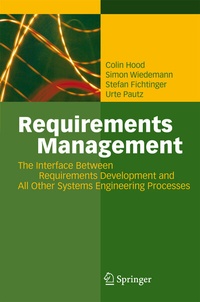
Requirements Management
Description

Requirements Management has proven itself to be an enormous potential for the optimization of development projects throughout the last few years. Especially in the climate of an increasingly competitive market Requirements Management helps in carrying out developments faster, cheaper and with a higher quality.
This book focuses on the interfaces of Requirements Management to the other disciplines of Systems Engineering, for example Project Management, Change Management and Configuration and Version Management.
To this end, an introduction into Requirements Management and Requirements Development is given, along with a short sketch of Systems Engineering, and especially the necessary inputs and resulting outputs of Requirements Management are explained. Using these flows of information it is shown how Requirements Management can support and optimize the other project disciplines and how very important therefore a functioning Requirements Management is for all areas of development.
Reviews / Votes
It is well known that incorrect requirements account for up to two-thirds of software defects in software products. And yet, too many software development organizations still do not have a formal requirements process. Those who do practice requirements management often do not fully understand the special relationships between requirements management and the other disciplines of software development. This book attempts to show how requirements form the thread that connects all the disciplines of software development - a relationship that has long eluded many software development organizations. For software development organizations that are looking for ways to do requirements traceability, this book can show them what to trace from and what to trace to. . Using the interfaces as described in the book, the authors demonstrate how an implemented feature can be traced back to the person or group that wanted it during the requirements elicitation. Another positive feature is the arrangement: it is organized so that it can be used as a reference book. For every aspect of the software development process, the reader can zero in on the particular area of interest to see how requirements management relates to that development discipline.
(In: Computing Reviews, April 2009, Boniface Nwugwo, Ellicott City, MD)
More details
Other editions
Additional editions