

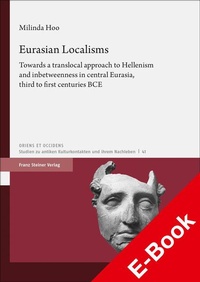
Eurasian Localisms
Description

From Mesopotamia to Central Asia, regions in central Eurasia in the Hellenistic period are often viewed, presented, and imbued with meaning as 'places in between' - cultural melting pots, resulting from a fusion of Eastern and Western cultures after Alexander the Great. Milinda Hoo critically explores scholarly understandings of cultural inbetweenness in the regions of Baktria, Parthia, and Babylonia in the third to first centuries BCE, focusing on the diverse ways in which the model of Hellenism has been used to make historical meaning out of eclectic material culture. The sites of Ai Khanum, Takht-i Sangin, Old Nisa, Seleukeia on the Tigris, and Babylon serve as core case studies to investigate perceptions of Hellenism in places that are considered culturally 'inbetween'. These form the foundation for a new translocal approach, based on globalization concepts, to better and more critically understand what we consider as Hellenism and localism in the East.
More details
Other editions
Additional editions
Person
ISNI:
Content
- Intro
- Contents
- List of figures
- Acknowledgements
- A note on spelling and style
- Part I: Contexts of Hellenism
- 1 Introduction
- 1.1 Setting the scene
- 1.2 Hellenistic Central Asia: a case for inbetweenness
- 1.2.1 Geographical inbetweenness
- 1.2.2 Temporal inbetweenness
- 1.3 Methodology
- 2 Hellenism's great debates
- 2.1 Hellenism: a history
- 2.1.1 The birth of a concept
- 2.1.2 Hellenism, empire, and colonialism
- 2.1.3 Post-war Hellenism
- 2.1.4 Postcolonialism and the limits of Hellenization
- 2.1.5 Postcolonialism, Orientalism, and the paradigm of continuity
- 2.2 New directions: hybridity and hybridization
- 2.2.1 Biological hybridity
- 2.2.2 Postcolonial hybridity
- 2.2.3 Hybridity in ancient history and archaeology
- 2.2.4 Hybridity and its discontents
- 2.3 Current trends: networks, globalization, and global perspectives
- 2.3.1 Networks and ancient globalization
- 2.3.2 Global perspectives and Hellenism now
- Part II: Cases of Hellenism
- 3 Ai Khanum on the Oxus
- 3.1 Introduction
- 3.2 Site context and features
- 3.3 Review
- 3.4 Hellenism and Greek identity
- 4 Takht-i Sangin and the Oxus Temple
- 4.1 Introduction
- 4.2 Site context and features
- 4.3 Review
- 4.4 Hellenism and religion
- 5 Old Nisa
- 5.1 Introduction
- 5.2 Site context and features
- 5.3 Review
- 5.4 Hellenism and Philhellenism
- 6 Seleukeia on the Tigris
- 6.1 Introduction
- 6.2 Site context and features
- 6.3 Review
- 6.4 Hellenism and hybridity
- 7 Hellenistic Babylon
- 7.1 Introduction
- 7.2 Site context and features
- 7.3 Review
- 7.4 Hellenism and localism
- Part III: Eurasian Localisms
- 8 Paradoxes of Hellenism
- 8.1 Baktria, Parthia, and Babylonia: a comparison
- 8.2 Hellenism and ethnicity baggage
- 8.3 The question of religion
- 8.4 The paradox of Philhellenism
- 8.5 Cultural reductions in cultural hybridity
- 8.6 The trouble with localism
- 9 Towards a translocal approach
- 9.1 Globalization in theory
- 9.1.1 Classics and globalization
- 9.1.2 Defining globalization
- 9.1.3 Complex connectivity
- 9.1.4 Time-space compression and deterritorialization
- 9.1.5 Glocalization and the local
- 9.1.6 Translocalism
- 9.2 Globalization in practice: outlook
- 9.2.1 A translocal view on Ai Khanum and Hellenism
- 9.2.2 A translocal view on Nisa and Hellenism
- 9.2.3 A translocal view on Takht-i Sangin and Hellenism
- 9.2.4 A translocal view on Babylon, Seleukeia, and Hellenism
- 10 Conclusion
- Abbreviations
- Bibliography
- Index
