

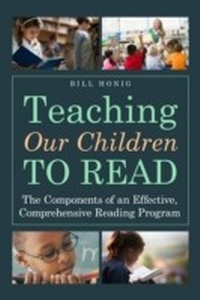
Teaching Our Children to Read
The Components of an Effective, Comprehensive Reading Program
1st Edition
Published on 6. May 2014
176 pages
978-1-62914-009-4 (ISBN)
Description

Studies of effective teaching practices have continued to validate the need for explicit and systematic instruction in basic reading skills, and Bill Honig uses this research to shed new light on an old problem-how to help all students become fluent readers.
Teaching Our Children to Read grows out of the experiences of scores of dedicated teachers and their success in the classroom. This book explores current research from the leading experts in the field, and presents new instructional strategies that bring all students to higher levels of literacy.
Highlights from Teaching Our Children to Read include:
. Phonics instruction and fluency
. Connected practice with decodable text
. Multisyllabic word instruction
. Spelling, vocabulary, and concept development
. Strategic reading, book discussions, and text organization
. Literacy benchmarks, assessment, and intervention
This is an essential resource for educators, administrators, policymakers, and parents concerned about how to successfully teach our children to read. Teaching Our Children to Read points the way to implementing the best research-based practices in adopting reading materials, training teachers, and providing the necessary school leadership.
Teaching Our Children to Read grows out of the experiences of scores of dedicated teachers and their success in the classroom. This book explores current research from the leading experts in the field, and presents new instructional strategies that bring all students to higher levels of literacy.
Highlights from Teaching Our Children to Read include:
. Phonics instruction and fluency
. Connected practice with decodable text
. Multisyllabic word instruction
. Spelling, vocabulary, and concept development
. Strategic reading, book discussions, and text organization
. Literacy benchmarks, assessment, and intervention
This is an essential resource for educators, administrators, policymakers, and parents concerned about how to successfully teach our children to read. Teaching Our Children to Read points the way to implementing the best research-based practices in adopting reading materials, training teachers, and providing the necessary school leadership.
More details
Other editions
Additional editions
Bill Honig
Teaching Our Children to Read
The Components of an Effective, Comprehensive Reading Program
Book
05/2014
Skyhorse Publishing
€14.50
Shipment within 3-4 weeks
Person
Bill Honig is the cofounder and president of CORE, a professional development organization for the implementation of comprehensive, research-based literacy programs. He is the author of Last Chance for Our Children: How You Can Help Save Our Schools and the Handbook for an Effective Reading Program. He lives in San Francisco, California.
Content
- Intro
- Dedication
- Title Page
- Copyright
- Contents
- Preface
- Acknowledgments
- About the Author
- 1. The Case for a Balanced Approach
- The Great Debate
- Successful Early Reading Programs in Practice Essential
- Components of an Effective Literacy Program
- Comprehensive and Balanced: Not the Same as Eclectic
- Summary
- 2. What Skilled Readers Do
- The Importance of Seeing Letter Combinations in Words
- The Importance of Connecting Letter Combinations With Discrete Sounds and Meaning
- Skills Needed to Become a Proficient Reader
- 3. Beginning-to-Read Instruction for Preschool and Kindergarten
- Listening and Responding to Stories at School and at Home
- Naming and Recognizing Letters
- The Importance of Phonemic Awareness
- Print Concepts
- Mastering a Few Sight Words
- Syntactic Awareness
- Summary
- 4. Beginning-to-Read Instruction for Early First Grade
- Decoding and Comprehension
- Recognizing Single Words
- Learning to Decode
- Reading and Comprehension
- Practice Makes Perfect: The Sequence of Becoming an Automatic Reader
- Reading Instruction for Early First Grade
- Individual Diagnosis and Benchmarks: Keys to Effective Instruction
- Combining Reading With Discussions and Feedback
- Specially Designed Books and Materials
- Correctness Versus Coverage
- The Importance of Timely, Early
- Intervention Individual and Group Tutoring
- Successful Reading Programs in the Classroom
- Grouping Strategies
- Determining Structure
- 5. Reading Instruction for Middle First Grade to Upper Elementary Grades
- A Book- and Story-Driven Strategy to Teach Skills
- First Principle: Match Books to Students' Levels
- Second Principle: Frequently Evaluate Students' Reading
- Continued Phonics, Spelling, and Decoding Support
- Multisyllabic Word Instruction
- 6. Spelling, Beginning Writing, and Vocabulary
- Spelling
- Stages of Spelling Development
- Teaching Spelling
- Beginning Writing
- Vocabulary
- 7. Comprehension and Assessment
- Independent, Wide Reading
- Strategic Reading
- Book Discussions
- Assessment
- 8. Writing and Speaking
- Written and Oral Applications
- Writing
- 9. Frequently Asked Questions
- 10. Conclusions
- Resource A
- Resource B: The Role of Skills in a Comprehensive Elementary Reading Program-24 Major Points
- References
- Suggested Reading
- Index
