

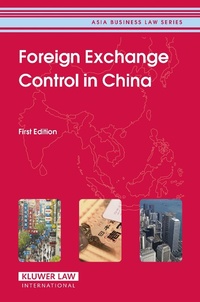
Foreign Exchange Control in China
Published on 7. September 2005
410 pages
978-90-411-8087-2 (ISBN)
Description

Foreign Exchange Control in China lays out comprehensively the compliance requirements, procedures and documentation for the conduct of foreign exchange transactions in China.
Written in an easy-to-read format, the book is designed to help readers understand and handle the various complicated aspects and requirements of foreign exchange control in China, Compliance requirements for the current and capital accounts, foreign exchange settlements, use and administration of foreign exchange accounts, foreign debts and guarantees, import, export, service trade, bonded zones and qualified foreign institutional investors are closely examined with a list of the procedures to follow and applicable documentation provided.
Contents are specially included to assist foreign investors deal with foreign exchange requirements whilst operating in China, including those for capital movements and remittance of profits and dividends out of China.
Foreign Exchange Control in China is an indispensable guide to foreign investors and multinational companies as well as to lawyers, financial, accounting and tax professionals.
Written in an easy-to-read format, the book is designed to help readers understand and handle the various complicated aspects and requirements of foreign exchange control in China, Compliance requirements for the current and capital accounts, foreign exchange settlements, use and administration of foreign exchange accounts, foreign debts and guarantees, import, export, service trade, bonded zones and qualified foreign institutional investors are closely examined with a list of the procedures to follow and applicable documentation provided.
Contents are specially included to assist foreign investors deal with foreign exchange requirements whilst operating in China, including those for capital movements and remittance of profits and dividends out of China.
Foreign Exchange Control in China is an indispensable guide to foreign investors and multinational companies as well as to lawyers, financial, accounting and tax professionals.
More details
Other editions
Additional editions
Book
09/2005
Kluwer Law International
€291.17
Shipment within 10-20 days
Content
- Cover
- Half Title Page
- Title Page
- Copyright Page
- FOREWORD
- ABOUT THE AUTHOR
- PREFACE
- Table of Contents
- ABBREVIATIONS
- PART I - AN INTRODUCTION TO FOREIGN EXCHANGE CONTROL
- 1 History and Evolution
- ¶1-100 Introduction
- ¶1-200 History of foreign exchange control in the world
- ¶1-300 History and evolution of foreign exchange control in China
- ¶1-400 Present legal framework of foreign exchange control of China
- 2 Modes and Objectives
- ¶2-100 Modes of foreign exchange control
- ¶2-200 Objectives of foreign exchange control
- PART II - FOREIGN EXCHANGE CONTROL AND REGULATIONS OF CHINA
- 3 The Current Account
- ¶3-100 Components
- ¶3-200 Goods trade transactions
- ¶3-300 Service, income and current transfer transactions
- ¶3-310 International service trade
- ¶3-320 Foreign exchange control of non-trade transactions in China
- ¶3-400 Regulations of the current account
- 4 The Capital Account
- ¶4-100 Introduction
- ¶4-110 Capital and financial account
- ¶4-120 Overview of foreign exchange control of the capital account
- ¶4-200 Foreign debts
- ¶4-210 Categories of foreign debts
- ¶4-220 Administration of foreign debts
- ¶4-230 Registration of foreign debts
- ¶4-300 International commercial loans and external guarantees
- ¶4-310 International commercial loans
- ¶4-320 External guarantees
- ¶4-400 Security investments
- ¶4-500 Direct investments
- ¶4-510 Investments abroad
- ¶4-520 Foreign direct investment
- ¶4-600 Regulations of the capital account
- 5 Foreign Exchange Market and Foreign Exchange Operations of Financial Institutions
- ¶5-100 Introduction
- ¶5-200 International exchange rate systems and RMB exchange rate
- ¶5-210 Exchange rate system classification
- ¶5-220 Quoting of exchange rate
- ¶5-230 RMB exchange rate
- ¶5-300 Foreign exchange markets in China
- ¶5-310 China Foreign Exchange Trading System (CFETS)
- ¶5-320 Retail foreign exchange market
- ¶5-400 Control of foreign exchange operations of financial institutions
- ¶5-410 Financial institutions in China
- ¶5-420 Foreign exchange business
- ¶5-430 Market admission and termination of foreign exchange business
- ¶5-440 Supervision of foreign exchange business
- ¶5-500 Foreign-funded financial institutions
- ¶5-510 Foreign-funded financial institutions in China
- ¶5-520 Establishment and registration
- ¶5-600 Regulations for control of foreign exchange market and financial institutions in China
- 6 Balance of Payments and Foreign Exchange Statistics
- ¶6-100 Balance of payments (BoP)
- ¶6-200 Administration of BoP in China
- ¶6-210 Basic definitions of BoP reporting in China
- ¶6-220 Transaction subjects and responsibilities
- ¶6-300 How to deal with BoP reporting in China
- ¶6-310 Indirect reporting
- ¶6-320 Direct reporting
- ¶6-400 Administration of foreign exchange statistics in China
- ¶6-500 Regulations on BoP administration and foreign exchange statistics
- 7 Foreign Exchange Inspection and Penalties
- ¶7-100 Introduction
- ¶7-200 Illegal practices and penalties
- ¶7-205 Evasion of foreign exchange
- ¶7-210 Acquiring foreign exchange illegally
- ¶7-215 Unauthorised foreign exchange operations
- ¶7-220 Illicit use of foreign exchange
- ¶7-225 Buying and selling foreign exchange illegally
- ¶7-230 Foreign exchange accounts violations
- ¶7-235 Settlements and sales in foreign exchange violations
- ¶7-240 Import and export verification violations
- ¶7-245 Foreign debts violations
- ¶7-250 Foreign exchange market violations
- ¶7-255 Exchange rate violations
- ¶7-260 Reporting of BoP statistics violations
- ¶7-265 Foreign exchange statistics violations
- ¶7-300 Foreign exchange inspection
- ¶7-400 Regulations on foreign exchange inspection and penalties
- PART III - PRACTICAL GUIDELINES FOR FOREIGN EXCHANGE TRANSACTIONS IN CHINA
- PART III - INTRODUCTION
- 8 Foreign Exchange Accounts
- ¶8-100 Introduction
- ¶8-200 Administration of the foreign exchange account
- ¶8-210 Account for current account transactions
- ¶8-220 Account for capital account transactions
- ¶8-230 Overseas foreign exchange account
- ¶8-300 Guidelines for the administration of foreign exchange accounts
- ¶8-310 Opening of foreign exchange account for current account transactions
- ¶8-320 Changes to foreign exchange account for current account transactions
- ¶8-330 Closing of foreign exchange account for current account transactions
- ¶8-340 Opening, closing of and changes to foreign exchange account under the capital account
- ¶8-350 Opening, closing of and changes to overseas account
- ¶8-360 Domestic foreign exchange transfer
- 9 Foreign Exchange Control Compliance Requirements for Foreign Investment Enterprises
- ¶9-100 Introduction
- ¶9-110 Basic types of FIEs in China
- ¶9-120 FIEs subject to foreign exchange control
- ¶9-200 Foreign exchange control regulations for FIEs
- ¶9-300 Compliance guidelines for FIE
- ¶9-310 Foreign exchange registration
- ¶9-320 Capital change of FIE and outward remittance
- ¶9-330 Outward remittance of profits, dividends, bonuses of FIEs
- ¶9-340 Annual foreign exchange inspection of FIE
- ¶9-350 Foreign exchange income and expenditure of FIE
- 10 Verification of Export Collection
- ¶10-100 Introduction
- ¶10-200 Guidelines for verification of export collection in foreign exchange
- ¶10-202 Exporter record
- ¶10-204 Applying and acquiring verification certificate
- ¶10-206 Exporter's administration of verification certificate
- ¶10-208 Registration of use of verification certificate through CHINAPORT
- ¶10-210 Export declaration at customs
- ¶10-212 Registration of used verification certificate via CHINAPORT
- ¶10-214 Special voucher for verification of export collection
- ¶10-216 Ordinary trade mode
- ¶10-218 Barter trade
- ¶10-220 Processing of materials supplied from outside of China
- ¶10-222 Compensation trade
- ¶10-224 Export under contract with foreigner
- ¶10-226 Frontier trade in small amounts
- ¶10-228 Returned goods
- ¶10-230 Bonded factory trade
- ¶10-232 Consignment trade
- ¶10-234 Processing of imported materials by FIE
- ¶10-236 Export by agent
- ¶10-238 Export settled by foreign currency cash notes
- ¶10-240 Difference in export collection
- ¶10-242 Recording for future verification
- ¶10-244 Export collection elsewhere
- ¶10-246 Exporters by classification
- 11 Verification of ImportPayment
- ¶11-100 Introduction
- ¶11-200 Guidelines for verification of import payment
- ¶11-210 Importer recording and Importers List
- ¶11-215 Importers Blacklist
- ¶11-220 Recording of import payment
- ¶11-225 Recording of payment elsewhere
- ¶11-230 Recording of goods arrival after 180 days
- ¶11-235 Recording of genuineness examination
- ¶11-240 Import payment by L/C, D/A and D/P
- ¶11-245 Import payment by T/T
- ¶11-250 Import payment for FIE equipment
- ¶11-255 Transfer-for-advanced-processing
- ¶11-260 Returned goods
- ¶11-265 Entreport trade
- 12 Foreign Exchange Administration of Service Trade and Individuals
- ¶12-100 Introduction
- ¶12-110 Non-trade transactions in China
- ¶12-140 Foreign exchange administration of non-trade transactions
- ¶12-160 Taxation certificate for payments in non-trade transactions
- ¶12-200 Guidelines for non-trade transactions
- ¶12-210 Foreign exchange income of residential individuals
- ¶12-215 Sales and payments in foreign exchange by residential individuals
- ¶12-220 Foreign exchange accounts of residential individuals
- ¶12-225 Foreign exchange administration of non-residential individuals
- ¶12-230 Foreign exchange for going abroad on duty
- ¶12-235 Carrying foreign exchange cash in and out of China
- ¶12-240 International travel
- ¶12-245 Intangible assets
- ¶12-250 International ocean transportation
- ¶12-255 International communication services
- ¶12-260 Ocean fishery
- ¶12-265 International air ticket sales
- 13 Bonded Zones, QFII & M&A
- ¶13-000 Introduction
- ¶13-100 Foreign exchange administration of bonded zones
- ¶13-120 Foreign exchange registration and annual inspection
- ¶13-150 Foreign exchange account administration
- ¶13-180 Use of foreign exchange account and surrenders and sales in foreign exchange
- ¶13-200 Foreign exchange administration of QFII
- ¶13-220 Qualification of QFII
- ¶13-240 Investment quota of QFII
- ¶13-260 Special account of QFII
- ¶13-280 Conversion and remittance by QFII
- ¶13-300 Mergers and acquisitions
- ¶13-320 Application for M&A
- ¶13-350 Payment and transfer for M&A
- 14 Foreign Exchange Administration of Banking
- ¶14-100 Introduction
- ¶14-200 Exchange rate administration by the bank
- ¶14-300 Payment by L/C
- ¶14-400 Payment by D/P or D/A
- ¶14-500 Trade prepayment by T/T
- ¶14-600 Trade payment by T/T
- ¶14-700 Non-trade payment by T/T
- PART IV - MISCELLANEOUS
- PART IV - INTRODUCTION
- 15 Latest Developments and Future of Foreign Exchange Control in China
- ¶15-100 Controversies
- ¶15-200 Role of SAFE
- ¶15-400 RMB exchange rate
- ¶15-600 Convertibility of RMB under the capital account
- ¶15-800 Future
- PART V - FAQs
- 16 Frequently-asked Questions and Answers
- ¶16-000 Introduction
- ¶16-010 What is foreign exchange in China?
- ¶16-020 What is the purpose of foreign exchange control?
- ¶16-030 Why does China practise foreign exchange control? What foreign exchange control measures in general does China adopt?
- ¶16-040 Now that China has committed to the absolute convertibility of the RMB under the current account, why is it still necessary for enterprises to undergo documentary processing when making external payments for transactions under the current account?
- ¶16-050 Why is registration of a foreign debt necessary? Is registration of the foreign debt a form of guarantee provided by the state?
- ¶16-060 What is balance of payments (BoP)? What is and why does China adopt a BoP reporting system?
- ¶16-070 Why does China adopt the import and export verification system? Will the verification system exert negative influence on ordinary imports and exports?
- ¶16-080 What is a "settlement" or "surrender" in foreign exchange?
- ¶16-090 What is a "sale" in foreign exchange?
- ¶16-100 What are the compliance requirements for the foreign exchange account of cash notes for both entities and individuals?
- ¶16-110 What are the disadvantages in PBC not publishing the exchange rates of all freely-convertible currencies?
- ¶16-120 What initial registrations are necessary for a new FIE with SAFE?
- ¶16-130 How does a FIE remit abroad its profits, dividends and bonuses?
- ¶16-140 If the registered capital of the FIE has not been paid in full, can its profits, dividends and bonuses be remitted abroad?
- ¶16-150 How does a non-residential employee of a domestic entity, including foreigners, overseas Chinese, those from Hong Kong, Macao and Taiwan, remit their wages, bonuses and subsidies abroad?
- ¶16-160 What are the causes of problems in a FIE's daily foreign exchange receipts and payments? How can these problems be avoided?
- ¶16-170 Can a FIE borrow from its foreign parent company or investors?
- ¶16-180 If the FIE is closed down and liquidated, how can the final funds be remitted abroad?
- ¶16-190 Is the registered capital of a FIE transferable upon its liquidation?
- ¶16-200 What foreign exchange income and expenditure of the FIE must be approved by SAFE before processing at the bank?
- ¶16-210 Can a Chinese-funded bank provide offshore banking services to its customers?
- PART VI - LEGISLATION
- ¶17-000 Rules of the People's Republic of China on Foreign Exchange Control
- ¶18-000 Administrative Regulations on Foreign Exchange Settlements, Sales and Payments
- ¶19-000 Administrative Regulations on Domestic Foreign Exchange Accounts
- ¶20-000 Provisional Regulations on the Monitoring of External Debt
- ¶30-000 Appendix
- INDEX
- Back Cover
