

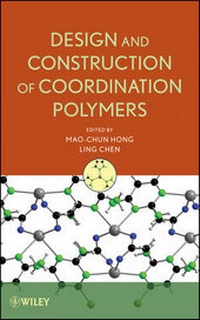
Design and Construction of Coordination Polymers
Description

Reviews / Votes
"The sum of the individual components makes the whole a usefulreference to complement other recent contributions on the subjectof CPs." (JACS, 2010)More details
Other editions
Additional editions
Persons
Content
Preface.
1 Coordinative Flexibility of Monovalent Silver in [AgI!L1]L2 Complexes (Gerd Meyer, Muhamet Sehabi, and Ingo Pantenburg).
1.1 Introduction.
1.2 Ligands L1 with 1,2 N-Donor Functions.
1.3 Ligands L1 with 1,3 N-Donor Functions.
1.4 Ligands L1 with 1,4 N-Donor Functions.
1.5 Conclusions.
References.
2 Indium(III)-Organic Coordination Polymers with Versatile Topological Structures Based on Multicarboxylate Ligands (Lian Chen, Fei-Long Jiang, Zheng-Zhong Lin, and Mao-Chun Hong).
2.1 Introduction.
2.2 Architectures Constructed by In(III) and Benzenedicarboxylates.
2.3 Architectures Constructed by In(III) and Benzenetricarboxylates.
2.4 Architectures Constructed by In(III) and Other Benzenemulticarboxylates.
2.5 Luminescence, Ion Exchange, and Hydrogen Storage.
2.6 Conclusions.
References.
3 Crystal Engineering of Coordination Polymers via Solvothermal In Situ Metal-Ligand Reactions (Jie-Peng Zhang and Xiao-Ming Chen).
3.1 Introduction.
3.2 Metal-Redox Reaction.
3.3 Conversion of Carboxylic Acid.
3.4 Carbon-Carbon Bond Formation.
3.5 Heterocycle Formation from Small Molecules.
3.6 Transformation of Sulfur-Containing Ligands.
3.7 Conclusions.
References.
4 Construction of Some Organic-Inorganic Hybrid Complexes Based on Polyoxometalates (Can-Zhong Lu, Quan-Guo Zhai, Xiao-Yuan Wu, Li-Juan Chen, Shu-Mei Chen, Zhen-Guo Zhao, and Xiao-Yu Jiang).
4.1 Introduction.
4.2 Complexes Built Up by POMs with 1,2,4-Triazolate and Its Derivatives.
4.3 Complexes Built Up by Molybdenum Oxide Chains with Pyridine Derivatives.
4.4 Conclusions.
References.
5 Silver(I) Coordination Polymers (Cheng-Yong Su, Chun-Long Chen, Jian-Yong Zhang, and Bei-Sheng Kang).
5.1 Introduction.
5.2 Coordination Geometries of Ag þ Ions.
5.3 Ligands in Silver(I) Coordination Polymers.
5.4 Supramolecular Interactions and Counter Anions in Silver(I) Coordination Polymers.
5.5 One- to Three-Dimensional Coordination Polymers Based on Silver-Ligand Coordination Bonds.
5.6 Intertwining or Interpenetrating of Silver(I) Coordination Polymers.
5.7 Properties of Silver(I) Coordination Polymers.
References.
6 Tuning Structures and Properties of Coordination Polymers by the Noncoordinating Backbone of Bridging Ligands (Miao Du and Xian-He Bu).
6.1 Introduction.
6.2 Ligand Design for Coordination Polymers.
6.3 Role of Noncoordinating Backbones of Bridging Ligands.
6.4 Conclusions.
References.
7 Ferroelectric Metal-Organic Coordination Compounds (Heng-Yun Ye, Wen Zhang, and Ren-Gen Xiong).
7.1 Introduction.
7.2 Homochiral Discrete or Zero-Dimensional MOCCs.
7.3 Acentric MOCPs Produced by Supramolecular Crystal Engineering.
7.4 Homochiral MOCPs Constructed with Optical Organic Ligands.
7.5 Conclusions.
References.
8 Constructing Magnetic Molecular Solids by Employing Three-Atom Ligands as Bridges (Xin-Yi Wang, Zhe-Ming Wang, and Song Gao).
8.1 Introduction.
8.2 Coordination Characteristics of Three-Atom Bridges and Their Role in Mediating Magnetic Interaction.
8.3 Co-Ligands, Templating Cations, and Other Short Bridges.
8.4 Magnetic Molecular Solids Based on Three-Atom Bridges.
8.5 Conclusions.
References.
9 Structures and Properties of Heavy Main-Group Iodometalates (Li-Ming Wu and Ling Chen).
9.1 Introduction.
9.2 Structural Features of Iodobismuthates and Iodoplumbates.
9.3 Structural Modification.
9.4 Optical and Thermal Properties.
9.5 Summary.
References.
10 Cluster-Based Supramolecular Compounds from Mo(W)/Cu/S Cluster Precursors (Jian-Ping Lang, Wen-Hua Zhang, Hong-Xi Li, and Zhi-Gang Ren).
10.1 Introduction.
10.2 Strategies for Design and Assembly.
10.3 Structural Features.
10.4 Luminescent and Third-Order Nonlinear Optical Properties.
10.5 Conclusions.
References.
11 Microporous Metal-Organic Frameworks as Functional Materials for Gas Storage and Separation (Long Pan, Kun-Hao Li, JeongYong Lee, David H. Olson, and Jing Li).
11.1 Introduction.
11.2 Design, Rational Synthesis, and Structure Description.
11.3 Structure Stability, Permanent Microporosity, and Hydrogen Adsorption.
11.4 Hydrocarbon Adsorption.
11.5 Ship-in-Bottle Synthesis.
11.6 Summary and Conclusions.
References.
12 Design and Construction of Metal-Organic Frameworks for Hydrogen Storage and Selective Gas Adsorption (Sheng-Qian Ma, Christopher D. Collier, and Hong-Cai Zhou).
12.1 Introduction.
12.2 Hydrogen Storage in Porous Metal-Organic Frameworks.
12.3 Porous Metal-Organic Frameworks for Selective Gas Adsorption.
12.4 Outlook.
References.
13 Structure and Activity of Some Bioinorganic Coordination Complexes (Jin-Tao Wang, Yu-Jia Wang, Ping Hu, and Zong-Wan Mao).
13.1 Introduction.
13.2 Biomimetic Modeling of a Metalloenzyme with a Cluster Structure.
13.3 Bioinspired Complexes with a Recognition Domain.
13.4 Functional Complexes as Therapeutic Agents.
13.5 Conclusions.
References.
Index.
