

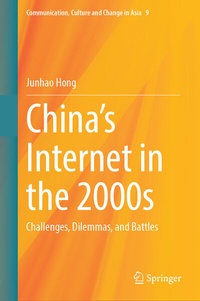
China's Internet in the 2000s
Description

This book studies China's Internet in the 2000s, with a focus on the challenges and dilemmas of the authorities and the battles between the authorities and the newly networked society in the cyber space, which has been a critical centerpiece in the Chinese authorities' struggle for political stability. The book also examines the distinct technological means and political/legal regulations/restrictions used for Internet control, unique characteristics, and the implications of their influences on the political change and social transformation of the world's most populous country. It illuminates the fierce competition between the authorities and the newly networked Chinese society by looking at how Chinese netizens make every possible effort to gain access to the Internet for truth and make their voices and views heard, while how the authorities use whatever possible means to prevent that from happening. The in-depth analyses of how these challenges, dilemmas and battles have been affecting and changing China's political system, the ruling communist ideology, the public's access to information as well as the expression of the public's discourse are relevant to policymakers and analysts in both business and government sectors, as well as scholars and researchers with an interest in Asian Studies, Chinese Studies, communication, new media, political science, and sociology.
More details
Other editions
Additional editions
Person
Junhao Hong is Professor in the Department of Communication at The State University of New York at Buffalo, USA. He received his PhD in communication from University of Texas at Austin, USA. His research focuses on international communication and international politics, media and society, and impact of new media and new communication/information technology. He has published a dozen or so books and numerous research articles and book chapters.
Content
Introduction.- The Interplay of Authorities and Netizens over the Internet.- The Architectural History of China's Internet.- The Challenge and Dilemma of Using the Internet for Social Development or Political Stability.- The Macro Socio-Political Control of the Internet.- The Micro Technical Control of the Internet.- Netizens' Anti-Control of the Internet.- The Chinese Netizens In The New Chinese Society.- The Enduring Impacts and Implications.- Conclusion.
