

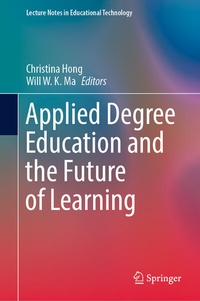
Applied Degree Education and the Future of Learning
Description

This book draws on the responses to learning and teaching and applied education futures thinking, that provide insights into the future of learning. It brings together more than 30 novel and important applied research and scholarly contributions from around the world, including Australia, Canada, Finland, Germany, Hong Kong, Japan, Macau, Mainland China, Malaysia, Morocco, Pakistan, and the UK. The chapters, including reflective essays and practice-based case examples, are divided into five major themes:
Future ready values and competencies for the future of work
Innovative pedagogies in applied degree learning and training
Driving student access, engagement, and success through digital technologies
Intelligent technologies: Embedding the new world of work into applied degrees
Lifelong learning, partnering, and the future of work
This book is important for readers interested in international perspectives on the future of work and professional education.
More details
Other editions
Additional editions
Persons
Professor Christina Hong, Ph.D., is President of Technological and Higher Education Institute of Hong Kong (THEi). She has a strong background in educational management and leadership with an emphasis on organizational change management, curriculum transformation, technology-enhanced learning, and teacher praxis across the school, VET, and higher education sectors. Her prior roles include senior executive roles in the TAFE and university sectors in Australia as well as national educational reform and leadership roles in New Zealand. She is particularly interested in how tertiary institutions foster C21st employability skills, the dynamic of innovation ecosystems, and collaboration through internationalization and applied research activities. Together with Dr Will Ma, she has co-edited two thematic publications: Applied degree education and the future of work (2020) and this current edition.
Will W. K. Ma, Ph.D., is Head of the Learning Commons & Digital Innovation, Technological and Higher Education Institute of Hong Kong (THEi). The Learning Commons & Digital Innovation is responsible for providing physical learning space, information technology services, physical and online learning resources for staff and students to promote applied research and to enhance learning. He is also a champion of staff development, especially in technology-enhanced learning. His research focuses on the use of information systems for communication, knowledge sharing, and knowledge creation. He has publications in Computers & Education, Computers in Human Behavior, Journal of Computer Assisted Learning, International Journal of Communications, Law and Policy, and Information & Management. He was Co-editor of the Journal of Communication and Education (2015-Present) and Editor of Cogent Social Sciences (2017-2019).
