

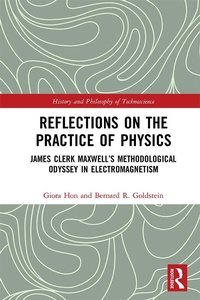
Reflections on the Practice of Physics
James Clerk Maxwell's Methodological Odyssey in Electromagnetism
1st Edition
Published on 24. February 2020
274 pages
978-1-000-03064-8 (ISBN)
Description

This monograph examines James Clerk Maxwell's contributions to electromagnetism to gain insight into the practice of science by focusing on scientific methodology as applied by scientists. First and foremost, this study is concerned with practices that are reflected in scientific texts and the ways scientists frame their research. The book is therefore about means and not ends.
More details
Series
Edition
1. Auflage
Language
English
Place of publication
London
United Kingdom
Publishing group
Taylor & Francis Ltd
Target group
College/higher education
ISBN-13
978-1-000-03064-8 (9781000030648)
Copyright in bibliographic data and cover images is held by Nielsen Book Services Limited or by the publishers or by their respective licensors: all rights reserved.
Schweitzer Classification
Other editions
Additional editions
Giora Hon | Bernard R. Goldstein
Reflections on the Practice of Physics
James Clerk Maxwell's Methodological Odyssey in Electromagnetism
Book
09/2021
1st Edition
Routledge
€67.90
Shipment within 10-20 days
Giora Hon | Bernard R. Goldstein
Reflections on the Practice of Physics
James Clerk Maxwell's Methodological Odyssey in Electromagnetism
Book
02/2020
1st Edition
Routledge
€193.50
Shipment within 15-20 days
Persons
Giora Hon is a professor of the History and Philosophy of Science in the Department of Philosophy, University of Haifa.
Bernard R. Goldstein is a historian of science and University Professor Emeritus at the University of Pittsburgh.
Bernard R. Goldstein is a historian of science and University Professor Emeritus at the University of Pittsburgh.
Content
1. Introduction
1.1. Methodology: Framing scientific knowledge
1.2. An Overview of Maxwell's approach to methodology
1.3. Maxwell's initial publication of 1856 (an abstract)-placing methodology at the forefront
1.4. Methodology as an essential feature of scientific practice: The case of Maxwell
1.5. The argument
2. Maxwell's choice: Faraday vs. Ampere
2.1. Michael Faraday (1791-1867) and James Clerk Maxwell: A unique relation
2.2. Andre-Marie Ampere (1775-1836): The contrast
3. Thomson, Stokes, Rankine, and Thomson and Tait
3.1. Introduction: Methodology in electromagnetism
3.2. William Thomson (1824-1907): From analogy to representation
3.3. George Stokes (1819-1903): Idealization
3.4. William J. M. Rankine (1820-1872): Energy-a novel unifying concept
3.5. William Thomson and Peter Tait (1831-1901): Abstract dynamics
3.6. Conclusion
4. Station 1 (1856-1858): On Faraday's lines of force
4.1. A novel methodology: Modifying the methodology of analogy
4.2. The structure of Maxwell's argument
4.3. From the general to the specific
4.4. Confronting Ampere's theory
4.5. Conclusion
4.6. Appendix: A bibliographical note on Maxwell 1858
5. Station 2 (1861-1862): On physical lines of force
5.1. Introduction
5.2. Preliminary: From instrumentalism to causality
5.3. The methodology: Linking hypothesis to representation
5.4. Applying the methodology: Assumptions and their consequences
5.5. Part III: A landmark in the history of physics
5.6. Conclusion
6. Station 3 (1865): A dynamical theory of the electromagnetic field
6.1. Introduction
6.2. Part I: Marking the goal-the construction of a formal theory consisting of a set of general equations
6.3. Part II: The flywheel analogy
6.4. The methodology of reversing the argument
6.5. Intermediate summary
6.6. A physical theory in symbolic language
6.7. Conclusion
7. Station 4 (1873): A treatise on electricity and magnetism
7.1. Introduction
7.2. Framework
7.3. Novel methodologies
7.4. The impact of the new methodologies on the construction of the theory
7.5. Conclusion
8. Philosophical reflections on Maxwell's methodological odyssey
8.1. Commitment
8.2. Modifications of methodologies
8.3. Methodologies in Maxwell's practice
8.4. Concluding remarks
9. References
1.1. Methodology: Framing scientific knowledge
1.2. An Overview of Maxwell's approach to methodology
1.3. Maxwell's initial publication of 1856 (an abstract)-placing methodology at the forefront
1.4. Methodology as an essential feature of scientific practice: The case of Maxwell
1.5. The argument
2. Maxwell's choice: Faraday vs. Ampere
2.1. Michael Faraday (1791-1867) and James Clerk Maxwell: A unique relation
2.2. Andre-Marie Ampere (1775-1836): The contrast
3. Thomson, Stokes, Rankine, and Thomson and Tait
3.1. Introduction: Methodology in electromagnetism
3.2. William Thomson (1824-1907): From analogy to representation
3.3. George Stokes (1819-1903): Idealization
3.4. William J. M. Rankine (1820-1872): Energy-a novel unifying concept
3.5. William Thomson and Peter Tait (1831-1901): Abstract dynamics
3.6. Conclusion
4. Station 1 (1856-1858): On Faraday's lines of force
4.1. A novel methodology: Modifying the methodology of analogy
4.2. The structure of Maxwell's argument
4.3. From the general to the specific
4.4. Confronting Ampere's theory
4.5. Conclusion
4.6. Appendix: A bibliographical note on Maxwell 1858
5. Station 2 (1861-1862): On physical lines of force
5.1. Introduction
5.2. Preliminary: From instrumentalism to causality
5.3. The methodology: Linking hypothesis to representation
5.4. Applying the methodology: Assumptions and their consequences
5.5. Part III: A landmark in the history of physics
5.6. Conclusion
6. Station 3 (1865): A dynamical theory of the electromagnetic field
6.1. Introduction
6.2. Part I: Marking the goal-the construction of a formal theory consisting of a set of general equations
6.3. Part II: The flywheel analogy
6.4. The methodology of reversing the argument
6.5. Intermediate summary
6.6. A physical theory in symbolic language
6.7. Conclusion
7. Station 4 (1873): A treatise on electricity and magnetism
7.1. Introduction
7.2. Framework
7.3. Novel methodologies
7.4. The impact of the new methodologies on the construction of the theory
7.5. Conclusion
8. Philosophical reflections on Maxwell's methodological odyssey
8.1. Commitment
8.2. Modifications of methodologies
8.3. Methodologies in Maxwell's practice
8.4. Concluding remarks
9. References
