

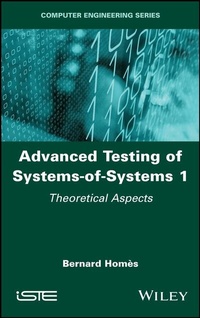
Advanced Testing of Systems-of-Systems, Volume 1
Description

Based on more than 40 years of practice in the development and testing of systems, including safety-critical systems, this book discusses development models, testing methodologies and techniques, and identifies their advantages and disadvantages.
Pragmatic and clear, this book displays many examples and references that will help you improve the quality of your systemsof-systems efficiently and effectively and lead you to identify the impact of upstream decisions and their consequences.
Advanced Testing of Systems-of-Systems 1 is complemented by a second volume dealing with the practical implementation and use of the techniques and methodologies proposed here.
More details
Other editions
Additional editions
Person
Bernard Homès is the founder of ISTQB, AST and the CFTL, senior member of the IEEE Standards Association and president of TESSCO sas. He has published several recognized books on software testing, standards and ISTQB Advanced v2007 and v2012 syllabi.
Content
Dedication and Acknowledgments xiii
Preface xv
Chapter 1 Introduction 1
1.1 Definition 1
1.2 Why and for who are these books? 3
1.2.1 Why? 3
1.2.2 Who is this book for? 4
1.2.3 Organization of this book 5
1.3 Examples 5
1.4 Limitations 7
1.5 Why test? 7
1.6 MOA and MOE 8
1.7 Major challenges 9
1.7.1 Increased complexity 9
1.7.2 Significant failure rate 12
1.7.3 Limited visibility 12
1.7.4 Multi-sources and complexity 13
1.7.5 Multi-enterprise politics 14
1.7.6 Multiple test levels 16
1.7.7 Contract follow-up, measures, reporting and penalties 18
1.7.8 Integration and test environments 19
1.7.9 Availability of components 20
1.7.10 Combination and coverage 21
1.7.11 Data quality 21
1.7.12 Flows, pivots and data conversions 22
1.7.13 Evolution and transition 23
1.7.14 History and historization 23
1.7.15 Impostors 24
Chapter 2 Software Development Life Cycle 27
2.1 Sequential development cycles 28
2.1.1 Waterfall 29
2.1.2 V-cycle 30
2.1.3 Spiral and prototyping 32
2.1.4 Challenges of sequential developments 34
2.2 Incremental development cycles 34
2.2.1 Challenges of incremental development 35
2.3 Agile development cycles 35
2.3.1 Agile Manifesto 36
2.3.2 eXtreme Programming 39
2.3.3 Challenges of iterative cycles 40
2.3.4 Lean 47
2.3.5 DevOps and continuous delivery 49
2.3.6 Agile development challenges 52
2.4 Acquisition 53
2.5 Maintenance 54
2.6 OK, what about reality? 55
Chapter 3 Test Policy and Test Strategy 59
3.1 Test policy 59
3.1.1 Writing test policy 60
3.1.2 Scope of the test policy 60
3.1.3 Applicability of the test policy 61
3.2 Test strategy 61
3.2.1 Content of a test strategy 63
3.2.2 Test strategies and Taylorism 65
3.2.3 Types of test strategies 66
3.2.4 Test strategy and environments 70
3.3 Selecting a test strategy 71
3.3.1 "Completeness" of the strategy 71
3.3.2 Important points in the strategy 72
3.3.3 Strategy monitoring 73
3.3.4 Shift left, costs and time 74
3.3.5 "Optimal" strategy 76
3.3.6 Ensuring success 77
3.3.7 Why multiple test iterations? 78
3.3.8 Progress forecast 80
3.3.9 Continuous improvements 81
Chapter 4 Testing Methodologies 83
4.1 Risk-based tests (RBT) 83
4.1.1 RBT hypothesis 84
4.1.2 RBT methodology 84
4.1.3 RBT versus RRBT 90
4.1.4 Reactions to risks 90
4.1.5 Risk computation 91
4.1.6 RBT synthesis 97
4.1.7 Additional references 97
4.2 Requirement-based tests (TBX) 97
4.2.1 TBX hypothesis 98
4.2.2 TBX methodology 99
4.2.3 TBX calculation 99
4.2.4 TBX synthesis 100
4.3 Standard-based (TBS) and systematic tests 101
4.3.1 TBS hypothesis 101
4.3.2 TBS calculation 101
4.3.3 TBS synthesis 102
4.4 Model-based testing (MBT) 102
4.4.1 MBT hypothesis 103
4.4.2 MBT calculation 104
4.4.3 MBT synthesis 104
4.5 Testing in Agile methodologies 105
4.5.1 Agile "test" methodologies? 105
4.5.2 Test coverage 105
4.5.3 Hypothesis 112
4.5.4 Calculation methods 114
4.5.5 Synthesis 116
4.6 Selecting a multi-level methodology 116
4.6.1 Hypothesis 117
4.6.2 Calculation 118
4.7 From design to delivery 119
Chapter 5 Quality Characteristics 121
5.1 Product quality characteristics 122
5.2 Quality in use 125
5.3 Quality for acquirers 125
5.4 Quality for suppliers 126
5.5 Quality for users 126
5.6 Impact of quality on criticality and priority 127
5.7 Quality characteristics demonstration 128
5.7.1 Two schools 128
5.7.2 IADT proofs 129
5.7.3 Other thoughts 130
Chapter 6 Test Levels 131
6.1 Generic elements of a test level 132
6.1.1 Impacts on development cycles 133
6.1.2 Methods and techniques 134
6.1.3 Fundamental principles 134
6.2 Unit testing 137
6.3 Component integration testing 139
6.3.1 Types of interfaces to integrate 140
6.3.2 Integration challenges 140
6.3.3 Integration models 141
6.3.4 Hardware-software integration tests 142
6.4 Component tests 143
6.5 Component integration tests 144
6.6 System tests 145
6.7 Acceptance tests or functional acceptance 147
6.8 Particularities of specific systems 148
6.8.1 Safety critical systems 148
6.8.2 Airborne systems 148
6.8.3 Confidentiality and data security 149
Chapter 7 Test Documentation 151
7.1 Objectives for documentation 152
7.2 Conformity construction plan (CCP) 153
7.3 Articulation of the test documentation 153
7.4 Test policy 154
7.5 Test strategy 155
7.6 Master test plan (MTP) 156
7.7 Level test plan 158
7.8 Test design documents 159
7.9 Test case specification 160
7.10 Test procedure specification 160
7.11 Test data specifications 161
7.12 Test environment specification 161
7.13 Reporting and progress reports 161
7.14 Project documentation 162
7.15 Other deliverables 163
Chapter 8 Reporting 165
8.1 Introduction 165
8.2 Stakeholders 167
8.3 Product quality 168
8.4 Cost of defects 168
8.5 Frequency of reporting 170
8.6 Test progress and interpretation 170
8.6.1 Requirements coverage 171
8.6.2 Risk coverage 172
8.6.3 Component or functional coverage 174
8.7 Progress and defects 175
8.7.1 Defect identification 176
8.7.2 Defects fixing 177
8.7.3 Defect backlog 177
8.7.4 Number of reopened defects 179
8.8 Efficiency and effectiveness of test activities 180
8.9 Continuous improvement 181
8.9.1 Implementing continuous improvements 181
8.10 Reporting attention points 184
8.10.1 Audience 184
8.10.2 Usage 185
8.10.3 Impartiality 185
8.10.4 Evolution of reporting 186
8.10.5 Scrum reporting 187
8.10.6 KANBAN reporting 188
8.10.7 Test design reporting 188
8.10.8 Test execution reporting 189
8.10.9 Reporting software defects 190
8.10.10 UAT progress reporting 194
8.10.11 Reporting for stakeholders 194
Chapter 9 Testing Techniques 197
9.1 Test typologies 197
9.1.1 Static tests and reviews 198
9.1.2 Technical tests 198
9.2 Test techniques 199
9.3 CRUD 200
9.4 Paths (PATH) 200
9.4.1 Operation 200
9.4.2 Coverage 204
9.4.3 Limitations and risks 204
9.5 Equivalence partitions (EP) 204
9.5.1 Objective 207
9.5.2 Operation 207
9.5.3 Coverage 207
9.5.4 Limitations and risks 207
9.6 Boundary value analysis (BVA) 207
9.6.1 Objective 208
9.6.2 Operation 208
9.6.3 Coverage 208
9.6.4 Limitations and risks 208
9.7 Decision table testing (DTT) 208
9.7.1 Objective 209
9.7.2 Operation 209
9.7.3 Coverage 212
9.7.4 Limitations and risks 212
9.8 Use case testing (UCT) 212
9.8.1 Objective 212
9.8.2 Operation 213
9.8.3 Coverage 213
9.8.4 Limitations and risks 213
9.9 Data combination testing (DCOT) 214
9.9.1 Objective 214
9.9.2 Operation 214
9.9.3 Coverage 214
9.9.4 Challenge 214
9.10 Data life cycle testing (DCYT) 215
9.10.1 Objective 215
9.10.2 Operation 215
9.10.3 Coverage 215
9.10.4 Challenge 215
9.11 Exploratory testing (ET) 216
9.11.1 Objective 216
9.11.2 Operation 216
9.11.3 Coverage 217
9.11.4 Limitations and risks 217
9.12 State transition testing (STT) 218
9.12.1 Objective 218
9.12.2 Operation 219
9.12.3 Coverage 219
9.13 Process cycle testing (PCT) 219
9.13.1 Objective 219
9.13.2 Operation 219
9.13.3 Coverage 220
9.13.4 Limitations and risks 220
9.14 Real life testing (RLT) 221
9.14.1 Objective 221
9.14.2 Operation 221
9.14.3 Coverage 222
9.14.4 Limitations and risks 222
9.15 Other types of tests 223
9.15.1 Regression tests or non-regression tests (NRTs) 223
9.15.2 Automated tests 224
9.15.3 Performance tests 225
9.15.4 Security tests 226
9.16 Combinatorial explosion 227
9.16.1 Orthogonal array testing (OAT) 228
9.16.2 Classification tree testing (CTT) 229
9.16.3 Domain testing (DOM) 230
9.16.4 Built-in tests (BIT, IBIT, CBIT and PBIT) 231
Chapter 10 Static Tests, Reviews and Inspections 233
10.1 What is static testing? 235
10.2 Reviews or tests? 236
10.2.1 What is a review? 236
10.2.2 What can be subjected to reviews? 236
10.3 Types and formalism of reviews 237
10.3.1 Informal or ad hoc reviews 239
10.3.2 Technical reviews 239
10.3.3 Checklist-based reviews 240
10.3.4 Scenario-based reviews 240
10.3.5 Perspective-based reviews (PBRs) 241
10.3.6 Role-based reviews 241
10.3.7 Walkthrough 241
10.3.8 Inspections 241
10.3.9 Milestone review 242
10.3.10 Peer review 242
10.4 Implementing reviews 242
10.5 Reviews checklists 243
10.5.1 Reviews and viewpoint 243
10.5.2 Checklist for specifications or requirements review 244
10.5.3 Checklist for architecture review 245
10.5.4 Checklist for high-level design review 247
10.5.5 Checklist for critical design review (CDR) 248
10.5.6 Checklist for code review 250
10.6 Defects taxonomies 251
10.7 Effectiveness of reviews 252
10.8 Safety analysis 253
Terminology 255
References 263
Index 269
Summary of Volume 2 271
1
Introduction
1.1. Definition
There are many definitions of what a system-of-systems (or SoS) is. We will use the following one: "A system-of-systems is a set of systems, software and/or hardware, developed to provide a service by collaborating together, by organizations that are not under the same management". This simple definition entails challenges and adaptations that we will identify and study.
A system-of-systems can be considered from two points of view: on the one hand, from the global systemic level (we could take the image of a company information system) and, on the other hand, from the unitary application system (which we may call a subsystem, application system or application, software-predominant equipment or component). We will thus have at the upper level a system-of-systems that could be a "information system" that is made of multiple systems that we will call subsystems. For example, a company may have in their information system one accounting system, a CRM, a human resource management system, a stock management system, etc. These different systems are most likely developed by different editors and their interaction provides a service to the company. Other examples of systems-of-systems are air traffic systems, aircrafts and satellite systems, vehicles and crafts. In these systems-of-systems, the service is provided to the users when all subsystems work, correctly and quickly exchanging data between them.
Systems-of-systems, even if they are often complex, are intrinsically different from complex systems: a complex system, such as an operating system, may be developed by a single organization (see Figure 1.1) and thus does not respond exactly to the definition as the subsystems are developed under the same hierarchy. The issue of diverse organizations and directions (see Figure 1.2) implies technical, economic and financial objectives that may diverge between the parties and thus multiple separate systems creating, when put together, a system-of-systems. A more exhaustive description is presented in ISO21840 (2019).
Figure 1.1 Complex system
Figure 1.2 System-of-systems
Usually, a system-of-systems tend to have:
- multiple levels of stakeholders, sometimes with competing interests;
- multiple and possibly contradictory objectives and purposes;
- disparate management structures whose limits of responsibility are not always clearly defined;
- multiple life cycles with elements implemented asynchronously, resulting in the need to manage obsolescence of subsystems;
- multiple owners - depending on subsystems - making individual resource and priority decisions.
It is important to note that the characteristics differ between systems and systems-of-systems and are not mutually exclusive.
1.2. Why and for who are these books?
1.2.1. Why?
Why a book on the testing of systems-of-systems? Systems-of-systems are part of our everyday life, but they are not addressed in software testing books that focus only on one software at a time, without taking into account the physical systems that are required to execute them, nor the interactions between them that increase the difficulty and combinatorial complexity of testing. To ensure quality for a system-of-systems means to ensure for each subsystem (and sub-subsystem) the quality of the design process for each of these systems, subsystems, components, software, etc., that make them up.
Frequently, actors on a system-of-systems project focus only on their own activity, resecting contractual obligations, without considering the requirements of the overall system-of-systems or the impact their system may have on the system-of-systems. This focus also applies when developing software to be used in a company's information system: the development teams seldom exchange with the teams in charge of support or production. This slowly changes with the introduction of DevOps in some environments, but the gap between IT and business domains remains large.
As more projects become increasingly complex, connected to one another in integrated systems-of-systems, books on advanced level software testing in the frame of these kinds of systems become necessary.
Most books on software testing focus on testing one software for one structure, where those that define requirements, design the software and test it are in the same organization, or - at least - under the same hierarchy. These are thus a common point for decisions. In a system-of-systems, there are at least two sets of organizations: the client and the contractors. A contractual relationship exists and directs the exchanges between these organizations.
Many specific challenges are associated with these contractual relationships:
- Are requirements and specifications correctly defined and understood by all parties?
- Are functionalities and technical characteristics coherent with the rest of the system-of-systems with which the system will be merged?
- Have evolutions, replacements and possible obsolescence been considered for the whole duration of the system-of-systems being developed?
In a system-of-systems, interactions with other systems are more numerous than in a simple system. Thus, the verification of these numerous exchanges between components and systems will be a heavier load than for other software. In case of defect, it will be necessary to identify which party will have to implement the fixes, and each actor will prefer to reject the responsibility to others. These decisions may be influenced by economic factors (it may be cheaper to fix one system instead of another), regulatory factors (conformance may be easier to demonstrate on one system instead of another), contractual or technical (one system may be simpler to change than another).
Responsibilities are different between the client and the organization that executes the development. The impact is primarily felt by the client, and it is up to the development organization to ensure the quality of the developments.
The increase in the complexity of IT solutions forces us to envisage a more efficient management of specific challenges linked to systems-of-systems to which we are increasingly dependent.
1.2.2. Who is this book for?
Design of software, systems and systems-of-systems requires interaction between many individuals, each with different objectives and different points of view. The notion of "quality" of a deliverable will vary and depend on the relative position of each party. This book tries to cover each point of view and shows the major differences between what is described in many other books - design and test of a single software application - with regard to the complexity and reality of systems-of-systems. The persons who could benefit from reading this book are as follows:
- design organization project managers who must ensure that the needs of users, their customers and their clients are met and therefore that the applications, systems and systems-of-systems are correctly developed and tested (i.e. verified and validated);
- by extension, the design organization we will have assistant Project Managers, who will have to ensure that the overall objectives of the designing organization are correctly checked and validated, especially taking into account the needs of the users - forever changing given the length of systems-of-systems projects - and that the evidence provided to justify a level of quality is real;
- customer project managers, whether for physical (hardware) production or for digital (software) production, and specifically those responsible for programs, development projects or test projects, in order to ensure that the objectives of Design organizations are correctly understood, deduced and implemented in the solutions they put in place;
- test managers in charge of quality and system-of-systems testing (at design organization level), as well as test managers in charge of quality and system testing (at design and at client level), applications and predominant software components entering into the composition of systems-of-systems, with the particularity that the so-called "end-to-end" (E2E) tests are not limited to a single application or system, but cover all the systems making up the system-of-systems;
- testers, test analysts and technical test analysts wishing to obtain a more global and general vision of their activities, to understand how to implement their skills and knowledge to further develop their careers;
- anyone wishing to develop their knowledge of testing and their impact on the quality of complex systems and systems-of-systems.
1.2.3. Organization of this book
These books are part of a cycle of three books on software testing:
- the first book (Fundamentals of Software Testing, ISTE and Wiley, 2012) focuses on the ISTQB Foundation level tester certification and is an aid to obtaining this certification; it was elected third best software testing book of all time by BookAuthority.org;
- this present book on the general aspects of systems-of-systems testing;
- a third book on practical implementation and case studies showing how to implement tests in a system-of-systems, Advanced Testing of Systems-of-Systems 2: Practical Aspects (ISTE and Wiley,...
