

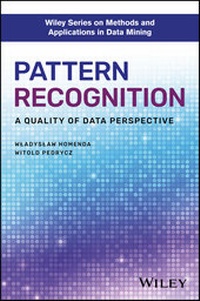
Pattern Recognition
Description

Detailing foundational concepts before introducing more complex methodologies and algorithms, this book is a self-contained manual for advanced data analysis and data mining. Top-down organization presents detailed applications only after methodological issues have been mastered, and step-by-step instructions help ensure successful implementation of new processes. By positioning data quality as a factor to be dealt with rather than overcome, the framework provided serves as a valuable, versatile tool in the analysis arsenal.
For decades, practical need has inspired intense theoretical and applied research into pattern recognition for numerous and diverse applications. Throughout, the limiting factor and perpetual problem has been data--its sheer diversity, abundance, and variable quality presents the central challenge to pattern recognition innovation. Pattern Recognition: A Quality of Data Perspective repositions that challenge from a hurdle to a given, and presents a new framework for comprehensive data analysis that is designed specifically to accommodate problem data.
Designed as both a practical manual and a discussion about the most useful elements of pattern recognition innovation, this book:
* Details fundamental pattern recognition concepts, including feature space construction, classifiers, rejection, and evaluation
* Provides a systematic examination of the concepts, design methodology, and algorithms involved in pattern recognition
* Includes numerous experiments, detailed schemes, and more advanced problems that reinforce complex concepts
* Acts as a self-contained primer toward advanced solutions, with detailed background and step-by-step processes
* Introduces the concept of granules and provides a framework for granular computing
Pattern recognition plays a pivotal role in data analysis and data mining, fields which are themselves being applied in an expanding sphere of utility. By facing the data quality issue head-on, this book provides students, practitioners, and researchers with a clear way forward amidst the ever-expanding data supply.
More details
Other editions
Additional editions


Persons
WLADYSLAW HOMENDA, MSc., PhD, DSc., is an Associate Professor with the Faculty of Mathematics and Information Science at the Warsaw University of Technology, Poland, and an Associate Professor with the Faculty of Economics and Informatics in Vilnius at the University of Bialystok, Lithuania.
WITOLD PEDRYCZ is a Professor with the Systems Research Institute, Polish Academy of Sciences Warsaw, Poland and Department of Electrical & Computer Engineering, University of Alberta, Edmonton, AB, Canada.
Content
Preface ix
Part I Fundamentals 1
Chapter 1 Pattern Recognition: Feature Space Construction 3
1.1 Concepts 3
1.2 From Patterns to Features 8
1.3 Features Scaling 17
1.4 Evaluation and Selection of Features 23
1.5 Conclusions 47
Appendix 1.A 48
Appendix 1.B 50
References 50
Chapter 2 Pattern Recognition: Classifiers 53
2.1 Concepts 53
2.2 Nearest Neighbors Classification Method 55
2.3 Support Vector Machines Classification Algorithm 57
2.4 Decision Trees in Classification Problems 65
2.5 Ensemble Classifiers 78
2.6 Bayes Classifiers 82
2.7 Conclusions 97
References 97
Chapter 3 Classification with Rejection Problem Formulation And An Overview 101
3.1 Concepts 102
3.2 The Concept of Rejecting Architectures 107
3.3 Native Patterns-Based Rejection 112
3.4 Rejection Option in the Dataset of Native Patterns: A Case Study 118
3.5 Conclusions 129
References 130
Chapter 4 Evaluating Pattern Recognition Problem 133
4.1 Evaluating Recognition with Rejection: Basic Concepts 133
4.2 Classification with Rejection with No Foreign Patterns 145
4.3 Classification with Rejection: Local Characterization 149
4.4 Conclusions 156
References 156
Chapter 5 Recognition with Rejection: Empirical Analysis 159
5.1 Experimental Results 160
5.2 Geometrical Approach 175
5.3 Conclusions 191
References 192
Part II Advanced Topics: a Framework of Granular Computing 195
Chapter 6 Concepts and Notions of Information Granules 197
6.1 Information Granularity and Granular Computing 197
6.2 Formal Platforms of Information Granularity 201
6.3 Intervals and Calculus of Intervals 205
6.4 Calculus of Fuzzy Sets 208
6.5 Characterization of Information Granules: Coverage and Specificity 216
6.6 Matching Information Granules 219
6.7 Conclusions 220
References 221
Chapter 7 Information Granules: Fundamental Constructs 223
7.1 The Principle of Justifiable Granularity 223
7.2 Information Granularity as a Design Asset 230
7.3 Single-Step and Multistep Prediction of Temporal Data in Time Series Models 235
7.4 Development of Granular Models of Higher Type 236
7.5 Classification with Granular Patterns 241
7.6 Conclusions 245
References 246
Chapter 8 Clustering 247
8.1 Fuzzy C-Means Clustering Method 247
8.2 k-Means Clustering Algorithm 252
8.3 Augmented Fuzzy Clustering with Clusters and Variables Weighting 253
8.4 Knowledge-Based Clustering 254
8.5 Quality of Clustering Results 254
8.6 Information Granules and Interpretation of Clustering Results 256
8.7 Hierarchical Clustering 258
8.8 Information Granules in Privacy Problem: A Concept of Microaggregation 261
8.9 Development of Information Granules of Higher Type 262
8.10 Experimental Studies 264
8.11 Conclusions 272
References 273
Chapter 9 Quality of Data: Imputation and Data Balancing 275
9.1 Data Imputation: Underlying Concepts and Key Problems 275
9.2 Selected Categories of Imputation Methods 276
9.3 Imputation with the Use of Information Granules 278
9.4 Granular Imputation with the Principle of Justifiable Granularity 279
9.5 Granular Imputation with Fuzzy Clustering 283
9.6 Data Imputation in System Modeling 285
9.7 Imbalanced Data and their Granular Characterization 286
9.8 Conclusions 291
References 291
Index 293
PREFACE
Pattern recognition has established itself as an advanced area with a well-defined methodology, a plethora of algorithms, and well-defined application areas. For decades, pattern recognition has been a subject of intense theoretical and applied research inspired by practical needs. Prudently formulated evaluation strategies and methods of pattern recognition, especially a suite of classification algorithms, constitute the crux of numerous pattern classifiers. There are numerous representative realms of applications including recognizing printed text and manuscripts, identifying musical notation, supporting multimodal biometric systems (voice, iris, signature), classifying medical signals (including ECG, EEG, EMG, etc.), and classifying and interpreting images.
With the abundance of data, their volume, and existing diversity arise evident challenges that need to be carefully addressed to foster further advancements of the area and meet the needs of the ever-growing applications. In a nutshell, they are concerned with the data quality. This term manifests in numerous ways and has to be perceived in a very general sense. Missing data, data affected by noise, foreign patterns, limited precision, information granularity, and imbalanced data are commonly encountered phenomena one has to take into consideration in building pattern classifiers and carrying out comprehensive data analysis. In particular, one has to engage suitable ways of transforming (preprocessing) data (patterns) prior to their analysis, classification, and interpretation.
The quality of data impacts the very essence of pattern recognition and calls for thorough investigations of the principles of the area. Data quality exhibits a direct impact on architectures and the development schemes of the classifiers. This book aims to cover the essentials of pattern recognition by casting it in a new perspective of data quality-in essence we advocate that a new framework of pattern recognition along with its methodology and algorithms has to be established to cope with the challenges of data quality. As a representative example, it is of interest to look at the problem of the so-called foreign (odd) patterns. By foreign patterns we mean patterns not belonging to a family of classes under consideration. The ever-growing presence of pattern recognition technologies increases the importance of identifying foreign patterns. For example, in recognition of printed texts, odd patterns (say, blots, grease, or damaged symbols) appear quite rarely. On the other hand, in recognition problem completed for some other sources such as geodetic maps or musical notation, foreign patterns occur quite often and their presence cannot be ignored. Unlike printed text, such documents contain objects of irregular positioning, differing in size, overlapping, or having complex shape. Thus, too strict segmentation results in the rejection of many recognizable symbols. Due to the weak separability of recognized patterns, segmentation criteria need to be relaxed and foreign patterns similar to recognized symbols have to be carefully inspected and rejected.
The exposure of the overall material is structured into two parts, Part I: Fundamentals and Part II: Advanced Topics: A Framework of Granular Computing. This arrangement reflects the general nature of the main topics being covered.
Part I addresses the principles of pattern recognition with rejection. The task of a rejection of foreign pattern arises as an extension and an enhancement of the standard schemes and practices of pattern recognition. Essential notions of pattern recognition are elaborated on and carefully revisited in order to clarify on how to augment existing classifiers with a new rejection option required to cope with the discussed category of problems. As stressed, this book is self-contained, and this implies that a number well-known methods and algorithms are discussed to offer a complete overview of the area to identify main objectives and to present main phases of pattern recognition. The key topics here involve problem formulation and understanding; feature space formation, selection, transformation, and reduction; pattern classification; and performance evaluation. Analyzed is the evolution of research on pattern recognition with rejection, including historical perspective. Identified are current approaches along with present and forthcoming issues that need to be tackled to ensure further progress in this domain. In particular, new trends are identified and linked with existing challenges. The chapters forming this part revisit the well-known material, as well as elaborate on new approaches to pattern recognition with rejection. Chapter 1 covers fundamental notions of feature space formation. Feature space is of a paramount relevance implying quality of classifiers. The focus of the chapter is on the analysis and comparative assessment of the main categories of methods used in feature construction, transformation, and reduction. In Chapter 2, we cover a variety of design approaches to the design of fundamental classifiers, including such well-known constructs as k-NN (nearest neighbor), naïve Bayesian classifier, decision trees, random forests, and support vector machines (SVMs). Comparative studies are supported by a suite of illustrative examples. Chapter 3 offers a detailed formulation of the problem of recognition with rejection. It delivers a number of motivating examples and elaborates on the existing studies carried out in this domain. Chapter 4 covers a suite of evaluation methods required to realize tasks of pattern recognition with a rejection option. Along with classic performance evaluation approaches, a thorough discussion is presented on a multifaceted nature of pattern recognition evaluation mechanisms. The analysis is extended by dealing with balanced and imbalanced datasets. The discussion commences with an evaluation of a standard pattern recognition problem and then progresses toward pattern recognition with rejection. We tackle an issue of how to evaluate pattern recognition with rejection when the problem is further exacerbated by the presence of imbalanced data. A wide spectrum of measures is discussed and employed in experiments, including those of comparative nature. In Chapter 5, we present an empirical evaluation of different rejecting architectures. An empirical verification is performed using datasets of handwritten digits and symbols of printed music notation. In addition, we propose a rejecting method based on a concept of geometrical regions. This method, unlike rejecting architectures, is a stand-alone approach to support discrimination between native and foreign patterns. We study the usage of elementary geometrical regions, especially hyperrectangles and hyperellipsoids.
Part II focuses on the fundamental concept of information granules and information granularity. Information granules give rise to the area of granular computing-a paradigm of forming, processing, and interpreting information granules. Information granularity comes hand in hand with the key notion of data quality-it helps identify, quantify, and process patterns of a certain quality. The chapters are structured in a way to offer a top-down way of material exposure. Chapter 6 brings the fundamentals of information granules delivering the key motivating factors, elaborating on the underlying formalisms (including sets, fuzzy sets, probabilities) along with the operations and transformation mechanisms as well as the characterization of information granules. The design of information granules is covered in Chapter 7. Chapter 8 positions clustering in a new setting, revealing its role as a mechanism of building information granules. In the same vein, it is shown that the clustering results (predominantly of a numeric nature) are significantly augmented by bringing information granularity to the description of the originally constructed numeric clusters. A question of clustering information granules is posed and translated into some algorithmic augmentations of the existing clustering methods. Further studies on data quality and its quantification and processing are contained in Chapter 9. Here we focus on data (value) imputation and imbalanced data-the two dominant manifestations in which the quality of data plays a pivotal role. In both situations, the problem is captured through information granules that lead to the quantification of the quality of data as well as enrich the ensuing classification schemes.
This book exhibits a number of essential and appealing features:
Systematic exposure of the concepts, design methodology, and detailed algorithms. In the organization of the material, we adhere to the top-down strategy starting with the concepts and motivation and then proceeding with the detailed design materializing in specific algorithms and a slew of representative applications.
A wealth of carefully structured and organized illustrative material. This book includes a series of brief illustrative numeric experiments, detailed schemes, and more advanced problems.
Self-containment. We aimed at the delivery of self-contained material providing with all necessary prerequisites. If required, some parts of the text are augmented with a step-by-step explanation of more advanced concepts supported by carefully selected illustrative material.
Given the central theme of this book, we hope that this volume would appeal to a broad audience of researchers and practitioners in the area of pattern recognition and data analytics. It can...
