

Topics in Programming Languages
Description
Alles über E-Books | Antworten auf Fragen rund um E-Books, Kopierschutz und Dateiformate finden Sie in unserem Info- & Hilfebereich.
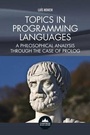
'Topics in Programming Languages' explores the arch from the formation of alphabet and classical philosophy to artificial programming languages in the structure of one argumentative topics list: as if it were philosophy interpreted and programmed. One such endeavour is taken to tend toward phonetics and sounds of speech analysis with ¿-calculus, and, ultimately, Prolog - the programming language of choice in artificial intelligence - born of the natural language processing reverie and delusion. The well-ordered list of arguments targets the conceptual tree behind both the functional and the logical, the procedural and the declarative paradigms in programming languages by studying close the ascendum (convolution) of the Aristotelian efficient cause into the notions of function (Leibniz), rule (Kant) and algorithm as effective procedures in computation (Church-Turing).
More details
Other editions
Additional editions

System requirements
File format: ePUB
Copy protection: Adobe-DRM (Digital Rights Management)
System requirements:
- Computer (Windows; MacOS X; Linux): Install the free reader Adobe Digital Editions prior to download (see eBook Help).
- Tablet/smartphone (Android; iOS): Install the free app Adobe Digital Editions or the app PocketBook before downloading (see eBook Help).
- E-reader: Bookeen, Kobo, Pocketbook, Sony, Tolino and many more (not Kindle).
The file format ePub works well for novels and non-fiction books – i.e., „flowing” text without complex layout. On an e-reader or smartphone, line and page breaks automatically adjust to fit the small displays.
This eBook uses Adobe-DRM, a „hard” copy protection. If the necessary requirements are not met, unfortunately you will not be able to open the eBook. You will therefore need to prepare your reading hardware before downloading.
Please note: We strongly recommend that you authorise using your personal Adobe ID after installation of any reading software.
For more information, see our ebook Help page.