

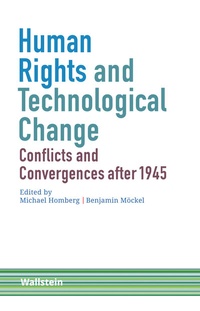
Human Rights and Technological Change
Conflicts and Convergences after 1945
1st Edition
Published on 25. May 2022
392 pages
978-3-8353-4842-4 (ISBN)
Description

Über das Spannungsverhältnis zwischen Menschenrechten und modernen Technologien für die Zeit seit dem Zweiten Weltkrieg.
Werkzeug der Unterdrückung oder Vehikel der Emanzipation? Moderne Technologien sind zu einem wichtigen Thema der Menschenrechtspolitik geworden. Überwachungstechnik, militärische Drohnen und digitale Datenanalysen stellen die internationale Menschenrechtsbewegung vor neue Herausforderungen. Gleichzeitig eröffnen diese Techniken auch neue Chancen, Menschenrechtsverletzungen zu dokumentieren, anzuprangern und ein zivilgesellschaftliches Engagement zu fördern. In diesem Band wird diese ambivalente Beziehung in historischer Perspektive analysiert.
Gezeigt wird, wie die Verbreitung moderner Technologien die Menschenrechtspolitik herausforderte und unterstützte. Hervorgehoben werden dabei vier Schlüsselbereiche: 1. Entwicklungspolitik, allen voran bei Infrastrukturen und technischen Großprojekten, 2. Bevölkerungspolitik und demographisches Wissen, 3. Medien- und Kommunikationstechnologien und 4. die gesellschaftlichen Auswirkungen der Computerisierung. Indem diese Debatten für die Zeit nach 1945 nachgezeichnet werden, erhalten aktuelle Diskussionen über die Herausforderungen neuer technologischer Entwicklungen eine historische Dimension.
Der Band erscheint vollständig in englischer Sprache.
_____
The volume analyses the ambivalent relationship between human rights and modern technologies since 1945.
Tools of suppression or agents of emancipation? Modern technologies have become a major subject of human rights policy. Surveillance technology, the military use of drones, and the possibilities of Big Data analysis pose new challenges for the international human rights movement. At the same time, these techniques offer new ways to document and denounce violations of human rights and to promote mass mobilization. The volume analyses this ambivalent relationship between human rights and technological change in a historical perspective.
Showing how the spread of modern technologies both challenged and served human rights policies, the volume focuses on four key areas of technological change: 1) development politics, infrastructures and large technical systems, 2) population politics and demographical knowledge, 3) media cultures and communication technologies, and 4) the societal impact of computerization. By sketching these debates since 1945, the volume adds a historical perspective to current debates about the political and ethical challenges of new technological developments.
The volume is published entirely in English.
More details
Other editions
Additional editions
Michael Homberg | Benjamin Möckel
Human Rights and Technological Change
Conflicts and Convergences after 1945
Book
05/2022
1st Edition
Wallstein
€41.00
Shipment within 5-7 days
Persons
Editor
Michael Homberg, geb. 1987, studierte Geschichte, Politologie und Germanistik in Köln. Für seine Dissertation wurde er 2017 mit dem Offermann-Hergarten-Preis ausgezeichnet. Er war Feodor Lynen-Stipendiat der Alexander von Humboldt-Stiftung an der Stanford University, der UC Berkeley und der Harvard University. Seit 2020 ist er wissenschaftlicher Mitarbeiter am Leibniz-Zentrum für Zeithistorische Forschung Potsdam (ZZF).
Veröffentlichungen u. a.: Human Rights and Technological Change. Conflicts and Convergences after 1945 (mit Benjamin Möckel, 2022); Informationskämpfe. Globale Zirkulation und politische Bedeutung falscher Nachrichten, 1880 bis 1930 (mit Volker Barth, 2019); Reporter Streifzüge. Metropolitane Nachrichtenkultur und die Wahrnehmung der Welt 1870-1918 (2017).
ISNI:
ISNI:
Benjamin Möckel, geb. 1983, ist zurzeit Vertretungsprofessor und Leiter einer Forschungsgruppe zur Demokratiegeschichte an der Universität Göttingen. Im Rahmen von Fellowships forschte Benjamin Möckel u.a. am University College London und an der University of Oxford. Seine Forschungsschwerpunkte liegen in der Kulturgeschichte der Ökonomie, der Geschichte politischer Partizipation und der Generations- und Erfahrungsgeschichte.
Veröffentlichungen u.a.: Erfahrungsbruch und Generationsbehauptung. Die Kriegsjugendgeneration in den beiden Nachkriegsgesellschaften, Göttingen 2014; Human Rights and Technological Change. Conflicts and Convergences since the 1950s, Göttingen 2022 (mit Michael Homberg); Ökonomie und Moral. Eine Anthologie, Göttingen 2022 (mit Jürgen Finger).
ISNI:
ISNI:
Content
- Umschlag
- Titel
- Impressum
- Table of Contents
- Michael Homberg/Benjamin Möckel: Introduction: Human Rights and Technological Change
- I. Colonial Legacies, Postcolonial Developments: Human Rights, Labor, and Technology
- Ute Hasenöhrl: »Powering Progress, Empowering People«? (Hydro)Electricity and Human Rights in Post/Colonial India,1920s-1990s
- Anna Sailer: Rationalising the Workplace. The Bengal Jute Industry between the 1920s and the 1950s
- Daniel Roger Maul: The ILO, Asia, and the Beginnings of Technical Assistance, 1945-1960
- II. Reproductive Rights: Family Planning and Demographic Politics
- Roman Birke: Reproductive Technologies, Contraceptives, and Human Rights
- Heinrich Hartmann: Contested Reproductive Rights. Population Technologies and the Quest for Individualism in the 1960s and 1970s
- Claudia Roesch: A Human Right or a Danger to the Future? Debates about Family Planning Between Parental Rights and Duties in 1960s West Germany
- III. Media Wars: Representing Rights, Legitimizing Violence
- Daniel Stahl: Freedom Fighter. Weapons and Rights in the Cold War
- Daniel Palmieri: Innovation, Technology, and Humanitarianism. The Example of the International Committee of the Red Cross
- Lia Börsch: Image Activists. Building Structures, Arguing with Images, and Cooperating with Media Actors at Amnesty International 1975-1985
- IV. Computer Technologies: (In-)Forming the Public
- Benedikt Neuroth: Origins of a Human Right to Privacy. The United Nations' Debate on Science and Technology in the Context of the United States' Domestic Politics
- Julia Gül Erdogan: Computer Power to the People. West German Hackers' Activism and Online Communication During the Yugoslavian Wars
- Barbara Keys: Information and Communication Technologies in Human Rights Work in the 1990s
- Moritz Riesewieck: Into the Open. An Essay on Democratizing Social Media
- Bibliography
- Abbreviations and Acronyms
- Contributors
- Index of Persons
