

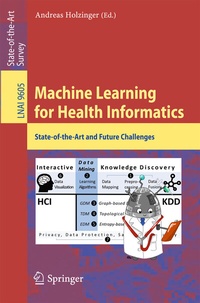
Machine Learning for Health Informatics
Description

Machine learning (ML) is the fastest growing field in computer science, and Health Informatics (HI) is amongst the greatest application challenges, providing future benefits in improved medical diagnoses, disease analyses, and pharmaceutical development. However, successful ML for HI needs a concerted effort, fostering integrative research between experts ranging from diverse disciplines from data science to visualization.
Tackling complex challenges needs both disciplinary excellence and cross-disciplinary networking without any boundaries. Following the HCI-KDD approach, in combining the best of two worlds, it is aimed to support human intelligence with machine intelligence.
This state-of-the-art survey is an output of the international HCI-KDD expert network and features 22 carefully selected and peer-reviewed chapters on hot topics in machine learning for health informatics; they discuss open problems and future challenges in order to stimulate further research and international progress in this field.
More details
Other editions
Additional editions
Person
The editor Andreas Holzinger is lead of the Holzinger Group, HCI-KDD, Institute for Medical Informatics, Statistics and Documentation at the Medical University Graz, and Associate Professor of Applied Computer Science at the Faculty of Computer Science and Biomedical Engineering at Graz University of Technology. Currently, Andreas is Visiting Professor for Machine Learning in Health Informatics at the Faculty of Informatics at Vienna University of Technology. He serves as consultant for the Canadian, US, UK, Swiss, French, Italian and Dutch governments, for the German Excellence Initiative, and as national expert in the European Commission. His research interests are in supporting human intelligence with machine intelligence to help solve problems in health informatics.
Andreas obtained a PhD in Cognitive Science from Graz University in 1998 and his Habilitation (second PhD) in Computer Science from Graz University of Technology in 2003. Andreas was Visiting Professor in Berlin, Innsbruck, London (twice), and Aachen. He founded the Expert Network HCI-KDD to foster a synergistic combination of methodologies of two areas that offer ideal conditions toward unravelling problems in understanding intelligence: Human-Computer Interaction (HCI) and Knowledge Discovery/Data Mining (KDD), with the goal of supporting human intelligence with machine learning. Andreas is Associate Editor of Knowledge and Information Systems(KAIS), Section Editor of BMC Medical Informatics and Decision Making (MIDM), and member of IFIP WG 12.9 Computational Intelligence, more information: http://hci-kdd.org
Content
Machine Learning for Health Informatics.- Bagging Soft Decision Trees.- Grammars for Discrete Dynamics.- Empowering Bridging Term Discovery for Cross-domain Literature Mining in the TextFlows Platform.- Visualisation of Integrated Patient-Centric Data as Pathways: Enhancing Electronic Medical Records in Clinical Practice.- Deep learning trends for focal brain pathology segmentation in MRI.- Differentiation between Normal and Epileptic EEG using K-Nearest-Neighbors Technique.- Survey on Feature Extraction and Applications of Biosignals.- Argumentation for knowledge representation, conflict resolution, defeasible inference and its integration with machine learning.- Machine Learning and Data mining Methods for Managing Parkinson's Disease.- Challenges of Medical Text and Image Processing: Machine Learning Approaches.- Visual Intelligent Decision Support Systems in the medical field: design and evaluation.
