

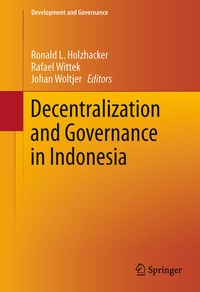
Decentralization and Governance in Indonesia
Published on 11. September 2015
XIV, 298 pages
978-3-319-22434-3 (ISBN)
Description

Indonesia over the past two decades has embarked on a process of decentralization as part of a broader process of democratization, which followed earlier periods of centralized governance and authoritarian rule across the archipelago. The purpose of this book is to begin to explore the connections between governance and sustainable society in a wide variety of policy fields in Indonesia, and how reforming governance structures may contribute to societal benefits and the creation of a long-term sustainable society. This book bridges important theoretical debates related to governance and sustainable society and provides empirical research from Indonesia in important policy areas related to this debate. By placing research in different policy areas in a single volume, the link to the broader concepts of governance, decentralization, and societal outcomes is strengthened. The book builds on the recent interest that has focused on Indonesia and the continued development of democracy in the country. The chapters in the book show a rich variety of decentralized governance arrangements and capacity building at the local level in particular. Central standards (for example for social sustainability, anti-corruption arrangements, or for dealing with direct foreign investment), combined with local innovation (for example for municipal coordination of primary health care or metropolitan transport), are key to Indonesia as a country in a continuing process of transformation. We identify three key trends in the on-going process of decentralization and governance in Indonesia. First, we find that formal governance, the relation between the national and local government, is characterized by a system of 'variable geometry multi-level governance' depending on the policy area. The challenge ahead is strengthening accountability mechanisms to assure national standards while preserving and encouraging local innovation. Secondly, informal governance mechanisms are evolving to move from 'hierarchical to network' forms of governance. Here the challenge is to insure democratic input by citizens and civil society organizations. Finally, we identify a trend toward 'shared value creation and sustainable cooperation.' Indonesia is beginning to move from a rather singular policy focus on economic growth to a more complex and developing notion of policymaking for inclusive growth and the creation of a sustainable society for present and future generations. Here the challenge is sound implementation and to increase the effectiveness of governance mechanisms. There is also a noted diffusion of goals, to focus beyond the Jakarta metropolitan area to smaller regional cities, as urbanization continues and rural areas are changing.This book will be of interest for use in advanced undergraduate and graduate courses related to Southeast Asia in the fields of international relations, political science, public administration, economics, law, sociology, education, public health, and the spatial sciences. It will also be of interest to policymakers and government officials at the national and local level in Southeast Asia and middle-income developing countries, officials and policymakers in institutions of regional governance such as the Association of Southeast Asian Nations (ASEAN), and of global governance such as the United Nations and World Bank. It will also be of interest to civil society organizations and other actors focused on policy development and economic development, health, education, the environment, sustainable transport, etc. The book will also be of interest to business people interested in economic and governance issues, such as the management and governance of in-bound foreign investment, inclusive growth, and corporate governance. Finally, the book should be of interest to citizens in advanced, middle-income, and developing countries motivated to learn more about the links between governance and the creation of a sustainable society for current and future generations.
More details
Series
Edition
1st ed. 2016
Language
English
Place of publication
Cham
Switzerland
Publishing group
Springer International Publishing
Target group
Professional and scholarly
Product notice
Reflowable
Illustrations
XIV, 298 p. 16 illus., 8 illus. in color.
File size
3,14 MB
ISBN-13
978-3-319-22434-3 (9783319224343)
DOI
10.1007/978-3-319-22434-3
Schweitzer Classification
Other editions
Additional editions
Ronald L. Holzhacker | Rafael Wittek | Johan Woltjer
Decentralization and Governance in Indonesia
Book
09/2015
Springer
€106.99
Shipment within 10-15 days
Persons
Ronald Holzhacker is Senior Lecturer in Comparative Political Science and International Relations at the University of Groningen, the Netherlands. He holds a PhD from the University of Michigan in political science and a JD from the University of Minnesota Law School. He serves as the Director of the Spirit Indonesia Groningen (SInGA) research program on good governance and sustainable society, which is supported by scholarships from the World Bank and other sources. He has delivered a series of lectures at universities and conferences in Southeast Asia over the past few years on governance and sustainable society and on EU-ASEAN relations. His research focuses on the implementation of human rights in multi-level governance situations involving civil society, states, and regional institutions. He is published in such journals as Law & Policy, Comparative European Politics, Party Politics, European Union Politics, Nations and Nationalism, and the Journal of Legislative Studies. He also served as editor of numerous edited volumes, including Freedom, Security, and Justice in the European Union: Internal and External Dimensions of Increased Cooperation after the Lisbon Treaty, (NY: Springer 2014), The Transnationalization of Economies, States, and Civil Societies: New Challenges for Governance in Europe (NY: Springer 2009), and Democratic Governance and European Integration: Linking Societal and State Processes of Democracy (Edward Elgar 2007). Over the past four years he servedas a senior EU expert for the Network of Socio-Economic Experts in the Field of Anti-Discrimination, established by the European Commission to monitor the implementation of the anti-discrimination directives in the member states. Recently, he has been appointed as a senior EU expert for the network 'Knowledge-based analysis and policy advice in the antidiscrimination field and the EU 2020 Strategy' for the period 2014-2017. Rafael Wittek is professor of theoretical sociology at the University of Groningen, The Netherlands, and co-initiator of SPIRIT Indonesia Groningen. He holds a PhD (with distinction) from the University of Groningen, and an M.A. (with distinction) from the University of Tübingen (Germany). He taught at the Cornell University and the University of Erlangen-Nürnberg, and held guest professorships at ETH Zurich and the Universita della Svizzera Italiana (USI, Lugano). He chaired the think tank of the strategic research theme "Sustainable Society" of the University of Groningen. His research is in the field of organizational governance, social networks, and social theory. He has co-edited The Handbook of Rational Choice Social Research (Stanford University Press, 2013), which received the bi-annual James Coleman book award of the Rationality and Society Section of the American Sociological Association. He is also co-editor of Humanitarian Crises, Intervention and Security (Routledge, 2014). Recent articles appeared in journals like the European Sociological Review, Journal of Public Administration Research and Theory, Public Administration and Development, Work, Employment and Society, Group and Organization Management, Social Networks. Johan Woltjer is Professor of Urban Infrastructures at the University of Westminster, and Head of the Department of Planning and Transportation. He is also a Professor of Regional Planning and Development at the University of Groningen. Prof Woltjer concentrates his research work on institutional innovations for urban regions (specifically infrastructure development and planning). He has delivered policy advice for institutions including the EU, the OECD, and government agencies. His work is funded by grants, such as from the Royal Dutch Academy of Sciences (KNAW) and the Netherlands Organisation for Scientific Research (NWO). Prof Woltjer is actively involved in international education and educational management. His work has contributed to an international and internationally comparative view to the field, particularly focusing on Europe (Netherlands, UK, Germany) and South-Eastern Asia (e.g., Indonesia and China). The impact of his work is visible through papers and articles on urban governance, regional development, infrastructure management, policy evaluation, and capacity building, appearing in high-impact journals such as the Journal of the American Planning Association, Land Use Policy, Urban Studies, International Planning Studies, and Environment and Planning A. Recent books include 'Consensus Planning, the relevance of communicative planning theory in Dutch infrastructure development', 'Evaluation for Participation and Sustainability in Planning' (Routledge), and 'Place-Based Evaluation for Infrastructure and Spatial Projects' (Ashgate).
Content
- Intro
- Preface
- Contents
- Editors and Contributors
- Part I Theoretical Reflections on Decentralization and Governance for Sustainable Society
- 1 Decentralization and Governance for Sustainable Society in Indonesia
- 1 Decentralization in Indonesia
- 2 Decentralization and Sustainable Society
- 3 Governance Modes: Multi-level Structures
- 4 Governance Objectives: Indonesia's Priorities in International Context
- 5 Governance Mechanisms: Neo-Institutional Approaches
- 6 Governance Outcomes: A Conceptual Framework
- 7 Decentralization, Governance Failures, and Solutions
- 8 Organization of the Book
- 9 Conclusions
- References
- 2 Good Governance Contested: Exploring Human Rights and Sustainability as Normative Goals
- Abstract
- 1 Introduction
- 2 Governance, Good Governance and Development
- 3 Criticism Against the Concept of Good Governance
- Good Governance Versus Economic Growth
- 4 The Good of Governance: Towards a New Framework
- 4.1 Sustainability and International Legal Human Rights
- 4.2 Good Governance, Status-Egalitarianism and Well-Being
- 5 Good Governance: Policy Evaluation
- 6 Conclusions
- References
- Part II Decentralization and Policy Making
- 3 Decentralization and Primary Health Care Innovations in Indonesia
- Abstract
- 1 Introduction
- 1.1 Research Question
- 1.2 Social and Scientific Significance
- 1.3 Research Methods and Data
- 2 Indonesia's Primary Health Care System under Decentralization
- 2.1 The Primary Health Care System
- 2.2 Two Waves of Decentralization
- 2.2.1 Political Decentralization
- 2.2.2 Administrative Decentralization
- 2.2.3 Fiscal Decentralization
- 3 Analytical Framework: The Decision Space Approach
- 3.1 Decision Space
- 3.2 Accountability Pressure
- 3.3 Organizational Capacity
- 4 Decentralization and Health System Innovation in Indonesia Institutional Analysis
- 4.1 Decision Space
- 4.2 Accountability Pressure
- 4.3 Institutional Analysis: Summary Conclusions
- 5 Decentralization and Health System Innovation in Indonesia: Case Analysis
- 5.1 District Level Innovations
- 5.1.1 Universal Health Insurance Coverage (Jembrana)
- 5.1.2 Health Insurance (Several Districts)
- 5.1.3 Midwife Coupon Service (Pemalang)
- 5.2 Community Health Centre Innovations
- 5.2.1 New Technology and New Services (Jagir)
- 5.2.2 Partnership and Collaboration (Mojoagung)
- 5.2.3 Obstetric and Neonatal Emergency Service Innovation, PONED (Several CHCs East Java)
- 5.3 Case Analysis: Summary Conclusions
- 6 Conclusion
- References
- 4 The Impact of Decentralization on Educational Attainment in Indonesia
- Abstract
- 1 Introduction
- 2 Research Questions
- 3 Social and Scientific Significance
- 4 Research Design and Methodology
- 5 Decentralization and Education in Indonesia
- 6 Theory and Hypotheses
- 7 Data and Method
- 7.1 Data and Measurements
- 7.2 Variables
- 7.3 Statistical Analysis Plan
- 7.4 Descriptive Results
- 7.5 Multilevel Analysis
- 8 Conclusion and Discussion
- 8.1 Summary of Findings
- 8.2 Unexpected Findings, Limitations, and Avenues for Future Research
- References
- 5 Decentralization, Foreign Direct Investment and Development in Indonesia
- Abstract
- 1 Introduction
- 2 Research Questions
- 3 Social and Scientific Significance
- 4 Research Design and Methodology
- 5 Literature Review
- 5.1 Foreign Direct Investment and Sustainable Development
- 5.1.1 FDI and Economic Development
- 5.1.2 FDI and Social Development
- 5.1.3 FDI and Environmental Protection
- 5.2 Decentralization, FDI and Sustainable Development
- 5.3 Intergovernmental Relations
- 5.3.1 Coordinate Authority Model
- 5.3.2 Overlapping Authority Model
- 5.3.3 Inclusive Authority Model
- 6 Discussion and Analysis
- 6.1 The Investment Policies in Indonesia
- 6.1.1 The Centralized Era (1967-1998)
- 6.1.2 First Wave of Decentralization (1999-2003)
- 6.1.3 Second Wave of Decentralization (2004-Present)
- 6.2 Implementation Policies and Intergovernmental Relations
- 6.2.1 Centralized Periods (1967-1998)
- 6.2.2 The First Wave of Decentralization (1999-2003)
- 6.2.3 The Second Wave of Decentralization (2004-Present)
- Mechanism of Intergovernmental Relations through the One-Stop Services Office
- 7 Conclusion
- References
- 6 The Inclusive Growth Concept: Strengths, Weaknesses, and a Research Agenda for Indonesia
- Abstract
- 1 Introduction
- 2 Definition and Measurement of Inclusive Growth
- 3 Methodological Problems in Analysing Inclusive Growth
- 4 Indonesia's Development
- 4.1 An Overview of Indonesia's Development Planning
- 4.2 Indonesia's Inclusive Growth: Results from Recent Studies
- 5 Further Research on Inclusive Growth
- 6 Conclusions
- References
- Part III Challenges of Decentralization for Cities to Create Sustainable Futures
- 7 Metropolitan Governance and Institutional Design: Transportation in the Jakarta Metropolitan Region
- Abstract
- 1 Challenges of Governing Metropolitan Transportation
- 1.1 Jakarta Metropolitan Region
- 1.2 Appropriate Institutional Design
- 1.3 Research Design and Methodology
- 2 Combining Metropolitan Governance and Institutional Design
- 2.1 Metropolitan Governance
- 2.2 Institutional Design
- 2.3 Theoretical Framework
- 3 Transportation in the Jakarta Metropolitan Region
- 3.1 Improvement Phase 1: The 'Megapolitan' Proposal (2005-2007)
- 3.2 Improvement Phase 2: The Spatial Plan of the JMR (2008-2012)
- 4 Improvement Phase 3: Strengthening Inter-local Governmental Cooperation, Supported by the Central Government (2012-Now)
- 4.1 Analysis
- 5 Appropriate Governance for Metropolitan Transportation
- 5.1 Effective Governance and Regional Coordination
- 5.2 Appropriate Institutional Design
- 5.3 Metropolitan Transportation Governance: Meso-level Institutional Arrangements and Actor Coordination
- References
- 8 Environmental Governance by Transnational Municipal Networks: The Case of Indonesian Cities
- Abstract
- 1 Introduction
- 1.1 Research Question
- 1.2 Scientific and Social Significance
- 1.3 Research Design and Methodology
- 2 Theoretical Framework
- 2.1 What Are Transnational Municipal Networks?
- 2.2 The Governance System of the TMNs
- 3 Analysis
- 3.1 Decentralized Governance and Environmental Policy in Indonesia
- 3.2 The Wakatobi Experience Under the DELGOSEA Program
- 3.2.1 TMNs and Decentralized Governance in Wakatobi
- 3.2.2 The Internal Governance of the TMNs in Wakatobi
- 3.2.3 The External Governance of the TMNs in Wakatobi
- 3.3 The Yogyakarta Experience Under the ICLEI Program
- 3.3.1 TMNs and Decentralized Governance in Yogyakarta
- 3.3.2 The Internal Governance of the TMNs in Yogyakarta
- 3.3.3 The External Governance of the TMNs in Yogyakarta
- 3.4 Comparative Analysis
- 4 Conclusion
- References
- Part IV Governance to Limit Opportunities for Corruption in a Decentralized Environment
- 9 Institutional Change and Corruption of Public Leaders: A Social Capital Perspective on Indonesia
- Abstract
- 1 Introduction
- 2 Research Question
- 3 Scientific and Societal Relevance
- 4 Research Design
- 5 Theoretical Background
- 6 Types of Corruption
- 7 Centralized Autocratic Regimes and Decentralized Democratic Regimes
- 8 Institutional Change and Its General Implications for Corruption
- 9 Institutional Change and Social Capital Traits of Corruption Structures
- 9.1 Corruption Actors
- 9.2 Types of Relation
- 10 Data and Results
- 10.1 Data Collection and Analysis Process
- 11 Results
- 11.1 Types of Corruption
- 11.2 Number and Types of Corruption Actors
- 11.3 Type and Nature of Relations
- 11.3.1 Dyadic and Triadic Relations
- 11.3.2 Formal and Informal Relations
- 11.3.3 Multiplex Relations
- 12 Discussion and Conclusion
- References
- 10 Corporate Governance and Corruption: A Comparative Study of Southeast Asia
- Abstract
- 1 Introduction
- 1.1 Background
- 1.2 Research Questions
- 1.3 Scientific and Social Significance
- 1.4 Methodology
- 2 Literature Review
- 2.1 Corporate Governance
- 2.2 Agency Problem and Bribery
- 2.3 Corporate Governance and Bribery
- 2.4 Shareholder Rights
- 2.5 Board of Directors
- 2.6 Accounting and Auditing Practices
- 2.7 Transparency
- 3 Institutional Setting
- 4 Discussion and Analysis
- 4.1 Comparative Corporate Governance Institutional Framework
- 4.2 Shareholder Rights
- 4.3 Board of Directors
- 4.4 Accounting and Auditing
- 4.5 Transparency
- 5 Conclusion
- References
- Index
