

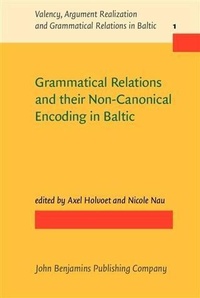
Grammatical Relations and their Non-Canonical Encoding in Baltic
1st Edition
Published on 16. May 2014
VII, 370 pages
978-90-272-7039-9 (ISBN)
Description

This is the first of three volumes dealing with clausal architecture, grammatical relations, case-marking and the syntax-semantics interface in Baltic. It focuses on the grammatical relations of subject and object and the viability of these notions in languages like Lithuanian and Latvian, which have a rich case morphology and show many deviations from the canonical nominative-accusative pattern of case-marking. The issues examined include differential object marking, subjecthood in specificational copular constructions, 'swarm'-type alternations and what they tell us about grammatical relations, special types of subject and object marking in non-finite clauses, and non-canonical grammatical relations induced by modal predicates. One study provides a comparative outlook towards Icelandic, another language noted for its complex marking of grammatical relations. The articles in the volume represent various theoretical frameworks.
More details
Other editions
Additional editions
Axel Holvoet | Nicole Nau
Grammatical Relations and their Non-Canonical Encoding in Baltic
Book
05/2014
John Benjamins Publishing Co
€116.60
Shipment within 10-15 days
Persons
Content
- Grammatical Relations and their Non-Canonical Encoding in Baltic
- Editorial page
- Title page
- LCC data
- Table of contents
- Preface
- Argument marking and grammatical relations in Baltic: An overview
- 1. The project
- 2. Alignment and case marking in Baltic
- 3. Baltic in a typological context: Alternatives to the transitive pattern
- 4. Differential and non-canonical marking
- 5. Canonical marking
- 6. Concluding remarks and chapter summaries
- Abbreviations
- Sources
- References
- Case and word order in Lithuanian infinitival clauses revisited
- 1. Introduction
- 2. Basics of the Minimalist case theory
- 3. Franks & Lavine (2006)
- 4. Franks & Lavine (2006) revised
- 5. Typological parallels
- 6. Back to Lithuanian: A new analysis
- 7. Conclusions and implications
- Abbreviations
- References
- Non-canonical grammatical relations in a modal construction: The Latvian debitive
- 1. Introductory remarks
- 2. The debitive: A modal form with atypical syntactic properties
- 3. Monoclausal and biclausal debitives
- 4. The argument structure of modals
- 5. Grammatical relations and case marking with the debitive: Earlier discussion
- 6. Grammatical relations with the debitive
- 7. Some theoretical considerations
- 8. Shifts in the case marking of the B argument
- 9. The debitive and voice
- 10. The debitive and splits
- Abbreviations
- References
- Alternations in argument realization and problematic cases of subjecthood in Lithuanian
- 1. Introduction
- 2. Overview of Lithuanian swarm alternations
- 3. Semantic properties of the verbs and their arguments in Lithuanian swarm alternation
- 4. Discourse-pragmatic functions of the Lithuanian swarm alternation
- 5. Non-prototypical subjects in the Lithuanian swarm alternation
- 6. Conclusion
- Abbreviations
- Sources
- References
- References
- Subjecthood in specificational copular constructions in Lithuanian
- 1. Introduction
- 2. The treatment of copular constructions in Cognitive Grammar
- 3. Defining specificational copular constructions
- 4. Short review of the subject definition in Cognitive Grammar
- 5. Subjecthood in specificational copular constructions
- 6. Concluding remarks
- Abbreviations
- References
- References
- Differential object marking in Latgalian
- 1. Introduction
- 2. Morphology
- 3. Genitive marking with transitive verbs: Clause-level properties
- 4. Different marking for different kinds of NPs
- 5. Intransitive verbs with genitive arguments
- 6. Conclusions
- Acknowledgements
- Abbreviations
- Sources
- References
- The independent partitive genitive in Lithuanian
- 1. Introduction
- 2. Implicit quantifier
- 3. Implicit quantifier and aspect
- 4. Intensional contexts and negation
- 5. Conclusions
- Abbreviations
- References
- On the non-canonical marking of the highest-ranking argument in Lithuanian and Icelandic: Steps towa
- 1. Sketch of the project
- 2. Theoretical background
- 3. A first analysis of verb classes and case marking patterns in Lithuanian and Icelandic
- 4. Conclusions and outlook
- Abbreviations
- List of nonstandard abbreviations
- Sources
- References
- Language index
- Name index
- Subject index
