

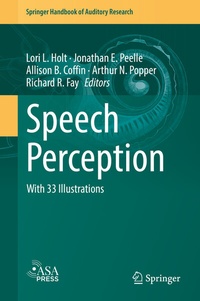
Speech Perception
Description

This volume reviews contemporary developments in the auditory cognitive neuroscience of speech perception, including both behavioral and neural contributions. It serves as an important update on the current state of research in speech perception.
The Auditory Cognitive Neuroscience of Speech Perception in Context
Lori L. Holt, and Jonathan E. Peelle
Subcortical Processing of Speech Sounds
Bharath Chandrasekaran, Rachel Tessmer, and G. Nike Gnanateja
Cortical Representation of Speech Sounds: Insights from Intracranial Electrophysiology
Yulia Oganian, Neal P. Fox, and Edward F. Chang
A Parsimonious Look at Neural Oscillations in Speech Perception
Sarah Tune, and Jonas Obleser
Extracting Language Content From Speech Sounds: The Information Theoretic Approach
Laura Gwilliams, and Matthew H. Davis
Speech Perception under Adverse Listening Conditions
Stephen C. VanHedger, and Ingrid S. Johnsrude
Adaptive Plasticity in Perceiving Speech Sounds
Shruti Ullas, Milene Bonte, Elia Formisano, and Jean Vroomen
Development of Speech Perception
Judit Gervain
Interactions Between Audition and Cognition in Hearing Loss and Aging
Chad S. Rogers, and Jonathan E. Peelle
Dr. Lori Holt is a Professor of Psychology at Carnegie Mellon University and has affiliations with the Center for the Neural Basis of Cognition and the Center for Neuroscience University of Pittsburgh.
Dr. Jonathan E. Peelle is a Professor in the Department of Otolaryngology at the Washington University in St. Louis.
Dr. Allison Coffin is an Associate Professor in the Department of Integrative Physiology and Neuroscience at Washington State University Vancouver.
Dr. Arthur N. Popper is Professor Emeritus and research professor in the Department of Biology at the University ofMaryland, College Park.
Dr. Richard R. Fay is Distinguished Research Professor of Psychology at Loyola, Chicago.
More details
Other editions
Additional editions
Persons
Dr. Lori Holt is a Professor of Psychology at Carnegie Mellon University and has affiliations with the Center for the Neural Basis of Cognition and the Center for Neuroscience University of Pittsburgh.
Dr. Jonathan E. Peelle is a Professor in the Department of Otolaryngology at the Washington University in St. Louis.
Dr. Allison Coffin is an Associate Professor in the Department of Integrative Physiology and Neuroscience at Washington State University Vancouver.
Dr. Arthur N. Popper is Professor Emeritus and research professor in the Department of Biology at the University of Maryland, College Park.
Content
1. The Auditory Cognitive Neuroscience of Speech Perception in Context.- 2. Subcortical Processing of Speech Sounds.- 3. Cortical Representation of Speech Sounds: Insights from Intracranial Electrophysiology.- 4. A Parsimonious Look at Neural Oscillations in Speech Perception.- 5. Extracting Language Content From Speech Sounds: The Information Theoretic Approach.- 6. Speech Perception under Adverse Listening Conditions.- 7. Adaptive Plasticity in Perceiving Speech Sounds.- 8. Development of Speech Perception.- 9. Interactions Between Audition and Cognition in Hearing Loss and Aging.
